
The question asks to identify the Indian author who wrote 'Things to Leave Behind', a book that chronicles life in the Kumaon hills. This requires knowledge of Indian literature and specific authors' works.
Correct Option: C) Namita Gokhale is the author of 'Things to Leave Behind', a novel that vividly portrays life in the Kumaon hills during a specific historical period. Her works often explore themes related to the Himalayas and Indian culture.
Complete the series given in the Problem Figure with an appropriate option from the Answer Figures.
Problem Figure: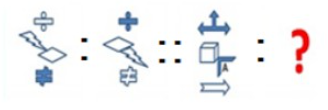
Answer Figures: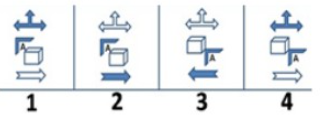
The problem involves identifying a pattern in the series of figures and selecting the correct option that completes the sequence. Each set of figures follows a specific transformation rule.
Correct Option: C) 2
To solve this problem, we first need to determine the original cost price (CP) of the tea-set. We are given the selling price (SP) and the percentage loss. Once the CP is found, we can calculate the desired selling price to make a 10% profit. Finally, we will find the difference between the desired selling price and the initial selling price.
Calculate the Cost Price (CP):
The tea-set was sold for ₹3,420, which was 43% below the cost price. This means the selling price represents \(100\% - 43\% = 57\%\) of the cost price.
Let CP be the cost price.
\[ \text{SP} = \text{CP} \times \left(1 - \frac{\text{Loss Percentage}}{100}\right) \] \[ 3420 = \text{CP} \times \left(1 - \frac{43}{100}\right) \] \[ 3420 = \text{CP} \times \left(\frac{100 - 43}{100}\right) \] \[ 3420 = \text{CP} \times \frac{57}{100} \] \[ \text{CP} = \frac{3420 \times 100}{57} \] \[ \text{CP} = 60 \times 100 \] \[ \text{CP} = \text{₹}6000 \]Calculate the Desired Selling Price (SP_desired) for a 10% profit:
To make a profit of 10%, the selling price should be 110% of the cost price.
\[ \text{SP_desired} = \text{CP} \times \left(1 + \frac{\text{Profit Percentage}}{100}\right) \] \[ \text{SP_desired} = 6000 \times \left(1 + \frac{10}{100}\right) \] \[ \text{SP_desired} = 6000 \times \left(\frac{110}{100}\right) \] \[ \text{SP_desired} = 60 \times 110 \] \[ \text{SP_desired} = \text{₹}6600 \]Calculate the additional amount the seller should have sold the set for:
This is the difference between the desired selling price and the actual selling price.
\[ \text{Additional Amount} = \text{SP_desired} - \text{Initial SP} \] \[ \text{Additional Amount} = 6600 - 3420 \] \[ \text{Additional Amount} = \text{₹}3180 \]Correct Option: B) ₹3,180
The problem asks us to identify which of the given natural numbers (X, Y, Z, U, V) are even. We need to determine if the provided statements, individually or together, are sufficient to answer this question. We will analyze each statement and their combination.
A) Both statements 1 and 2 together are sufficient — As shown in the step-by-step analysis, combining the fact that the numbers are consecutive and Z is odd allows us to determine the parity of all five numbers, specifically identifying Y and U as even. Therefore, both statements together are sufficient.
The problem asks for the energy supplied by a source to a resistor over a given time, when a current and potential difference are known. We need to recall the fundamental definitions of current, potential difference, and power in an electrical circuit, and then relate them to energy.
D) VIt is the correct expression for the energy supplied by the source in time \(t\). This is derived directly from the definitions of potential difference and current.
To convert a temperature from the Celsius scale to the Kelvin scale, we use a standard conversion formula. The Kelvin scale is an absolute temperature scale, where 0 K represents absolute zero.
Correct Option: D) 351 K
The question asks us to identify the correct word pair that follows the same grammatical pattern as the given pair "Buy : bought". The given pair represents the base form (present tense) of a verb and its past tense form.
D) Shut : Shut. The verb "shut" is an irregular verb where the base form, simple past tense, and past participle are all the same. Thus, "Shut" (base form) : "Shut" (simple past tense) correctly follows the pattern "Buy" (base form) : "bought" (simple past tense).
In which city is St. Peter's Basilica, one of the most famous churches in Christianity, located?
The question asks for the location of St. Peter's Basilica, a globally recognized Christian church. To answer this, one needs general knowledge about famous landmarks and their geographical locations.
Correct Option: A) Vatican City is the correct answer. St. Peter's Basilica is indeed located within Vatican City, which is the ecclesiastical state, city, and territory of the Roman Catholic Church.
This problem involves work and time, specifically pipes filling a tank. We will use the concept of work rate (fraction of tank filled per hour) to solve it. We'll set up equations based on the given information about pipes A and B working together and then separately.
Let the time taken by pipe A alone to fill the tank be \(T_A\) hours and by pipe B alone be \(T_B\) hours.
The work rate of A is \(\frac{1}{T_A}\) tank/hour, and the work rate of B is \(\frac{1}{T_B}\) tank/hour.
When A and B work together, they fill the tank in 10 hours. So, their combined work rate is \(\frac{1}{10}\) tank/hour.
\[ \frac{1}{T_A} + \frac{1}{T_B} = \frac{1}{10} \quad \text{(Equation 1)} \]A and B worked together for 4 hours. The fraction of the tank filled in these 4 hours is:
\[ 4 \times \left( \frac{1}{T_A} + \frac{1}{T_B} \right) = 4 \times \frac{1}{10} = \frac{4}{10} = \frac{2}{5} \]After 4 hours, B stopped. The remaining fraction of the tank to be filled is:
\[ 1 - \frac{2}{5} = \frac{3}{5} \]Pipe A continued filling the tank. The total time taken to fill the tank was 13 hours. Since A and B worked together for 4 hours, A worked alone for \(13 - 4 = 9\) hours.
In these 9 hours, pipe A filled the remaining \(\frac{3}{5}\) of the tank. So, the work done by A in 9 hours is \(\frac{3}{5}\).
\[ 9 \times \frac{1}{T_A} = \frac{3}{5} \]Now, we can solve for \(T_A\):
\[ \frac{9}{T_A} = \frac{3}{5} \] \[ 3 T_A = 9 \times 5 \] \[ 3 T_A = 45 \] \[ T_A = \frac{45}{3} \] \[ T_A = 15 \text{ hours} \]C) 15 hours. It would take A 15 hours to fill the empty tank alone.
This problem involves the Remainder Theorem. We will use the given conditions to form a system of two linear equations in terms of 'a' and 'b'. Solving these equations will give us the values of 'a' and 'b', which can then be used to find \(a^2 + b^2\).
Apply the Remainder Theorem for the first condition:
When \(P(x) = x^2 + ax + b\) is divided by \((x - 1)\), the remainder is 5.
According to the Remainder Theorem, if a polynomial \(P(x)\) is divided by \((x - c)\), the remainder is \(P(c)\).
Here, \(c = 1\). So, \(P(1) = 5\).
\[ (1)^2 + a(1) + b = 5 \]\[ 1 + a + b = 5 \]\[ a + b = 5 - 1 \]\[ a + b = 4 \quad \text{(Equation 1)} \]Apply the Remainder Theorem for the second condition:
When \(Q(x) = x^2 + bx + a\) is divided by \((x + 1)\), the remainder is -1.
Here, \(c = -1\). So, \(Q(-1) = -1\).
\[ (-1)^2 + b(-1) + a = -1 \]\[ 1 - b + a = -1 \]\[ a - b = -1 - 1 \]\[ a - b = -2 \quad \text{(Equation 2)} \]Solve the system of linear equations:
We have two equations:
Equation 1: \(a + b = 4\)
Equation 2: \(a - b = -2\)
Add Equation 1 and Equation 2:
\[ (a + b) + (a - b) = 4 + (-2) \]\[ 2a = 2 \]\[ a = \frac{2}{2} \]\[ a = 1 \]Substitute the value of 'a' into Equation 1 to find 'b':
\[ a + b = 4 \]\[ 1 + b = 4 \]\[ b = 4 - 1 \]\[ b = 3 \]Calculate \(a^2 + b^2\):
Now that we have \(a = 1\) and \(b = 3\), we can find \(a^2 + b^2\).
\[ a^2 + b^2 = (1)^2 + (3)^2 \]\[ a^2 + b^2 = 1 + 9 \]\[ a^2 + b^2 = 10 \]Correct Option: B) 10