
This is a statement and conclusion type of question. We need to analyze the given statement and determine which of the conclusions logically follows from it. The statement highlights a problem: a shortage of bus tickets during festival seasons. The conclusions propose solutions or reactions to this problem. We must choose the conclusion that is a direct, logical, and reasonable consequence or solution to the stated problem.
C) Only conclusion 2 follows.
Conclusion 2 is a direct and logical response to the problem of bus ticket unavailability. If tickets are not available, it means the supply (number of buses) is less than the demand. Increasing the supply by bringing in more buses is a sensible and expected action from the government or transport authorities to address the public's complaint.
If the resistance of a conductor is doubled, the current gets halved. This is because:
I = \( \frac{R}{V} \)
I = V - R
I = VR
I = \( \frac{V}{R} \)
This question tests the understanding of Ohm's Law, which describes the relationship between voltage, current, and resistance in an electrical circuit. We need to identify the correct mathematical expression of Ohm's Law that explains why current decreases when resistance increases.
D) I = \( \frac{V}{R} \) — This is the correct mathematical representation of Ohm's Law, showing the inverse relationship between current and resistance, which explains why current halves when resistance doubles (assuming voltage is constant).
The question asks for the specific term used to describe the receptors responsible for detecting taste. This requires knowledge of biological terminology related to sensory organs.
The receptors responsible for detecting taste are specifically known as gustatory receptors.
A) Gustatory receptors — These are the specialized sensory receptors located in the taste buds on the tongue that detect chemical stimuli dissolved in saliva, leading to the perception of taste.
Choose the correct mirror image of the problem figure when the mirror is placed to the right of the figure.
Problem Figure: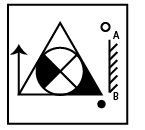
Answer Figures: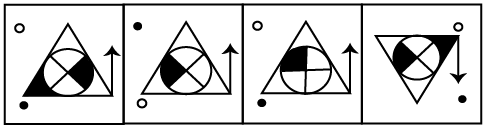
To find the correct mirror image of a figure, we need to visualize how the figure would appear if a mirror were placed on the right side. This involves reversing the horizontal orientation of the elements in the figure.
Correct Option: B) …
To find the ratio of sand to cement, we need to combine the two given ratios. This involves finding a common value for the component that is present in both ratios, which is gravel in this case. We will adjust the ratios so that the 'gravel' part is the same in both, allowing us to link sand and cement directly.
Identify the given ratios:
Find a common multiple for the gravel component:
The gravel component is 8 in the first ratio and 6 in the second. The least common multiple (LCM) of 8 and 6 is 24.
Adjust the first ratio:
To make the gravel part 24, multiply both parts of the ratio \(17 : 8\) by \(3\).
\[ \text{S} : \text{G} = (17 \times 3) : (8 \times 3) = 51 : 24 \]Adjust the second ratio:
To make the gravel part 24, multiply both parts of the ratio \(6 : 17\) by \(4\).
\[ \text{G} : \text{C} = (6 \times 4) : (17 \times 4) = 24 : 68 \]Combine the adjusted ratios:
Now we have \(\text{S} : \text{G} = 51 : 24\) and \(\text{G} : \text{C} = 24 : 68\). Since the gravel component is the same (24) in both, we can combine them to get the ratio of sand to gravel to cement:
\[ \text{S} : \text{G} : \text{C} = 51 : 24 : 68 \]Determine the ratio of sand to cement:
From the combined ratio, the ratio of sand to cement (\(\text{S} : \text{C}\)) is \(51 : 68\).
Simplify the ratio:
Both 51 and 68 are divisible by 17.
\[ 51 \div 17 = 3 \] \[ 68 \div 17 = 4 \]So, the simplified ratio of sand to cement is \(3 : 4\).
A) 3 : 4 is the correct ratio of sand to cement after combining and simplifying the given ratios.
B) 17 : 17 — This would imply that the amount of sand and cement are equal, which is not supported by the given ratios. This might arise from incorrectly assuming that since 17 appears in both original ratios, it directly relates sand and cement.
C) 289 : 48 — This ratio might be obtained by multiplying the sand part of the first ratio by the cement part of the second ratio (\(17 \times 17 = 289\)) and the gravel part of the first ratio by the gravel part of the second ratio (\(8 \times 6 = 48\)), which is an incorrect way to combine ratios.
D) 8 : 6 — This is the ratio of gravel to sand (if reversed from the first ratio) or gravel to cement (if not simplified). It does not represent the ratio of sand to cement.
The question asks to identify the Chief Minister of Telangana as of February 2018, who also holds the distinction of being the first Chief Minister of the state. This requires knowledge of current affairs and political history related to the state of Telangana.
K. Chandrashekar Rao (KCR) was instrumental in the movement for a separate Telangana state. Following the state's formation on June 2, 2014, he was sworn in as its first Chief Minister. He continued to hold this position through February 2018 and beyond, winning subsequent elections.
B) K Chandrasekhar Rao — K. Chandrasekhar Rao (KCR) was the first Chief Minister of Telangana, taking office on June 2, 2014, and he was still serving in this capacity in February 2018. He led the Telangana Rashtra Samithi (TRS) party (now Bharat Rashtra Samithi - BRS).
The question asks to identify the scientist who determined the value of the universal gravitation constant (G). This requires knowledge of the history of physics and specific contributions of prominent scientists.
Correct Option: B) Henry Cavendish was the first to experimentally determine the value of the universal gravitation constant (G) using a torsion balance in his famous Cavendish experiment.
If a body takes 't' seconds to go once round the circular path of radius 'r', the velocity 'v' is given by:
v = \(\frac{t}{2\pi r}\)
v = \(\frac{\pi r}{2t}\)
v = \(\frac{2\pi r}{t}\)
v = \(\frac{2\pi r^2}{t}\)
To find the velocity of a body moving in a circular path, we need to determine the total distance covered in one full revolution and the time taken for that revolution. Velocity is defined as the distance traveled per unit time.
Identify the given parameters:
Calculate the distance covered in one revolution:
When a body completes one full round on a circular path, the distance covered is equal to the circumference of the circle. The formula for the circumference of a circle is \(2\pi r\).
Apply the formula for velocity:
Velocity is defined as the total distance traveled divided by the total time taken.
Substitute the values:
Substitute the distance covered (\(2\pi r\)) and the time taken (\(t\)) into the velocity formula.
This formula gives the magnitude of the velocity, often referred to as speed, for a body moving uniformly in a circular path.
Correct Option: C) The velocity \(v\) is given by the formula \(v = \frac{2\pi r}{t}\). This correctly represents the circumference of the circle divided by the time taken for one revolution.
This question asks about the image formation by a concave mirror when the object is placed between the pole (P) and the principal focus (F). We need to recall the ray tracing rules for concave mirrors or the mirror formula to determine the nature and position of the image.
D) Behind the mirror - When an object is placed between the pole (P) and the principal focus (F) of a concave mirror, the reflected rays diverge and appear to originate from a point behind the mirror. This forms a virtual, erect, and magnified image behind the mirror.