
To find the angle between the hour hand and the minute hand of a clock, we need to calculate the individual angles made by each hand with respect to the 12 o'clock position. The minute hand moves 360 degrees in 60 minutes, and the hour hand moves 360 degrees in 12 hours. We will use these rates to find their positions at the given time and then calculate the difference.
C) 119.5° is the smaller angle formed between the hour hand and the minute hand at 5:49 p.m.
The question asks to identify a Chinese Buddhist monk who studied at Nalanda and made a significant trip to India from AD 627 to 643. This requires knowledge of prominent historical figures, particularly those associated with ancient India and Buddhism.
Correct Option: C) Hiuen Tsang is the correct answer. He was a Chinese Buddhist monk who traveled to India from AD 627 to 643 (though his main period in India was 630-645 AD, the given range broadly covers his journey) and studied extensively at Nalanda, documenting his experiences in detail.
Solve the following:
\(\frac{1}{1+\sin\theta}\) + \(\frac{1}{1-\sin\theta}\) = ?
To solve this trigonometric expression, we will combine the two fractions by finding a common denominator. Then, we will simplify the numerator and use fundamental trigonometric identities to arrive at the final simplified form.
The given expression is:
\[ \frac{1}{1+\sin\theta} + \frac{1}{1-\sin\theta} \]Find a common denominator, which is the product of the two denominators \((1+\sin\theta)(1-\sin\theta)\). This is in the form \((a+b)(a-b) = a^2 - b^2\).
\[ \frac{(1-\sin\theta) + (1+\sin\theta)}{(1+\sin\theta)(1-\sin\theta)} \]Simplify the numerator:
\[ 1 - \sin\theta + 1 + \sin\theta = 2 \]Simplify the denominator using the identity \((a+b)(a-b) = a^2 - b^2\):
\[ (1+\sin\theta)(1-\sin\theta) = 1^2 - \sin^2\theta = 1 - \sin^2\theta \]Recall the fundamental trigonometric identity: \(\sin^2\theta + \cos^2\theta = 1\). From this, we can derive \(\cos^2\theta = 1 - \sin^2\theta\).
Substitute the simplified numerator and denominator back into the expression:
\[ \frac{2}{1 - \sin^2\theta} = \frac{2}{\cos^2\theta} \]Recall that \(\sec\theta = \frac{1}{\cos\theta}\). Therefore, \(\sec^2\theta = \frac{1}{\cos^2\theta}\).
Substitute this into the expression:
\[ 2 \cdot \frac{1}{\cos^2\theta} = 2\sec^2\theta \]Correct Option: D) \(2\sec^2\theta\)
What is the number of squares in the following figure?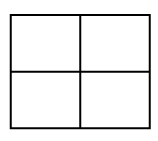
To determine the number of squares in the given figure, we need to count all possible squares, including smaller squares formed within larger ones.
Correct Option: D) 5
The question asks us to identify the relationship between the first two terms and apply the same relationship to find the fourth term. This is a classic analogy question where we need to find the unit of the given physical quantity.
B) Watt is the SI unit for Power, just as Joule is the SI unit for Work.
The question asks for the specific location of Indira Point on Great Nicobar Island. To answer this, one needs to recall the geographical facts about India's southernmost point.
Correct Option: C) Indira Point, the southernmost point of India, is located at the southern tip of Great Nicobar Island. It is also known as Pygmalion Point or Parsons Point. Its geographical coordinates are approximately \(6^\circ 45' N\) latitude.
To find the total quantity of water the vessel can hold, we need to calculate the volume of its two parts: the cylindrical neck and the spherical part. The total volume will be the sum of these two volumes.
Given:
Radius of the cylindrical neck, \[r_c = \frac{d_c}{2} = \frac{4}{2} = 2 \text{ cm}\]
The formula for the volume of a cylinder is \(V_c = \pi r_c^2 h\).
\[ V_c = \pi (2 \text{ cm})^2 (7 \text{ cm}) \]\[ V_c = \pi (4 \text{ cm}^2) (7 \text{ cm}) \]\[ V_c = 28\pi \text{ cm}^3 \]\[ V_c \approx 28 \times 3.14159 \text{ cm}^3 \]\[ V_c \approx 87.96452 \text{ cm}^3 \]Given:
Radius of the spherical part, \[r_s = \frac{d_s}{2} = \frac{21}{2} = 10.5 \text{ cm}\]
The formula for the volume of a sphere is \(V_s = \frac{4}{3}\pi r_s^3\).
\[ V_s = \frac{4}{3}\pi (10.5 \text{ cm})^3 \]\[ V_s = \frac{4}{3}\pi (1157.625 \text{ cm}^3) \]\[ V_s = 4 \times 385.875 \pi \text{ cm}^3 \]\[ V_s = 1543.5 \pi \text{ cm}^3 \]\[ V_s \approx 1543.5 \times 3.14159 \text{ cm}^3 \]\[ V_s \approx 4849.049 \text{ cm}^3 \]Total volume \(V_{total} = V_c + V_s\)
\[ V_{total} = 28\pi + 1543.5\pi \text{ cm}^3 \]\[ V_{total} = (28 + 1543.5)\pi \text{ cm}^3 \]\[ V_{total} = 1571.5\pi \text{ cm}^3 \]\[ V_{total} \approx 1571.5 \times 3.14159 \text{ cm}^3 \]\[ V_{total} \approx 4936.85 \text{ cm}^3 \]The closest option to \(4936.85 \text{ cm}^3\) is \(4939 \text{ cm}^3\).
D) \(4939 \text{ cm}^3\) is the closest value to the calculated total volume of approximately \(4936.85 \text{ cm}^3\).
To determine when a pair of linear equations has no solution, we need to recall the conditions for consistency and inconsistency of a system of two linear equations in two variables. For a system given by \(a_1x + b_1y = c_1\) and \(a_2x + b_2y = c_2\), there is no solution if the lines are parallel and distinct. This condition is met when the ratio of the coefficients of \(x\) and \(y\) are equal, but not equal to the ratio of the constant terms.
Identify the given linear equations:
Equation 1: \(3x + y = 1\)
Equation 2: \(px + 2y = 5\)
Compare these equations with the standard form \(a_1x + b_1y = c_1\) and \(a_2x + b_2y = c_2\).
From Equation 1:
\[a_1 = 3, \quad b_1 = 1, \quad c_1 = 1\]From Equation 2:
\[a_2 = p, \quad b_2 = 2, \quad c_2 = 5\]For a system of linear equations to have no solution, the lines represented by the equations must be parallel and distinct. The condition for this is:
\[\frac{a_1}{a_2} = \frac{b_1}{b_2} \neq \frac{c_1}{c_2}\]Substitute the coefficients into the condition:
\[\frac{3}{p} = \frac{1}{2} \neq \frac{1}{5}\]First, consider the equality part of the condition:
\[\frac{3}{p} = \frac{1}{2}\]Cross-multiply to solve for \(p\):
\[3 \times 2 = p \times 1\] \[6 = p\] \[p = 6\]Next, verify the inequality part with \(p=6\):
\[\frac{1}{2} \neq \frac{1}{5}\]This is true, as \(0.5 \neq 0.2\).
Since both conditions are satisfied for \(p=6\), the pair of linear equations has no solution when \(p=6\).
B) p = 6 is the correct answer because when \(p=6\), the ratios of the coefficients of \(x\) and \(y\) are equal (\[\frac{3}{6} = \frac{1}{2}\]), but this ratio is not equal to the ratio of the constant terms (\[\frac{1}{2} \neq \frac{1}{5}\]), which is the condition for no solution.
A) p \(\ge\) 6 — This is too broad. Only \(p=6\) specifically leads to no solution. For \(p > 6\), the ratio \(\frac{3}{p}\) would not be equal to \(\frac{1}{2}\), meaning the lines would intersect at a unique point.
C) 0 < p < 6 — For any value of \(p\) in this range, \[\frac{3}{p} \neq \frac{1}{2}\], which means the lines would intersect at a unique point, yielding a finite solution.
D) p = 0 — If \(p=0\), the first equation becomes \(3x + y = 1\) and the second becomes \(2y = 5\), or \(y = 2.5\). Substituting \(y=2.5\) into the first equation gives \(3x + 2.5 = 1 \Rightarrow 3x = -1.5 \Rightarrow x = -0.5\). This is a unique finite solution, so \(p=0\) is incorrect.
The question asks about the country collaborating with India to establish the high-speed rail link between Mumbai and Ahmedabad. This is a factual question related to international collaborations on infrastructure projects.
C) Japan — Japan is the primary international partner for India's Mumbai-Ahmedabad High-Speed Rail project. They are providing the Shinkansen technology and significant financial assistance.
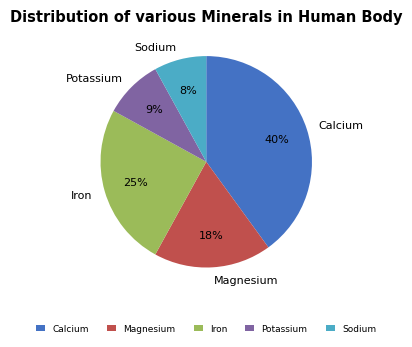
The given graph shows the distribution of minerals in the human body. Which two minerals are required almost in the same percentage for the human body?
Sodium and potassium
Magnesium and potassium
Calcium and sodium
Calcium and magnesium
The question requires identifying two minerals from the graph that have almost the same percentage distribution in the human body.
Correct Option: A) Sodium and potassium