The question asks to identify which of the given metals is a liquid at room temperature. This requires knowledge of the physical properties, specifically the melting points, of common metals.
Correct Option: C) Mercury is the only metal among the given options that is a liquid at room temperature. Its melting point is \(-38.83^\circ \text{C}\), which is well below typical room temperatures.
The question asks for an indicator commonly used to measure the exact pH of a solution. This implies an indicator that can provide a range of colors corresponding to a wide spectrum of pH values, rather than just indicating acidity or alkalinity.
C) Universal indicator is a mixture of several different indicators that displays a continuous range of color changes over a wide pH range (e.g., from pH 1 to pH 14). This allows for the estimation of the numerical pH value of a solution by comparing its color to a standard color chart, thus providing a more exact measurement than single indicators.
Which of the four figures can replace the question mark?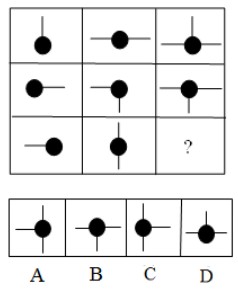
To solve this problem, we need to identify the pattern or sequence in the given grid and determine which option fits logically in the place of the question mark.
Correct Option: D) The pattern completes with lines extending downward.
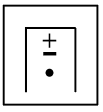
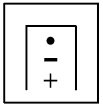
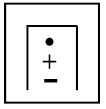
Select the option that would come next in the given figure series.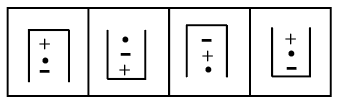
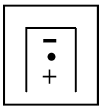
To determine the next figure in the series, observe the pattern of shapes and their positions within each box. The sequence involves a consistent arrangement of symbols: a plus sign, a minus sign, and a dot.
Option B matches this arrangement.
Correct Option: B) The dot is in the middle, the minus sign is at the top, and the plus sign is at the bottom.
The question asks to identify the Indian actor whose biography is titled 'Anything but Khamosh'. This is a direct factual recall question related to Indian cinema and literature.
Correct Option: C) Shatrughan Sinha
This question tests knowledge of the female reproductive system and the path an egg takes after ovulation. We need to identify the specific structure responsible for transporting the egg from the ovary to the uterus.
Correct Option: A) the oviduct. The oviduct (fallopian tube) is the tube that transports the egg from the ovary to the uterus. This is where fertilization usually takes place.
The question asks to identify the winner of the 2016 Women's Hockey Champions Trophy. This requires specific knowledge of past sports events and their outcomes.
Correct Option: C) Argentina
Argentina won the 2016 Women's Hockey Champions Trophy by defeating the Netherlands in the final match held in London. This was their seventh title in the tournament's history.
The problem asks us to identify the number pair that does not follow the same pattern as the others. We need to find a mathematical relationship between the two numbers in each pair and then check which pair deviates from this relationship.
Here, \(x = 1\) and \(y = 1\). We can observe that \(1^3 = 1\). So, \(y = x^3\).
Here, \(x = 4\) and \(y = 64\). Let's check if \(y = x^3\).
\[ 4^3 = 4 \times 4 \times 4 = 16 \times 4 = 64 \]This pair follows the pattern \(y = x^3\).
Here, \(x = 8\) and \(y = 512\). Let's check if \(y = x^3\).
\[ 8^3 = 8 \times 8 \times 8 = 64 \times 8 = 512 \]This pair also follows the pattern \(y = x^3\).
Here, \(x = 9\) and \(y = 719\). Let's check if \(y = x^3\).
\[ 9^3 = 9 \times 9 \times 9 = 81 \times 9 = 729 \]In this pair, \(y = 719\), but \(x^3 = 729\). Since \(719 \neq 729\), this pair does NOT follow the pattern \(y = x^3\).
Correct Option: C) (9, 719) is the number pair that does NOT belong in the group because \(9^3 = 729\), not 719.
If \( \frac{60}{75} \) is equivalent to \( \frac{12}{x} \), then the value of x is:
To find the value of \(x\) in the given equivalence of two fractions, we can use the concept of cross-multiplication or simplify the first fraction to find the common factor that relates it to the second fraction.
The given equivalence is:
\[ \frac{60}{75} = \frac{12}{x} \]Multiply the numerator of the first fraction by the denominator of the second fraction, and set it equal to the product of the denominator of the first fraction and the numerator of the second fraction:
\[ 60 \times x = 75 \times 12 \]\[ 60x = 900 \]Divide both sides by 60:
\[ x = \frac{900}{60} \]\[ x = 15 \]First, simplify the fraction \(\frac{60}{75}\) by finding the greatest common divisor (GCD) of 60 and 75. Both are divisible by 15.
\[ \frac{60 \div 15}{75 \div 15} = \frac{4}{5} \]Now, equate the simplified fraction to the second fraction:
\[ \frac{4}{5} = \frac{12}{x} \]Observe the relationship between the numerators. To get from 4 to 12, we multiply by 3 (\(4 \times 3 = 12\)).
To maintain the equivalence, the denominator must also be multiplied by the same factor:
\[ x = 5 \times 3 \]\[ x = 15 \]Both methods yield the same result.
D) 15 — As calculated by both cross-multiplication and simplification, the value of \(x\) is 15.
The acceleration due to gravity at the surface of the earth (mass M and radius R) is proportional to _____.
\( \frac{M}{R} \)
MR
\( \frac{M}{R^2} \)
\( \frac{M^2}{R} \)
To determine the proportionality of acceleration due to gravity, we will use Newton's Law of Universal Gravitation and Newton's Second Law of Motion.
Correct Option: C) The acceleration due to gravity at the surface of the earth is proportional to \( \frac{M}{R^2} \), as derived from the fundamental laws of gravitation and motion.