
The question asks to identify the term for a motile germ cell. We need to understand the definitions of different types of germ cells (gametes) and their characteristics, specifically motility.
C) Male gamete is the motile germ cell in most sexually reproducing organisms. For example, human sperm cells have a tail (flagellum) that allows them to swim towards the egg.
The problem asks us to find a number given that 26% of it is 65. We can set up an algebraic equation to represent this relationship and then solve for the unknown number.
Let the unknown number be \(x\).
The problem states that 26% of this number is 65. We can write 26% as a decimal or a fraction:
\[ 26\% = \frac{26}{100} \]Now, we can form the equation:
\[ \frac{26}{100} \times x = 65 \]To find \(x\), we need to isolate it. Multiply both sides of the equation by \(\frac{100}{26}\):
\[ x = 65 \times \frac{100}{26} \]Simplify the expression. We can divide 65 by 26. Notice that \(65 = 5 \times 13\) and \(26 = 2 \times 13\). So, we can simplify the fraction:
\[ x = \frac{65}{26} \times 100 \]\[ x = \frac{5 \times 13}{2 \times 13} \times 100 \]\[ x = \frac{5}{2} \times 100 \]Perform the multiplication:
\[ x = 5 \times \frac{100}{2} \]\[ x = 5 \times 50 \]\[ x = 250 \]Thus, the number is 250.
C) 250 is the correct answer because 26% of 250 is indeed 65.
To find the pattern of the sequence, we will test each given option by substituting the position of the term (n) into the algebraic expression and checking if it generates the corresponding term in the sequence. The sequence is 1, 5, 11, 19, 29.
Since Option D correctly generates all the terms in the given sequence, it is the correct pattern.
D) The expression \(x^2 + x - 1\) correctly generates all the terms of the sequence 1, 5, 11, 19, 29 when 'x' represents the position of the term.
To determine the work done on a body moving in a circle, we need to understand the definition of work in physics and the forces acting on the body during circular motion. Work done is defined as the dot product of force and displacement. In uniform circular motion, the centripetal force acts towards the center, while the displacement is always tangential to the circle.
Definition of Work Done: Work done (\(W\)) by a force (\(F\)) causing a displacement (\(d\)) is given by the formula:
\[ W = F \cdot d = Fd \cos \theta \]where \(\theta\) is the angle between the force vector and the displacement vector.
Forces in Circular Motion: When a body is whirled in a circle, there is a centripetal force acting on it. This force is always directed towards the center of the circular path.
Direction of Displacement: At any instant, the instantaneous displacement of the body is along the tangent to the circular path.
Angle between Force and Displacement: Since the centripetal force acts radially inwards and the displacement is tangential, the angle between the force and the instantaneous displacement is always \(90^\circ\).
Calculating Work Done: Substituting \(\theta = 90^\circ\) into the work done formula:
\[ W = Fd \cos(90^\circ) \]Since \(\cos(90^\circ) = 0\), the work done is:
\[ W = Fd \times 0 = 0 \]Therefore, the work done by the centripetal force on the body is zero.
Correct Option: C) is zero
The work done on a body whirled in a circle by the centripetal force is zero because the force is always perpendicular to the direction of motion (displacement).
A) cannot be determined — This is incorrect. The work done can be determined based on the relationship between force and displacement in circular motion.
B) is negative — Negative work is done when the force acts opposite to the direction of displacement (\(\theta = 180^\circ\)). This is not the case in circular motion.
D) is positive — Positive work is done when the force acts in the same direction as the displacement (\(\theta = 0^\circ\)) or has a component in that direction (\(0^\circ < \theta < 90^\circ\)). This is also not the case in circular motion.
The question asks to identify the Defence Minister of India as of February 2018. This requires knowledge of the Union Cabinet portfolios during that specific period.
Correct Option: B) Nirmala Sitharaman was the Defence Minister of India as of February 2018. She was the first full-time female Defence Minister of India.
This problem involves relating distance, speed, and time. We are given a total distance and two scenarios: one with an actual speed and time, and another with a reduced speed and increased time. We can set up equations based on the formula \( \text{Time} = \frac{\text{Distance}}{\text{Speed}} \) and solve for the unknown speed.
Let the actual speed of Krishna be \( S \) km/hr and the actual time taken be \( T \) hours.
The distance covered is 90 km. Using the formula \( \text{Distance} = \text{Speed} \times \text{Time} \), we have our first equation:
\[ 90 = S \times T \quad \text{(Equation 1)} \]From Equation 1, we can express \( T \) in terms of \( S \):
\[ T = \frac{90}{S} \quad \text{(Equation 2)} \]In the second scenario, Krishna cycles 3 km/hr slower, so the new speed is \( (S - 3) \) km/hr.
He would have taken 5 more hours, so the new time is \( (T + 5) \) hours.
The distance remains 90 km. So, for the second scenario:
\[ 90 = (S - 3) \times (T + 5) \quad \text{(Equation 3)} \]Substitute Equation 2 into Equation 3:
\[ 90 = (S - 3) \left( \frac{90}{S} + 5 \right) \]Expand the right side of the equation:
\[ 90 = S \left( \frac{90}{S} \right) + S(5) - 3 \left( \frac{90}{S} \right) - 3(5) \]\[ 90 = 90 + 5S - \frac{270}{S} - 15 \]Simplify the equation:
\[ 90 = 75 + 5S - \frac{270}{S} \]Subtract 75 from both sides:
\[ 15 = 5S - \frac{270}{S} \]Multiply the entire equation by \( S \) to eliminate the fraction:
\[ 15S = 5S^2 - 270 \]Rearrange the terms to form a quadratic equation:
\[ 5S^2 - 15S - 270 = 0 \]Divide the entire equation by 5 to simplify:
\[ S^2 - 3S - 54 = 0 \]Factor the quadratic equation. We need two numbers that multiply to -54 and add to -3. These numbers are -9 and 6.
\[ (S - 9)(S + 6) = 0 \]This gives two possible values for \( S \): \( S = 9 \) or \( S = -6 \).
Since speed cannot be negative, we discard \( S = -6 \).
Therefore, the actual speed at which Krishna cycled is 9 km/hr.
Correct Option: C) 9
Choose the correct figure that can replace the question mark.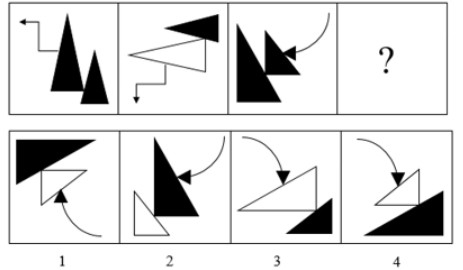
The problem involves identifying a pattern in a sequence of figures and determining which option completes the sequence.
Correct Option: C) 4
Solve the following:
24 - [25 - {26 - (27 - (\(\overline{28-29}\)))}] = ?
To solve this problem, we need to follow the order of operations (BODMAS/PEMDAS). This means we evaluate expressions inside the innermost brackets first, starting with the vinculum (bar), then parentheses, curly braces, and finally square brackets, working from inside out.
The innermost operation is \(\overline{28-29}\).
\[ 28 - 29 = -1 \]The expression becomes:
\[ 24 - [25 - \{26 - (27 - (-1))\}] \]The expression becomes:
\[ 24 - [25 - \{26 - 28\}] \]The expression becomes:
\[ 24 - [25 - (-2)] \]Thus, the final answer is \(-3\).
D) -3 is the correct answer, as derived by following the order of operations.
To find a percentage of a number, convert the percentage into a decimal or a fraction and then multiply it by the given number.
A percentage can be written as a fraction by dividing it by 100.
\[ 46\% = \frac{46}{100} \]Now, multiply this fraction by 250.
\[ \text{Value} = \frac{46}{100} \times 250 \]We can simplify the multiplication by canceling common factors.
\[ \text{Value} = 46 \times \frac{250}{100} \]\[ \text{Value} = 46 \times \frac{25}{10} \]\[ \text{Value} = 46 \times 2.5 \]Multiply 46 by 2.5.
\[ 46 \times 2.5 = 115 \]Thus, 46% of 250 is 115.
A) 115 is the correct answer, as calculated above.
The question asks for the atomicity of Phosphorus. Atomicity refers to the number of atoms present in one molecule of an element. We need to recall the common molecular form of Phosphorus.
Correct Option: A) Tetra-atomic. Phosphorus, particularly white phosphorus, exists as \(\text{P}_4\) molecules, meaning each molecule contains four phosphorus atoms, making it tetra-atomic.