
This is a statement and assumption type of question. We need to identify which of the given assumptions is implicitly made in the argument. An assumption is something taken for granted or supposed without proof. It must be directly related to the argument and necessary for the argument to hold true.
C) Only assumption 1 is implicit. The father's advice about the route to Mangalore logically implies that the son has a desire or need to travel to Mangalore. Without this desire, the advice would be pointless.
The question asks to identify a multicellular organism from the given options. We need to recall the basic characteristics of each organism mentioned and classify them as unicellular or multicellular.
Correct Option: D) Agaricus is a genus of mushrooms, which are fungi. Fungi are eukaryotic organisms, and most fungi, including mushrooms, are multicellular, forming complex structures from hyphae.
The question asks to identify a practical application of uranium isotopes. We need to recall the primary uses of uranium and then evaluate the given options.
Correct Option: C) Fuel in nuclear reactors. Uranium, specifically its isotope Uranium-235, is the primary fuel source for nuclear power reactors. Its fission reaction releases a large amount of energy, which is harnessed to generate electricity.
According to the given Venn diagram, the total number of non-athletic and disciplined boys is _____.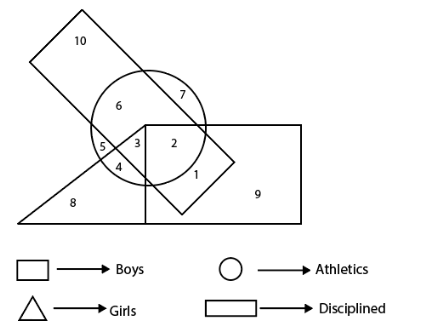
To find the total number of non-athletic and disciplined boys, we need to identify the sections of the Venn diagram that represent boys who are disciplined but not involved in athletics.
Correct Option: A) 10
The question asks to identify the unit of power from the given options. To answer this, one needs to recall the definitions and standard units of fundamental physical quantities.
B) Watt is the SI unit of power. One Watt is defined as one Joule per second (1 W = 1 J/s).
A defective piece of article which costs ₹1,200 is being sold at a loss of 15%. If the price is further reduced by 5%, find the S.P.
The problem involves calculating the selling price (S.P.) of an article after successive percentage reductions. First, a loss of 15% is applied to the cost price. Then, the resulting price is further reduced by 5%. We need to calculate the final selling price.
D) ₹969 is the correct selling price after a 15% loss and a subsequent 5% reduction.
The problem asks us to evaluate two conclusions based on a given statement. We need to determine which conclusion(s) logically follow from the statement. The statement describes a common observation: people selling things on footpaths in busy market areas. We must assume the statement to be true and then decide if the conclusions are reasonable and direct consequences of the statement.
B) Both 1 and 2 follow. Conclusion 1 is a logical inference about the primary purpose of a footpath, which is being violated. Conclusion 2 is a logical and practical solution to the problem described, which would resolve the conflict between vendors and pedestrians.
The question asks us to identify the pair of words that share the same relationship as the given pair, "Rapid : Slow". We need to determine the nature of the relationship between "Rapid" and "Slow" first, and then find an option where the words have an identical relationship.
C) Increase : Shrink
Just like "Rapid" and "Slow" are antonyms (opposites), "Increase" and "Shrink" are also antonyms.
The question asks to identify the Malayalam actor who received a Special Jury National Award for their performance in the Telugu film 'Janatha Garage'. This requires knowledge of prominent Malayalam actors and their accolades, specifically regarding their work in other language films.
C) Mohanlal — Mohanlal received the Special Jury National Award at the 64th National Film Awards for his performances, which included his role in the Telugu film 'Janatha Garage'.
The question asks about the difference in atomic mass units between subsequent members of a homologous series. A homologous series is a series of organic compounds with the same functional group but with each successive member differing by a \(\text{CH}_2\) group. We need to calculate the atomic mass of this \(\text{CH}_2\) group.
The atomic mass of Carbon (C) is approximately \(12\) atomic mass units (amu).
The atomic mass of Hydrogen (H) is approximately \(1\) atomic mass unit (amu).
Therefore, the atomic mass of the \(\text{CH}_2\) group is calculated as:
\[ \text{Mass of } \text{CH}_2 = (1 \times \text{Mass of C}) + (2 \times \text{Mass of H}) \]Substituting the atomic masses:
\[ \text{Mass of } \text{CH}_2 = (1 \times 12 \text{ amu}) + (2 \times 1 \text{ amu}) \]\[ \text{Mass of } \text{CH}_2 = 12 \text{ amu} + 2 \text{ amu} \]\[ \text{Mass of } \text{CH}_2 = 14 \text{ amu} \]C) The atomic mass of a \(\text{CH}_2\) group is \(12 + (2 \times 1) = 14\) amu. Thus, subsequent members of a homologous series differ by \(14\) atomic mass units.