
The question asks to identify the Bollywood actor who has been a long-standing brand ambassador for Hyundai Motors. This is a general knowledge question related to celebrity endorsements and brand associations, often tested in competitive exams to check awareness of popular culture and business.
Correct Option: C) Shah Rukh Khan has been the brand ambassador for Hyundai Motors in India since 1998. His association with the brand is one of the longest and most successful celebrity endorsements in the Indian market, spanning over two decades. He has featured in numerous advertisements for various Hyundai models, including Santro, Creta, and Verna.
The question asks to identify the Union Minister who launched the NARI portal in 2018, which focuses on women empowerment. This is a current affairs and general knowledge question related to government initiatives and ministerial portfolios.
Correct Option: A) Maneka Gandhi was the Union Minister for Women and Child Development when the NARI portal was launched in January 2018. The portal was launched to provide women with easy access to information on various government schemes and initiatives.
To determine the ratio of the mass of hydrogen to the mass of oxygen in a water molecule, we need to consider the chemical formula of water and the atomic masses of hydrogen and oxygen.
A) 1:8 — This is the correct ratio derived from the atomic masses of hydrogen and oxygen and the chemical formula of water.
If tanα = \(\sqrt{2}\) + 1, then the value of tanα – cotα is:
To find the value of \(\tan\alpha - \cot\alpha\), we are given \(\tan\alpha\). We know that \(\cot\alpha = \frac{1}{\tan\alpha}\). So, we will first calculate \(\cot\alpha\) and then substitute both values into the expression.
Given the value of \(\tan\alpha\):
\[ \tan\alpha = \sqrt{2} + 1 \]Calculate \(\cot\alpha\) using the reciprocal identity \(\cot\alpha = \frac{1}{\tan\alpha}\):
\[ \cot\alpha = \frac{1}{\sqrt{2} + 1} \]Rationalize the denominator for \(\cot\alpha\) by multiplying the numerator and denominator by the conjugate of the denominator, which is \(\sqrt{2} - 1\):
\[ \cot\alpha = \frac{1}{\sqrt{2} + 1} \times \frac{\sqrt{2} - 1}{\sqrt{2} - 1} \] \[ \cot\alpha = \frac{\sqrt{2} - 1}{(\sqrt{2})^2 - (1)^2} \] \[ \cot\alpha = \frac{\sqrt{2} - 1}{2 - 1} \] \[ \cot\alpha = \frac{\sqrt{2} - 1}{1} \] \[ \cot\alpha = \sqrt{2} - 1 \]Now, substitute the values of \(\tan\alpha\) and \(\cot\alpha\) into the expression \(\tan\alpha - \cot\alpha\):
\[ \tan\alpha - \cot\alpha = (\sqrt{2} + 1) - (\sqrt{2} - 1) \] \[ \tan\alpha - \cot\alpha = \sqrt{2} + 1 - \sqrt{2} + 1 \]Simplify the expression:
\[ \tan\alpha - \cot\alpha = (\sqrt{2} - \sqrt{2}) + (1 + 1) \] \[ \tan\alpha - \cot\alpha = 0 + 2 \] \[ \tan\alpha - \cot\alpha = 2 \]Correct Option: D) 2
This question tests the ability to identify implicit assumptions in a given statement or argument. An implicit assumption is something that is not explicitly stated but must be true for the argument to make sense or for the action to be carried out successfully.
A) Only assumption 1 is implicit. This is correct because for the command "Shoot Now" to be actionable and sensible, the soldier must implicitly understand the target and the context of the shooting.
The given series is an alternating series where two different operations are applied to consecutive terms. We need to identify these operations to find the missing term.
Consider the operations applied to alternate terms:
This pattern is not consistent. Let's look for a pattern that involves two operations applied in an alternating fashion.
Consider the operations:
The operations are \(\times 2\), \(+4\), \(\times 2\), \(-6\). The \(\times 2\) operation is consistent. The second operation is \(+4\) then \(-6\). This suggests a pattern where the second operation's value changes.
Let's try another approach: two interleaved series.
For Series A:
This doesn't show a simple pattern.
Let's try a simpler alternating pattern on the original series:
Let's try this pattern:
The operations are: \(\times 2\), \(+4\), \(\times 2\), \(-6\). The \(\times 2\) operation is consistent for alternate terms. The other operations are \(+4\) and \(-6\). This doesn't seem to be a simple arithmetic progression for the second operation.
Let's consider the pattern as two separate sub-series:
For Sub-series 1:
This doesn't show a clear, simple pattern for Sub-series 1.
Let's re-examine the original series with a different perspective:
The operations are \(\times 2\), \(+4\), \(\times 2\), \(-6\). The \(\times 2\) is consistent. The second operation changes from \(+4\) to \(-6\). This implies a change in the operation itself or the value.
Consider the pattern as:
The operations are \(\times 2\), \(+4\), \(\times 2\), \(-6\). The \(\times 2\) operation is applied to the 1st and 3rd terms to get the 2nd and 4th terms respectively. The operations applied to the 2nd and 4th terms to get the 3rd and 5th terms are \(+4\) and \(-6\). This is not a consistent pattern for the second operation.
Let's consider the pattern as two alternating operations:
Let's look at the operations again:
The pattern seems to be: \(\times 2\), then \(+4\), then \(\times 2\), then \(-6\).
The first operation is \(\times 2\). The second operation is \(+4\). The third operation is \(\times 2\). The fourth operation is \(-6\).
The next operation should be \(\times 2\).
So, the missing term will be \(18 \times 2\).
Missing term \( = 18 \times 2 = 36\).
A) 36 is the correct alternative because the series follows an alternating pattern of multiplying by 2 and then applying another operation. The sequence of operations is \(\times 2\), \(+4\), \(\times 2\), \(-6\), \(\times 2\). Following this pattern, the next operation after \(-6\) is \(\times 2\), so \(18 \times 2 = 36\).
The problem is a coding-decoding question where letters are assigned specific numerical codes. We need to identify the code for each letter from the given examples and then apply these codes to find the code for the target word.
D) 62375 is the correct code for WEARS based on the established letter-to-number mapping.
At the beginning of the 4th century CE, the Guptas established a small kingdom in _____.
The question asks about the initial location where the Gupta dynasty established its kingdom at the beginning of the 4th century CE. This requires knowledge of the early history and geographical origins of the Gupta Empire.
Correct Option: B) Magadh. The Guptas established their small kingdom in Magadha (modern-day Bihar and parts of Bengal) at the beginning of the 4th century CE. This region was historically significant and had been the seat of powerful empires like the Mauryas before them.
This problem involves understanding the relationship between the areas of similar triangles. When a smaller triangle is similar to a larger triangle, the ratio of their areas is equal to the square of the ratio of their corresponding sides. We will use this principle to find the area of the three small triangles and then the area of the remaining part of the bigger triangle.
Let the side length of the bigger triangle be \(S\). Since the smaller triangles are similar to the bigger triangle and each side of each smaller triangle is one-third as long as the corresponding side of the bigger triangle, the side length of each small triangle is \(\frac{S}{3}\).
The ratio of the side lengths of a small triangle to the bigger triangle is \[\frac{s_{\text{small}}}{S_{\text{big}}} = \frac{S/3}{S} = \frac{1}{3}\].
For similar triangles, the ratio of their areas is the square of the ratio of their corresponding sides. So, the ratio of the area of one small triangle to the area of the bigger triangle is:
\[ \frac{\text{Area}_{\text{small}}}{\text{Area}_{\text{big}}} = \left( \frac{s_{\text{small}}}{S_{\text{big}}} \right)^2 = \left( \frac{1}{3} \right)^2 = \frac{1}{9} \]Let \(\text{Area}_{\text{big}} = A\). Then the area of one small triangle is \(\text{Area}_{\text{small}} = \frac{1}{9} A\).
There are three such small triangles. So, the total area of the three small triangles taken together is:
\[ \text{Area}_{\text{3 small}} = 3 \times \text{Area}_{\text{small}} = 3 \times \frac{1}{9} A = \frac{3}{9} A = \frac{1}{3} A \]The area of the rest of the bigger triangle (the remaining part) is the total area of the bigger triangle minus the total area of the three small triangles:
\[ \text{Area}_{\text{rest}} = \text{Area}_{\text{big}} - \text{Area}_{\text{3 small}} = A - \frac{1}{3} A = \frac{2}{3} A \]Now, we need to find the ratio of the area of the three small triangles taken together to that of the rest of the bigger triangle:
\[ \text{Ratio} = \frac{\text{Area}_{\text{3 small}}}{\text{Area}_{\text{rest}}} = \frac{\frac{1}{3} A}{\frac{2}{3} A} = \frac{1/3}{2/3} = \frac{1}{2} \]Thus, the ratio is \(1:2\).
C) 1 : 2
Select the figure which does NOT belong to the group.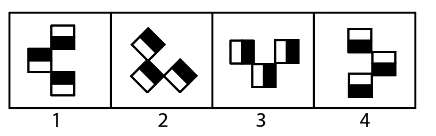
The task is to identify the figure that does not belong to the group based on a specific pattern or characteristic shared by the other figures.
Correct Option: C) 1