
The problem provides a multiplication fact and asks for the result of a division involving decimal numbers derived from the original numbers. The key is to use the given multiplication fact to simplify the division by manipulating decimal places.
The expression can be written as:
\[ \frac{0.0437}{1.9} = \frac{\frac{437}{10000}}{\frac{19}{10}} \]A) 0.023 — This is the correct result obtained by using the given multiplication fact and adjusting for the decimal places.
Select the correct option that will complete the given series.
UE5, TF4, SG6, RH3, _____
The problem presents a series of alphanumeric terms. To find the next term, we need to identify the pattern in the letters and the numbers separately.
Correct Option: B) QI 7
To find the least number that must be subtracted from 202 to make it a perfect square, we need to find the largest perfect square less than 202. Once we find that perfect square, the difference between 202 and that perfect square will be the required number.
A) 6 is the correct answer because subtracting 6 from 202 results in 196, which is \(14^2\), a perfect square. This is the largest perfect square less than 202, so 6 is the least number to subtract.
This problem involves finding the shortest distance between two points after movements in perpendicular directions. This can be visualized as a right-angled triangle, where the movements form the two perpendicular sides (legs), and the shortest distance between the final positions is the hypotenuse. We can use the Pythagorean theorem to solve this.
A) 25 km is the correct answer because, by applying the Pythagorean theorem to the right-angled triangle formed by the movements of X and Y, the shortest distance between them is calculated to be 25 km.
To find the smallest number by which 1875 must be divided to obtain a perfect square, we need to perform prime factorization of 1875. A number is a perfect square if all the exponents in its prime factorization are even. We will identify the prime factors with odd exponents and divide by the product of these factors to make all exponents even.
First, we find the prime factors of 1875.
\[ 1875 = 3 \times 625 \]\[ 625 = 5 \times 125 \]\[ 125 = 5 \times 25 \]\[ 25 = 5 \times 5 \]So, the prime factorization of 1875 is:\[ 1875 = 3 \times 5 \times 5 \times 5 \times 5 = 3^1 \times 5^4 \]For a number to be a perfect square, all the exponents in its prime factorization must be even. In the prime factorization of \(1875 = 3^1 \times 5^4\), the prime factor 5 has an exponent of 4 (which is even), but the prime factor 3 has an exponent of 1 (which is odd).
To make the exponent of 3 even, we need to divide 1875 by 3. If we divide by 3, the new number will be:
\[ \frac{1875}{3} = \frac{3^1 \times 5^4}{3^1} = 3^{(1-1)} \times 5^4 = 3^0 \times 5^4 = 1 \times 5^4 = 625 \]The resulting number is 625. We know that \(625 = 25^2\), which is a perfect square. Therefore, the smallest number by which 1875 must be divided to obtain a perfect square is 3.
Correct Option: B) 3
The question asks for the term that describes a conductor with an appreciable amount of resistance. We need to understand the definitions of conductors, semiconductors, resistors, and insulators to identify the correct term.
Correct Option: B) Resistor
A resistor is a component specifically designed to introduce a known amount of resistance into an electrical circuit. While all conductors have some resistance, a component designed to have an "appreciable" or significant resistance for circuit control is called a resistor.
Select the missing term based on the given related pair. Dog : Kennel :: Lion : ?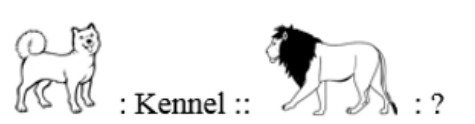
The question presents a pair of related terms and asks us to find a similar relationship for another pair. The relationship between the first pair is that of an animal and its dwelling place.
Correct Option: D) Den
The length of a minor arc is \( \frac{2}{9} \) of the circumference of the circle. Write the measure of the angle (in degrees) subtended by the arc at the centre of the circle.
The problem asks us to find the angle subtended by a minor arc at the center of a circle, given that the length of the arc is a fraction of the circle's circumference. We know that the angle subtended by an arc at the center is directly proportional to the length of the arc. A full circle (circumference) subtends an angle of \(360^\circ\) at the center.
Thus, the measure of the angle subtended by the arc at the center of the circle is \(80^\circ\).
Correct Option: C) 80
The question asks to identify the specific name for the upward force exerted by water on an object. This is a fundamental concept in fluid mechanics, particularly related to buoyancy.
B) Buoyant force is the correct term for the upward force exerted by water (or any fluid) on an object submerged in it.
When two trains cross each other while moving in opposite directions, the total distance covered is the sum of their lengths. The relative speed is the sum of their individual speeds. We can use the formula \(\text{Distance} = \text{Speed} \times \text{Time}\) to find the sum of their speeds in m/s and then convert it to km/hr.
The total distance covered when two trains cross each other is the sum of their lengths.
\[ \text{Total Distance} = \text{Length of Train 1} + \text{Length of Train 2} \]
\[ \text{Total Distance} = 150 \text{ m} + 130 \text{ m} = 280 \text{ m} \]
The time taken to cross each other is given as 7.2 seconds.
\[ \text{Time} = 7.2 \text{ s} \]
Using the formula \(\text{Speed} = \frac{\text{Distance}}{\text{Time}}\), we can find the sum of their speeds.
\[ \text{Sum of Speeds} = \frac{280 \text{ m}}{7.2 \text{ s}} \]
\[ \text{Sum of Speeds} = \frac{2800}{72} \text{ m/s} \]
\[ \text{Sum of Speeds} = \frac{350}{9} \text{ m/s} \]
To convert speed from m/s to km/hr, multiply by \(\frac{18}{5}\).
\[ \text{Sum of Speeds (km/hr)} = \frac{350}{9} \times \frac{18}{5} \]
\[ \text{Sum of Speeds (km/hr)} = \frac{350 \times 18}{9 \times 5} \]
\[ \text{Sum of Speeds (km/hr)} = \frac{350 \times 2}{5} \]
\[ \text{Sum of Speeds (km/hr)} = 70 \times 2 \]
\[ \text{Sum of Speeds (km/hr)} = 140 \text{ km/hr} \]
The sum of speed in km/hr directly represents the total distance covered by the trains together in one hour. So, the sum of speed of the two trains every hour is 140 km.
Correct Option: B) 140 km