
The problem asks us to express the area of a rectangle in terms of a quadratic equation involving its length \(x\). We are given the total area and a relationship between the length and breadth of the rectangle. We will use these pieces of information to form the quadratic equation.
Let the length of the rectangle be \(x\) cm.
Let the breadth of the rectangle be \(y\) cm.
The area of the rectangle is given as \(225 \text{ cm}^2\).
The relationship between length and breadth is: "The length (\(x\)) of the rectangle is 4 more than 4 times the breadth (\(y\))."
From the area, we have:
\[ \text{Area} = \text{length} \times \text{breadth} \]\[ 225 = x \times y \quad \ldots(1) \]From the relationship between length and breadth, we have:
\[ x = 4y + 4 \quad \ldots(2) \]From equation (2), we can express \(y\) in terms of \(x\):
\[ x - 4 = 4y \]\[ y = \frac{x - 4}{4} \quad \ldots(3) \]Substitute the expression for \(y\) from equation (3) into equation (1):
\[ 225 = x \times \left(\frac{x - 4}{4}\right) \]Multiply both sides by 4:
\[ 225 \times 4 = x(x - 4) \]\[ 900 = x^2 - 4x \]Rearrange the equation to the standard quadratic form (\(ax^2 + bx + c = 0\)):
\[ x^2 - 4x - 900 = 0 \]A) \(x^2 - 4x - 900 = 0\). This matches the quadratic equation derived in the step-by-step solution.
This is a logical reasoning problem involving the arrangement of boxes. We need to deduce the exact position of each box based on the given clues and then identify the box at the third position from the top. We will use a systematic approach by listing possible positions and eliminating them as per the conditions.
There are six boxes, so there are six positions. Let's number them from bottom to top: 1, 2, 3, 4, 5, 6.
Clue 1: "The red box is placed at an odd-number position when counted from the bottom but it is not in the fifth position."
Odd positions from the bottom are 1, 3, 5. Since Red is not at position 5, Red can be at position 1 or 3.
Clue 2: "The red box is placed immediately above the yellow box."
If Red is at position 1, Yellow would be at position 0, which is not possible. So, Red must be at position 3.
This means Yellow is at position 2.
Let's update the arrangement:
Clue 3: "Only two boxes are placed between the yellow box and the orange box."
Yellow is at position 2. Counting two boxes up from Yellow (positions 3 and 4), Orange would be at position 5.
Let's update the arrangement:
Clue 4: "Only two boxes are placed between the blue box and the pink box."
The remaining positions are 1, 4, 6. The only way to place two boxes between Blue and Pink is if they occupy positions 1 and 4, or 1 and 6, or 4 and 6. For two boxes to be between them, they must be at positions 1 and 4 or 4 and 1 (2 boxes between them are 2 and 3) or 1 and 6 (3 boxes between them) or 4 and 6 (1 box between them). So, Blue and Pink must be at positions 1 and 4, or 4 and 1.
Clue 5: "Only one box is placed between the blue box and the green box."
Let's consider the possibilities for Blue and Pink based on Clue 4:
Now apply Clue 5 to these cases:
So, the arrangement is:
The question asks: "Which box is placed third from the top?"
Counting from the top: Position 6 is 1st from top, Position 5 is 2nd from top, Position 4 is 3rd from top.
The box at Position 4 is Blue.
A) Blue — As per our deduction, the Blue box is at position 4, which is the third position from the top.
The problem asks us to find a set of three numbers that follow the same relationship as the given sets: (10, 300, 10) and (11, 165, 5). We need to identify the pattern connecting the three numbers in the given sets and then apply it to the options.
Let the numbers be \(A\), \(B\), and \(C\). So, \(A=10\), \(B=300\), \(C=10\).
We need to find a relationship between \(A\), \(B\), and \(C\). Let's try multiplication or division involving the first and third numbers to get the middle number.
Here, \(A=11\), \(B=165\), \(C=5\).
Let's test the pattern \(B = 3 \times A \times C\):
\[ 3 \times 11 \times 5 = 33 \times 5 = 165 \]This matches the middle number \(B=165\). So, the established pattern is \(B = 3 \times A \times C\).
D) (9, 243, 9)
Here, \(A=9\), \(C=9\).
Using the pattern \(B = 3 \times A \times C\):
\[ B = 3 \times 9 \times 9 = 3 \times 81 = 243 \]This matches the middle number \(243\). Therefore, option D follows the same relationship.
Here, \(A=8\), \(C=8\). According to the pattern, \(B = 3 \times 8 \times 8 = 3 \times 64 = 192\). The given middle number is \(20\), which is not \(192\).
Here, \(A=11\), \(C=6\). According to the pattern, \(B = 3 \times 11 \times 6 = 33 \times 6 = 198\). The given middle number is \(188\), which is not \(198\).
Here, \(A=10\), \(C=20\). According to the pattern, \(B = 3 \times 10 \times 20 = 3 \times 200 = 600\). The given middle number is \(400\), which is not \(600\).
In the given figure, if n ∥ m and m∠a : m∠b = 2 : 3, then what is m∠h?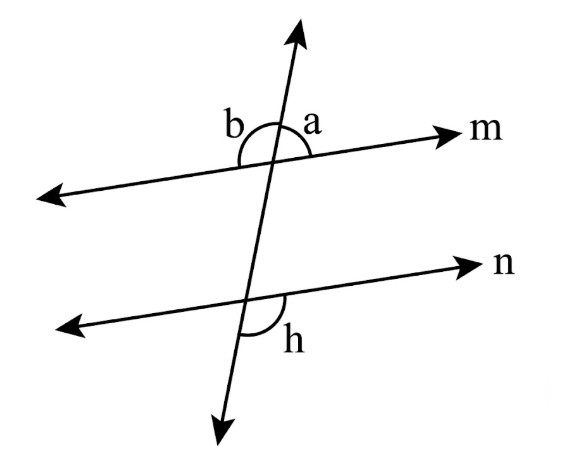
To find the measure of angle \( h \), we need to use the properties of parallel lines and the given ratio between angles \( a \) and \( b \).
\[ 2x + 3x = 180^\circ \]
\[ x = \frac{180^\circ}{5} = 36^\circ \]
Correct Option: B) 108°
The problem asks us to identify the largest and smallest numbers from a given set of three-digit numbers, then extract specific digits from them, and finally perform an addition operation. We need to carefully identify the digits based on their position (first, second, third) as specified in the example.
The resultant is 13.
A) 13 is the correct answer, as calculated by adding the third digit of the largest number (5) and the second digit of the smallest number (8).
To find the smallest prime number, we need to recall the definition of a prime number and then examine the given options based on this definition.
Definition of a Prime Number: A prime number is a natural number greater than 1 that has no positive divisors other than 1 and itself. In other words, it has exactly two distinct positive divisors.
Examine Option A (1): The number 1 has only one positive divisor, which is 1 itself. According to the definition, a prime number must have exactly two distinct positive divisors. Therefore, 1 is not a prime number.
Examine Option B (4): The number 4 has positive divisors 1, 2, and 4. Since it has more than two distinct positive divisors, 4 is not a prime number. It is a composite number.
Examine Option C (3): The number 3 has exactly two distinct positive divisors: 1 and 3. Therefore, 3 is a prime number.
Examine Option D (2): The number 2 has exactly two distinct positive divisors: 1 and 2. Therefore, 2 is a prime number.
Compare Prime Numbers: Comparing the prime numbers found (2 and 3), the smallest among them is 2.
D) 2 is the smallest prime number because it is a natural number greater than 1 and its only positive divisors are 1 and 2.
A) 1 — 1 is not a prime number because it only has one divisor (itself), whereas a prime number must have exactly two distinct positive divisors (1 and itself).
B) 4 — 4 is not a prime number because it has three divisors (1, 2, and 4). Numbers with more than two divisors are called composite numbers.
C) 3 — 3 is a prime number, as its only divisors are 1 and 3. However, it is not the smallest prime number; 2 is smaller than 3.
The question asks for the location of the Arabari forest. This is a factual question related to environmental studies and geography, specifically concerning important forest areas in India. Knowledge of specific forest locations is key to answering this type of question.
Correct Option: C) Midnapore
The Arabari forest is located in the West Midnapore district of West Bengal, India. It is famous for being the site where the Joint Forest Management (JFM) program was first successfully implemented in the early 1970s, involving local communities in forest protection and management.
The positive square root of
(6+2\(\sqrt{3}\))(6−2\(\sqrt{3}\)) is ______.
The problem asks for the positive square root of a product of two binomials. We can simplify the product first by recognizing it as a difference of squares, then take the square root of the result.
Identify the expression inside the square root:
\( (6+2\sqrt{3})(6-2\sqrt{3}) \)
Recognize the algebraic identity: \((a+b)(a-b) = a^2 - b^2\). Here, \(a=6\) and \(b=2\sqrt{3}\).
Apply the identity to simplify the product:
\[ (6+2\sqrt{3})(6-2\sqrt{3}) = (6)^2 - (2\sqrt{3})^2 \]Calculate the squares:
Substitute these values back into the expression:
\[ 36 - 12 = 24 \]The problem asks for the positive square root of this result. So, we need to find \(\sqrt{24}\).
Simplify \(\sqrt{24}\) by finding the largest perfect square factor of 24. The factors of 24 are 1, 2, 3, 4, 6, 8, 12, 24. The largest perfect square factor is 4.
Rewrite \(\sqrt{24}\) as \(\sqrt{4 \times 6}\):
\[ \sqrt{24} = \sqrt{4 \times 6} = \sqrt{4} \times \sqrt{6} = 2\sqrt{6} \]Since the question asks for the positive square root, the answer is \(2\sqrt{6}\).
B) 2\sqrt{6} is the correct positive square root of the given expression.
To find the total amount payable after 3 years when interest is compounded annually, we use the compound interest formula. This formula calculates the final amount by adding the interest earned each year to the principal for the subsequent year's calculation.
The formula for the amount (\(A\)) when compounded annually is:
\[ A = P \left(1 + \frac{R}{100}\right)^n \]Thus, the total amount payable after 3 years is Rs 1,331.
A) 1,331 is the correct amount calculated using the compound interest formula.
To determine the acid and base that form sodium hydrogen carbonate (NaHCO₃), we need to identify the cation and anion present in the salt and then deduce their parent acid and base. A salt is generally formed from the reaction of an acid and a base.
A) H₂CO₃ and NaOH — As explained above, carbonic acid (H₂CO₃) provides the hydrogen carbonate ion (HCO₃⁻) and sodium hydroxide (NaOH) provides the sodium ion (Na⁺) to form sodium hydrogen carbonate (NaHCO₃).