
To find the missing number in the series, we need to identify the pattern or relationship between consecutive numbers. We will analyze the differences between adjacent terms to uncover the underlying rule.
A) 30. Based on the identified pattern of increasing differences (2, 4, 6, 8, 10), the next number in the series is \(20 + 10 = 30\).
To solve this problem, we need to compare the original position of each letter in the given word with its position after arranging the letters alphabetically. We will count how many letters retain their original position.
| Original Position | Original Letter | Alphabetical Letter | Position Unchanged? |
|---|---|---|---|
| 1 | L | A | No |
| 2 | A | E | No |
| 3 | M | L | No |
| 4 | E | M | No |
| 5 | N | N | Yes |
| 6 | T | T | Yes |
A) Two — As determined in the step-by-step explanation, the letters 'N' and 'T' retain their original positions after the word "LAMENT" is arranged alphabetically. Thus, two letters remain unchanged.
Which figure is the correct representation of the movement of food in phloem?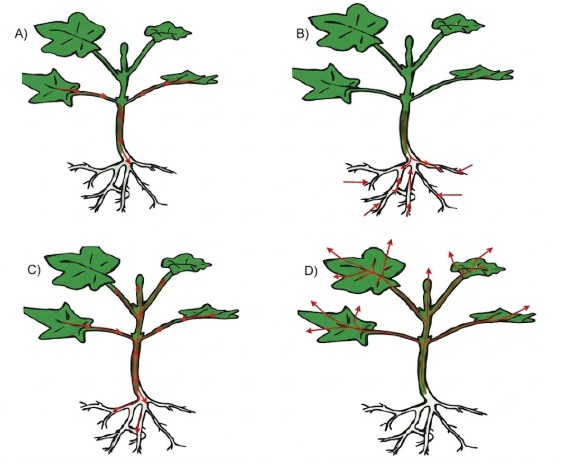
Phloem is responsible for transporting food, primarily sugars, from the leaves where they are produced during photosynthesis to other parts of the plant. This process is known as translocation.
Correct Option: A) Diagram A correctly represents the movement of food in phloem, as it shows arrows moving from the leaves to other parts of the plant.
We are given the difference between two numbers and their ratio. We can represent the numbers using a common multiple based on their ratio, set up an equation using the given difference, and then solve for the numbers.
Let the two numbers be \(7x\) and \(3x\), since their ratio is \(7:3\).
The difference between the two numbers is given as 52. So, we can write the equation:
\[ 7x - 3x = 52 \]Simplify the equation:
\[ 4x = 52 \]Solve for \(x\):
\[ x = \frac{52}{4} \]\[ x = 13 \]Now, find the two numbers:
The question asks for the greater of the two numbers. Comparing 91 and 39, the greater number is 91.
Correct Option: C) 91
30 people are standing in a queue facing north. Manoj is standing at the 11th position from the front. Shalini is standing at the 7th position from the back. Neeraj is standing exactly in front of Shalini. How many people are standing between Neeraj and Manoj?
The problem involves finding the number of people between two individuals in a queue. We need to determine the positions of Manoj and Neeraj from the front of the queue and then calculate the difference, accounting for their own positions.
Correct Option: A) 11
There are 11 people standing between Neeraj and Manoj.
The problem describes a car that changes its speed at regular intervals. To find the total time to cover a certain distance, we need to calculate the distance covered in each interval with its corresponding speed and sum them up until the total distance is reached or exceeded. We will then calculate the time for the remaining distance.
Initial speed and distance covered in the first 2 hours:
Initial speed \(S_1 = 60 \text{ km/h}\)
Time \(T_1 = 2 \text{ hours}\)
Distance covered in the first 2 hours \(D_1 = S_1 \times T_1 = 60 \text{ km/h} \times 2 \text{ h} = 120 \text{ km}\)
Speed and distance covered in the next 2 hours (after 2 hours):
Speed increases by \(15 \text{ km/h}\).
New speed \(S_2 = S_1 + 15 \text{ km/h} = 60 + 15 = 75 \text{ km/h}\)
Time \(T_2 = 2 \text{ hours}\)
Distance covered in the next 2 hours \(D_2 = S_2 \times T_2 = 75 \text{ km/h} \times 2 \text{ h} = 150 \text{ km}\)
Total distance covered after 4 hours:
Total distance \(D_{\text{total after 4h}} = D_1 + D_2 = 120 \text{ km} + 150 \text{ km} = 270 \text{ km}\)
Total time taken so far \(T_{\text{total after 4h}} = T_1 + T_2 = 2 \text{ h} + 2 \text{ h} = 4 \text{ hours}\)
Remaining distance to cover:
Total distance to be covered \(D_{\text{target}} = 360 \text{ km}\)
Remaining distance \(D_{\text{remaining}} = D_{\text{target}} - D_{\text{total after 4h}} = 360 \text{ km} - 270 \text{ km} = 90 \text{ km}\)
Speed for the remaining distance:
After 4 hours, the speed will increase again.
New speed \(S_3 = S_2 + 15 \text{ km/h} = 75 + 15 = 90 \text{ km/h}\)
Time to cover the remaining distance:
Time \[T_3 = \frac{D_{\text{remaining}}}{S_3} = \frac{90 \text{ km}}{90 \text{ km/h}} = 1 \text{ hour}\]
Total time taken:
Total time \(T_{\text{total}} = T_1 + T_2 + T_3 = 2 \text{ h} + 2 \text{ h} + 1 \text{ h} = 5 \text{ hours}\)
D) 5 hours
The problem involves solving two separate proportion equations to find the values of \(x\) and \(y\), and then substituting these values into the expression \(2x + y\).
The first proportion is given as \(9 : 12 :: 12 : x\). This can be written as a fraction:
\[ \frac{9}{12} = \frac{12}{x} \]To solve for \(x\), cross-multiply:
\[ 9 \times x = 12 \times 12 \]\[ 9x = 144 \]Divide by 9:
\[ x = \frac{144}{9} \]\[ x = 16 \]The second proportion is given as \(28 : 42 :: 42 : y\). This can be written as a fraction:
\[ \frac{28}{42} = \frac{42}{y} \]To solve for \(y\), cross-multiply:
\[ 28 \times y = 42 \times 42 \]\[ 28y = 1764 \]Divide by 28:
\[ y = \frac{1764}{28} \]\[ y = 63 \]Now substitute the values of \(x = 16\) and \(y = 63\) into the expression \(2x + y\):
\[ 2x + y = 2(16) + 63 \]\[ 2x + y = 32 + 63 \]\[ 2x + y = 95 \]A) The calculated value of \(2x + y\) is 95.
The question asks to identify which option is NOT a biotic component of an ecosystem. An ecosystem consists of biotic (living) and abiotic (non-living) components. We need to classify each given option as either biotic or abiotic.
Correct Option: B) Soil is an abiotic component, as it is a non-living physical factor in the ecosystem.
The question asks for the Highest Common Factor (HCF) of any set of 10 co-prime numbers. To solve this, we need to understand the definitions of HCF and co-prime numbers.
A) 1
By definition, co-prime numbers are numbers whose only common positive divisor is 1. Therefore, the HCF of any set of co-prime numbers, regardless of how many numbers are in the set, will always be 1.
Which two numbers should be interchanged to make the given equation correct?
7 × 8 + 9 − 6 ÷ 3 = 59
The problem requires us to find which pair of numbers, when interchanged in the given equation, makes the equation correct. We will test each option by interchanging the numbers and then evaluating the expression using the BODMAS/PEMDAS rule.
The given equation is:
\[ 7 \times 8 + 9 - 6 \div 3 = 59 \]If we interchange 3 and 6, the equation becomes:
\[ 7 \times 8 + 9 - 3 \div 6 \]\[ = 56 + 9 - 0.5 \]\[ = 65 - 0.5 \]\[ = 64.5 \]This is not equal to 59. So, option A is incorrect.If we interchange 8 and 9, the equation becomes:
\[ 7 \times 9 + 8 - 6 \div 3 \]\[ = 63 + 8 - 2 \]\[ = 71 - 2 \]\[ = 69 \]This is not equal to 59. So, option B is incorrect.If we interchange 7 and 3, the equation becomes:
\[ 3 \times 8 + 9 - 6 \div 7 \]\[ = 24 + 9 - 0.857... \]\[ = 33 - 0.857... \]\[ = 32.14... \]This is not equal to 59. So, option C is incorrect.If we interchange 6 and 9, the equation becomes:
\[ 7 \times 8 + 6 - 9 \div 3 \]Now, we evaluate this expression using the BODMAS/PEMDAS rule:
D) 6 and 9 — Interchanging 6 and 9 makes the equation \( 7 \times 8 + 6 - 9 \div 3 = 59 \) true, as \( 56 + 6 - 3 = 59 \).