
Gandhiji founded Harijan Sevak Sangh in _______ to eradicate untouchability and uplift the depressed classes.
The question asks for the year in which Gandhiji founded the Harijan Sevak Sangh. This requires knowledge of key historical events and organizations associated with Mahatma Gandhi's work for social reform in India.
Correct Option: A) 1932. Gandhiji founded the Harijan Sevak Sangh in September 1932, shortly after the Poona Pact, to work towards the eradication of untouchability and the upliftment of the depressed classes.
The question asks to identify the name of the first 'made in India' Petascale supercomputer deployed at IIT Roorkee in March 2022 with a capacity of 1.66 Petaflops. This requires knowledge of specific supercomputing projects and their deployment locations in India.
Correct Option: A) PARAM Ganga
PARAM Ganga is the correct answer. It is a 1.66 Petaflops supercomputer established at IIT Roorkee under the National Supercomputing Mission (NSM) and was inaugurated in March 2022. It is an indigenous supercomputer, designed and developed by the Centre for Development of Advanced Computing (C-DAC).
To find the principal focus of a concave mirror, we need to use the relationship between the radius of curvature and the focal length, along with the New Cartesian Sign Convention.
Correct Option: C) –9 cm — This is the correct focal length for a concave mirror with a radius of curvature of 18.0 cm, according to the New Cartesian Sign Convention.
The question asks for the exact date on which the Planning Commission of India was established. This is a factual recall question related to the history of economic planning in India.
D) 15 March 1950. The Planning Commission was indeed set up by a resolution of the Government of India on 15 March 1950. It was an advisory body responsible for formulating India's Five-Year Plans.
The question asks for the total forest and tree cover in India as a percentage of its geographical area, according to the India State of Forest Report (ISFR) 2021. This requires recalling the specific data published in the ISFR 2021.
A) 24.62% is the correct figure for the total forest and tree cover as a percentage of India's geographical area, as per the ISFR 2021.
The question asks for a possible reason why young females become teen mothers. We need to evaluate each option to determine which one logically contributes to early motherhood, particularly in the context of societal factors often observed in developing regions or conservative societies.
C) Familial and societal pressure is a significant factor contributing to teen motherhood. In many cultures, young girls face pressure to marry early and bear children, often due to traditional beliefs, economic reasons (e.g., dowry), or a lack of awareness about the importance of education and reproductive health. This pressure can lead to early marriages and subsequent pregnancies during adolescence.
In the following figure, deer occupies _______.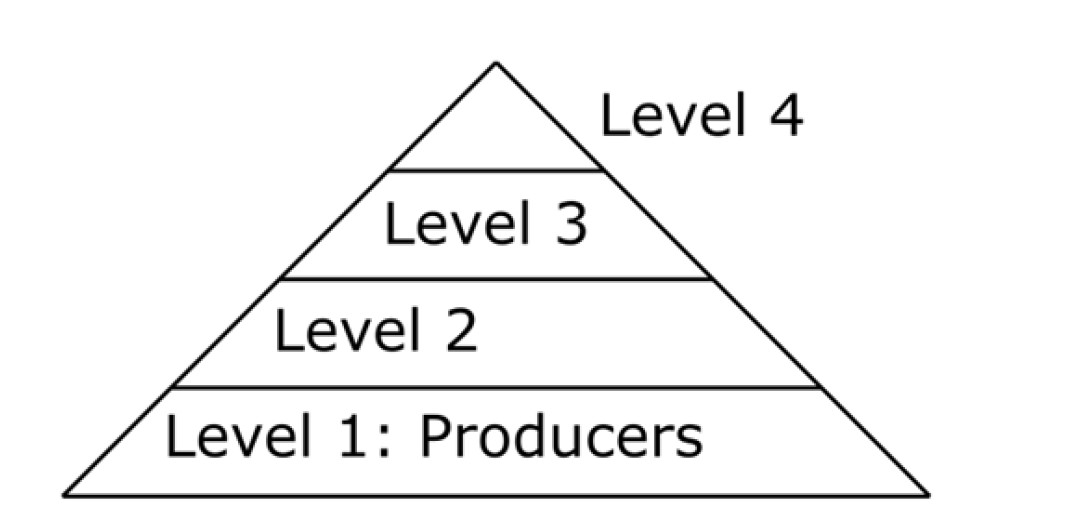
The diagram represents a trophic level pyramid, which is a model of the ecosystem structure showing different levels of organisms based on their role in the food chain.
Since deer are herbivores, they feed directly on producers and thus occupy Level 2 in the pyramid.
Correct Option: B) Level 2
To find the value(s) of \(b\) for which a quadratic equation has equal roots, we use the discriminant condition. For a quadratic equation of the form \(ax^2 + bx + c = 0\), the roots are equal if and only if the discriminant, \(\Delta = b^2 - 4ac\), is equal to zero.
Identify coefficients: The given quadratic equation is \(4x^2 + bx + 1 = 0\). Comparing this with the standard form \(ax^2 + Bx + C = 0\), we have:
Apply the discriminant condition: For equal roots, the discriminant must be zero.
\[ \Delta = B^2 - 4AC = 0 \]Substitute the coefficients: Substitute the values of \(a\), \(B\), and \(C\) into the discriminant formula:
\[ (b)^2 - 4(4)(1) = 0 \]\[ b^2 - 16 = 0 \]Solve for \(b\):
\[ b^2 = 16 \]\[ b = \pm\sqrt{16} \]\[ b = \pm 4 \]So, \(b\) can be \(4\) or \(-4\).
Consider the given condition: The problem states that \(b < 0\). Among the two possible values for \(b\), only \(-4\) satisfies this condition.
Correct Option: D) Only -4
This is a logical reasoning problem involving seating arrangement on different floors. We need to deduce the exact floor on which each person lives based on the given clues. We will use a table to keep track of the possibilities and eliminate them as we go.
Set up the floors: There are 6 floors, numbered 1 to 6.
| Floor No. | Person |
|---|---|
| 6 | |
| 5 | |
| 4 | |
| 3 | |
| 2 | |
| 1 |
Clue 1: B lives on an even-numbered floor but not on floor number 4.
Even-numbered floors are 2, 4, 6. Since B is not on floor 4, B can be on floor 2 or 6.
Clue 2: Only two people live between B and E.
| Floor No. | Person |
|---|---|
| 6 | B |
| 5 | |
| 4 | |
| 3 | E |
| 2 | |
| 1 |
| Floor No. | Person |
|---|---|
| 6 | |
| 5 | E |
| 4 | |
| 3 | |
| 2 | B |
| 1 |
Clue 3: D lives immediately below A. This means A and D occupy consecutive floors, with A above D.
Clue 4: A lives on an even-numbered floor. So, A can be on floor 2, 4, or 6.
| Floor No. | Person |
|---|---|
| 6 | B |
| 5 | |
| 4 | |
| 3 | E |
| 2 | A |
| 1 | D |
| Floor No. | Person |
|---|---|
| 6 | |
| 5 | E |
| 4 | A |
| 3 | D |
| 2 | B |
| 1 |
Clue 5: Neither D nor C lives on the lowermost floor (floor 1).
Final arrangement (from valid Case 2):
| Floor No. | Person |
|---|---|
| 6 | |
| 5 | E |
| 4 | A |
| 3 | D |
| 2 | B |
| 1 |
| Floor No. | Person |
|---|---|
| 6 | C |
| 5 | E |
| 4 | A |
| 3 | D |
| 2 | B |
| 1 | F |
Answer the question: Who lives on floor number 4?
From the final arrangement, A lives on floor number 4.