
This is a coding-decoding problem where we need to find the code for a specific word by comparing common words and codes across different given statements.
A) li is the code for 'cook'.
Study the given diagram carefully and answer the question. The numbers in different sections indicate the number of persons.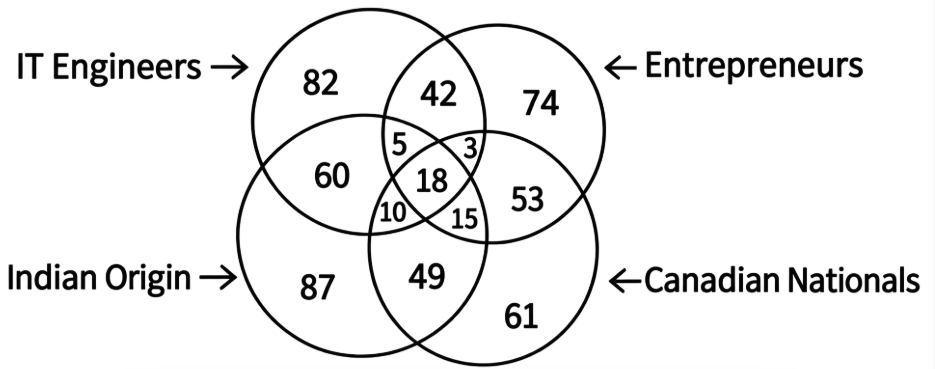
How many Canadian nationals are there who are entrepreneurs of Indian origin but NOT IT engineers?
To find the number of Canadian nationals who are entrepreneurs of Indian origin but not IT engineers, we need to analyze the Venn diagram and identify the relevant section.
Correct Option: D) 15
The problem asks us to modify a given letter series by dropping every third letter and then identify the fifth letter from the left in the new series. We will first write down the original series, then systematically remove every third letter, and finally count to find the fifth letter.
A F R G H U I N H F W D C T V G Y J M K O Q
Starting from the first letter, we count three letters and drop the third one. We repeat this process with the remaining letters.
The series after dropping every third letter is: A F G U I N F W C T G Y M K Q
Let's count the letters from the left in the modified series:
The fifth letter from the left is I.
Correct Option: D) I
To determine the number of carbon dioxide and water molecules produced from the combustion of one methane molecule, we need to write and balance the chemical equation for the complete combustion of methane.
Correct Option: C) 1; 2
The question asks to identify an element that is neither a metal nor a non-metal. Such elements are known as metalloids, which exhibit properties intermediate between metals and non-metals. We need to classify each given option as a metal, non-metal, or metalloid.
D) Ge (Germanium) is a metalloid. Metalloids are elements that exhibit properties intermediate between metals and non-metals. Germanium is a semiconductor, a characteristic property of metalloids.
Study the given pie-chart and answer the question that follows.
The pie-chart shows the percentage of questions asked in a competitive examination.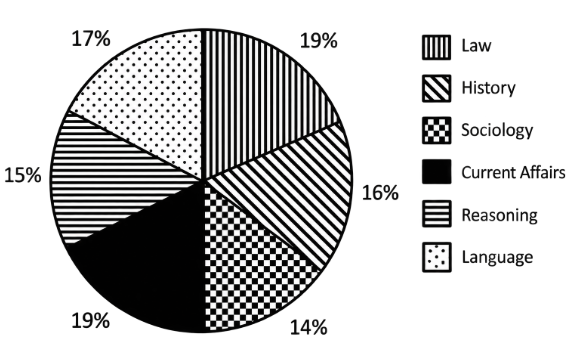
If the total number of questions asked in the examination was 350, how many questions were asked in History, Law, and Language taken together?
To find the total number of questions asked in History, Law, and Language, we need to calculate the percentage of each subject from the pie chart and then sum them up based on the total number of questions.
Correct Option: B) 182.00
To determine the least value of 'y' for which the number 6484y6 is divisible by 8, we need to apply the divisibility rule for 8. A number is divisible by 8 if its last three digits are divisible by 8.
Correct Option: B) 1
When \(y=1\), the number becomes 648416. The last three digits are 416. Since \(416 \div 8 = 52\), the number 648416 is divisible by 8. This is the least possible value for \(y\).
The value of \(\sqrt{75+\sqrt{41-\sqrt{21+\sqrt{19-\sqrt{9}}}}}\) is:
To solve this problem, we need to evaluate the expression by working from the innermost square root outwards. This involves performing the operations (subtraction, addition, square root) step-by-step.
Correct Option: A) 9
C is twice as efficient as A, while B takes thrice as many days as C to do the same work. A takes 10 days to do the work alone. If they work in pairs [like (A, B), (B, C) and (C, A)], with (A, B) working on the first day, then (B, C) working on the second day and (C, A) working on the third day and continuing the cycle till the work gets completed, then how many days will be required to complete this work?
5\( \frac{7}{8} \) days
7\( \frac{5}{8} \) days
4\( \frac{3}{8} \) days
6\( \frac{1}{8} \) days
This problem involves calculating the work done by three individuals (A, B, C) with different efficiencies and then determining the total time taken when they work in a specific cyclic pattern. We will first find the individual work rates, then the work done in one cycle of three days, and finally the total days required.
C) 4\( \frac{3}{8} \) days
The question asks to identify the INCORRECT feature of a respiratory surface in animals. We need to recall the essential characteristics that facilitate efficient gas exchange.
Correct Option: C) Is very thick. A respiratory surface must be very thin to allow for efficient diffusion of gases, not thick.