
This question tests knowledge about the composition of baking powder and the chemical reactions that occur when it is heated. Baking powder is a mixture, primarily containing sodium bicarbonate and a mild edible acid, usually tartaric acid.
Correct Option: B) Carbon dioxide and sodium salt of tartaric acid are produced.
The question asks for the most essential difference between a DC generator and an AC generator. Both generators work on the principle of electromagnetic induction, converting mechanical energy into electrical energy. The key distinction lies in how the induced current is collected and its nature (alternating or direct).
D) DC generator uses a commutator and AC generator uses slip rings. This statement correctly identifies the distinct components responsible for the type of output current (DC or AC) produced by each generator.
To determine the number of lamps that can be connected in parallel, we first need to find the current drawn by a single lamp. Then, knowing the maximum allowable current for the entire circuit, we can calculate how many such lamps can operate simultaneously without exceeding the limit.
The power \(P\) of a lamp is given by the product of voltage \(V\) and current \(I\), i.e., \(P = V \times I\). We are given \(P = 20 \text{ W}\) and \(V = 220 \text{ V}\).
\[ I_{\text{lamp}} = \frac{P}{V} = \frac{20 \text{ W}}{220 \text{ V}} = \frac{1}{11} \text{ A} \]When lamps are connected in parallel, the total current drawn from the supply is the sum of the currents drawn by individual lamps. Let \(N\) be the number of lamps. The total current \(I_{\text{total}}\) is \(N \times I_{\text{lamp}}\).
We are given that the maximum allowable current \(I_{\text{max}}\) is \(10 \text{ A}\). So, we must have:
\[ N \times I_{\text{lamp}} \le I_{\text{max}} \]\[ N \times \frac{1}{11} \text{ A} \le 10 \text{ A} \]\[ N \le 10 \times 11 \]\[ N \le 110 \]The maximum number of lamps that can be connected in parallel is 110.
B) The maximum number of lamps that can be connected in parallel without exceeding the maximum allowable current is 110.
This problem involves calculating the combined work done by two individuals working on alternate days. We need to find their individual work rates, then calculate the work done in cycles of two days, and finally determine the total time to complete the painting.
Sonu can complete the painting in 4 days. So, Sonu's one day's work is:
\[ \text{Sonu's work rate} = \frac{1}{4} \text{ of the painting per day} \]Mary can complete the painting in 6 days. So, Mary's one day's work is:
\[ \text{Mary's work rate} = \frac{1}{6} \text{ of the painting per day} \]They work on alternate days, starting with Mary.
On Day 1: Mary works. Work done by Mary = \( \frac{1}{6} \)
On Day 2: Sonu works. Work done by Sonu = \( \frac{1}{4} \)
Work done in 2 days (1 cycle) = Work done by Mary + Work done by Sonu
\[ \text{Work in 1 cycle} = \frac{1}{6} + \frac{1}{4} = \frac{2+3}{12} = \frac{5}{12} \]Let \( N \) be the number of 2-day cycles. We want to find how many cycles are needed to complete the painting (i.e., work done = 1).
Work done after \( N \) cycles = \( N \times \frac{5}{12} \)
We need to find the largest \( N \) such that \( N \times \frac{5}{12} < 1 \). If \( N \times \frac{5}{12} = 1 \), then \( N = \frac{12}{5} = 2.4 \). Since \( N \) must be an integer for full cycles, we take \( N=2 \).
Work done after 2 cycles (4 days) = \[2 \times \frac{5}{12} = \frac{10}{12} = \frac{5}{6}\]
Remaining work = Total work - Work done after 4 days
\[ \text{Remaining work} = 1 - \frac{5}{6} = \frac{1}{6} \]After 4 days (2 cycles), it's the beginning of Day 5. The work started with Mary, so on Day 5, Mary will work.
Mary's work rate = \( \frac{1}{6} \) of the painting per day.
The remaining work is \( \frac{1}{6} \).
Time taken by Mary to complete the remaining work = \[\frac{\text{Remaining work}}{\text{Mary's work rate}} = \frac{1/6}{1/6} = 1 \text{ day}\]
Total time = Time for 2 cycles + Time for remaining work
\[ \text{Total time} = 4 \text{ days} + 1 \text{ day} = 5 \text{ days} \]Correct Option: C) 5
In the given letter-cluster pairs, the first letter-cluster is related to the second letter-cluster following a certain logic. Study the given pairs carefully, and from the given options, select the pair that follows the same logic.
ON : NPMO
IN : HJMO
The problem asks us to identify the letter-cluster pair that follows the same logic as the given example pairs. We need to analyze the relationship between the first and second letter-clusters in the given examples and then apply that logic to the options.
D) TO : SUNP
If m=−9 and n=13, find the value of
25m2+40mn+16n2.
The problem asks us to find the value of an algebraic expression given specific values for the variables \(m\) and \(n\). The expression \(25m^2 + 40mn + 16n^2\) resembles the expansion of a perfect square trinomial. We can either substitute the values directly into the expression or first factorize the expression and then substitute the values.
B) 49 is the correct answer. By recognizing the expression as a perfect square trinomial \((5m+4n)^2\) and substituting the given values, we get \((5(-9) + 4(13))^2 = (-45 + 52)^2 = (7)^2 = 49\).
To solve this direction-based problem, we will trace Mohan's path step-by-step, visualizing his movements and turns. We'll determine his final position relative to his starting point.
Correct Option: C) South-West
Which of the options given below correctly describes the nature of the roots of the quadratic equation
x2 + 4\(\sqrt{3}\)x + 3 = 0
irrational and equal
irrational and unequal
rational and equal
rational and unequal
To determine the nature of the roots of a quadratic equation of the form \(ax^2 + bx + c = 0\), we use the discriminant, denoted by \(\Delta\) or \(D\), which is given by the formula \(D = b^2 - 4ac\). The nature of the roots depends on the value of the discriminant:
Additionally, if \(D > 0\) and \(D\) is a perfect square, the roots are rational and unequal. If \(D > 0\) and \(D\) is not a perfect square, the roots are irrational and unequal.
Identify coefficients: The given quadratic equation is \(x^2 + 4\sqrt{3}x + 3 = 0\).
Comparing this with the standard form \(ax^2 + bx + c = 0\), we have:
Calculate the discriminant: Use the formula \(D = b^2 - 4ac\).
\[ D = (4\sqrt{3})^2 - 4(1)(3) \] \[ D = (16 \times 3) - 12 \] \[ D = 48 - 12 \] \[ D = 36 \]Determine the nature of the roots:
Since \(D = 36\), which is greater than 0 (\(D > 0\)), the roots are real and unequal.
Now, we need to check if the roots are rational or irrational. Since \(D = 36\) is a perfect square (\(36 = 6^2\)), the roots are rational and unequal.
However, let's re-evaluate the question's options and the general understanding. If the coefficients \(a, b, c\) are rational, and \(D\) is a perfect square, the roots are rational. In this case, the coefficient \(b = 4\sqrt{3}\) is irrational. When coefficients are irrational, the standard rule for rationality based on the discriminant being a perfect square does not directly apply to determine if the roots themselves are rational or irrational in the same straightforward manner. Let's find the roots explicitly using the quadratic formula:
The quadratic formula is \(x = \frac{-b \pm \sqrt{D}}{2a}\).
Substitute the values of \(a, b, D\):
\[ x = \frac{-(4\sqrt{3}) \pm \sqrt{36}}{2(1)} \] \[ x = \frac{-4\sqrt{3} \pm 6}{2} \]This gives two roots:
\[ x_1 = \frac{-4\sqrt{3} + 6}{2} = -2\sqrt{3} + 3 \] \[ x_2 = \frac{-4\sqrt{3} - 6}{2} = -2\sqrt{3} - 3 \]Both roots, \(-2\sqrt{3} + 3\) and \(-2\sqrt{3} - 3\), involve \(\sqrt{3}\), which is an irrational number. Therefore, the roots are irrational.
Also, \(x_1 \neq x_2\), so the roots are unequal.
Conclusion: The roots are irrational and unequal.
Correct Option: B) irrational and unequal
The following graph shows the ratio of the imports and exports of an industry during the period from 2005 to 2011. Study the graph and answer the question that follows.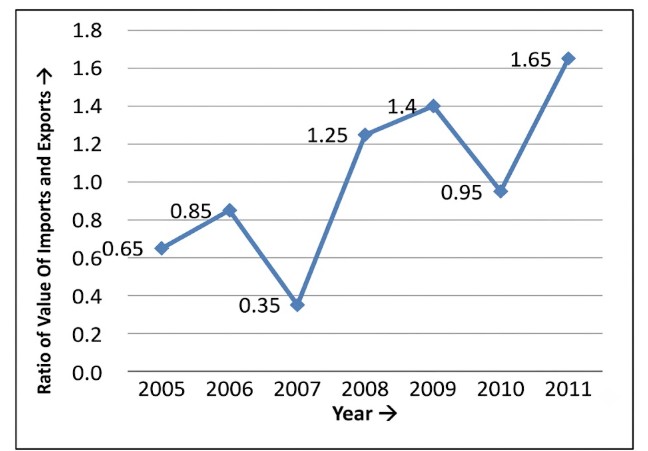
If the imports of the company in 2009 were 420 crore, then how much were the exports?
To find the exports for the year 2009, we need to use the given ratio of imports to exports and the value of imports for that year.
Thus, the exports in 2009 were 300 crore.
Correct Option: B) 300 crore