
We are given two ratios involving the ages of A and B at different points in time. We will use these ratios to set up a system of linear equations. By solving these equations, we can find the present ages of A and B, and then calculate the required difference.
Let the present ages of A and B be \(A_p\) and \(B_p\) respectively.
From the first statement, "The ratio of the present ages of A to B is 7 : 3", we can write:
\[ \frac{A_p}{B_p} = \frac{7}{3} \]This implies \(3A_p = 7B_p\), or \(A_p = \frac{7}{3}B_p\). Let's express them using a common multiplier, say \(x\). So, \(A_p = 7x\) and \(B_p = 3x\).
From the second statement, "The ratio of A’s age 4 years ago to B’s age 4 years hence is 2 : 1".
So, we can write the equation:
\[ \frac{7x - 4}{3x + 4} = \frac{2}{1} \]Now, solve this equation for \(x\):
\[ 1 \times (7x - 4) = 2 \times (3x + 4) \]\[ 7x - 4 = 6x + 8 \]\[ 7x - 6x = 8 + 4 \]\[ x = 12 \]Substitute the value of \(x\) back into the expressions for the present ages:
Finally, we need to find the difference between A’s age 4 years hence and B’s age 4 years ago.
The required difference is:
\[ \text{Difference} = (A_p + 4) - (B_p - 4) \]\[ \text{Difference} = 88 - 32 \]\[ \text{Difference} = 56 \text{ years} \]B) 56 years
The question asks about the authority granted by Article 123 of the Indian Constitution to enact Ordinances. This requires knowledge of the constitutional provisions regarding the legislative powers of the executive.
A) President. Article 123 of the Constitution of India empowers the President to promulgate Ordinances when both Houses of Parliament are not in session and the President is satisfied that circumstances exist which render it necessary for him to take immediate action. These Ordinances have the same force and effect as an Act of Parliament but are temporary in nature.
This question tests knowledge of common precipitation reactions in chemistry. When two soluble ionic compounds are mixed, they can sometimes react to form an insoluble product, which is called a precipitate. We need to identify the products of the reaction between aqueous silver nitrate and sodium chloride and determine the physical appearance of any precipitate formed.
Correct Option: B) White precipitate of silver chloride is produced.
The question asks to identify the initiative launched in January 2021 to promote innovative toys based on Indian values for children. This requires knowledge of recent government initiatives related to education and toy manufacturing in India.
B) Toycathon — Toycathon 2021 was indeed launched in January 2021 by the Ministry of Education's Innovation Cell, with support from various other ministries. Its aim was to challenge India's students, teachers, startups, and toy experts to conceptualize innovative toys and games based on the Indian value system, promoting positive behavior and good values among children. This perfectly matches the description in the question.
The question asks about the general characteristics of saturated carbon compounds. To answer this, we need to recall the definitions of saturated and unsaturated compounds and their typical chemical properties, especially regarding reactivity and stability.
B) less reactive than unsaturated compounds. Saturated compounds contain only single bonds, which are strong and stable, making them less prone to chemical reactions compared to unsaturated compounds that have reactive double or triple bonds.
The question asks to identify the most significant infrastructural contribution of British rule in India among the given options. This requires an understanding of the historical development of infrastructure during the colonial period and the impact of each option.
Correct Option: B) railways. The construction of an extensive railway network was by far the most significant and transformative infrastructural contribution of British rule in India. It facilitated military control, administrative efficiency, and, crucially, the economic exploitation of India's resources by connecting production centers to ports.
The question asks for the specific term used when a firm charges different prices to different customers for the same product. We need to identify the economic concept that describes this practice.
Correct Option: A) Price discrimination is the term used for a pricing strategy in which a firm charges different customers different prices for the same product. This strategy is often employed when a firm has market power and can segment its customers based on their willingness to pay.
The total cost price of 100 apples is Rs 700. They are sold at a rate of Rs 96 per dozen. The profit percentage is _____.
14\( \frac{2}{7} \)%
8\( \frac{2}{3} \)%
13\( \frac{1}{7} \)%
24\( \frac{1}{7} \)%
To find the profit percentage, we need to calculate the total cost price (CP) and the total selling price (SP) of the apples. The CP of 100 apples is given. We need to find the SP of 100 apples based on the selling rate per dozen, and then use the profit percentage formula.
Calculate the Cost Price (CP) per apple:
Given, total cost price of 100 apples = Rs 700.
\[ \text{CP per apple} = \frac{\text{Total CP}}{\text{Number of apples}} = \frac{700}{100} = \text{Rs } 7 \]Calculate the Selling Price (SP) per apple:
Given, apples are sold at Rs 96 per dozen.
Since 1 dozen = 12 apples,
\[ \text{SP per apple} = \frac{\text{Price per dozen}}{\text{Number of apples in a dozen}} = \frac{96}{12} = \text{Rs } 8 \]Calculate the Profit per apple:
\[ \text{Profit per apple} = \text{SP per apple} - \text{CP per apple} = 8 - 7 = \text{Rs } 1 \]Calculate the Profit Percentage:
The profit percentage is calculated with respect to the cost price.
\[ \text{Profit Percentage} = \left( \frac{\text{Profit per apple}}{\text{CP per apple}} \right) \times 100 \] \[ \text{Profit Percentage} = \left( \frac{1}{7} \right) \times 100 = \frac{100}{7} \% \]Converting the improper fraction to a mixed fraction:
\[ \frac{100}{7} = 14 \frac{2}{7} \% \]Correct Option: A) \(14 \frac{2}{7}\) %
The following figure shows a human nephron. Which part is the collecting duct?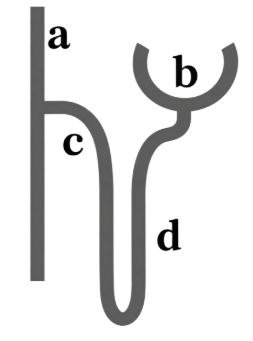
The nephron is the functional unit of the kidney, and understanding its structure is crucial for identifying its components. The collecting duct is a part of the nephron where urine is collected from the renal tubules.
Correct Option: A) Region a
The volume (in cm³) of a right circular cone, whose slant height is 28 cm and radius of base is 21 cm, is (π = \( \frac{22}{7} \))
To find the volume of a right circular cone, we need its radius and height. The problem provides the slant height and radius. We can use the Pythagorean theorem to find the height, and then apply the formula for the volume of a cone.
For a right circular cone, the radius, height, and slant height form a right-angled triangle. So, we can use the Pythagorean theorem:
\[ l^2 = r^2 + h^2 \]\[ 28^2 = 21^2 + h^2 \]\[ 784 = 441 + h^2 \]\[ h^2 = 784 - 441 \]\[ h^2 = 343 \]\[ h = \sqrt{343} \]To simplify \(\sqrt{343}\):\[ 343 = 7 \times 49 = 7 \times 7 \times 7 \]\[ h = \sqrt{7 \times 7 \times 7} = 7\sqrt{7} \text{ cm} \]The formula for the volume (\(V\)) of a right circular cone is:
\[ V = \frac{1}{3} \pi r^2 h \]Substitute the values of \(\pi\), \(r\), and \(h\):\[ V = \frac{1}{3} \times \frac{22}{7} \times (21)^2 \times 7\sqrt{7} \]\[ V = \frac{1}{3} \times \frac{22}{7} \times 441 \times 7\sqrt{7} \]Cancel out the 7 in the denominator with \(7\sqrt{7}\) and simplify:\[ V = \frac{1}{3} \times 22 \times 441 \times \sqrt{7} \]Divide 441 by 3:\[ 441 \div 3 = 147 \]So,\[ V = 22 \times 147 \times \sqrt{7} \]Now, multiply 22 by 147:\[ 22 \times 147 = 3234 \]Therefore, the volume is:\[ V = 3234\sqrt{7} \text{ cm}^3 \]C) \(3234\sqrt{7}\) is the calculated volume of the cone.