
This question asks about the product formed when zinc oxide reacts with carbon. This is a classic example of a reduction reaction where a more reactive element (carbon) displaces a less reactive element (zinc) from its oxide. We need to identify the gaseous product of this reaction.
C) Carbon monoxide is released when zinc oxide reacts with carbon. Carbon acts as a reducing agent, reducing zinc oxide to zinc metal and getting oxidized itself to carbon monoxide.
This problem involves analyzing inequalities. We need to derive conclusions from the given statement and check which of the options logically follows. The statement is a combined inequality, and we will break it down into simpler parts to evaluate each option.
Correct Option: A) \(F \leq U \geq A\). This conclusion is directly derivable from the given statement \(X \leq F \leq U \geq A \ J\). Specifically, the parts \(F \leq U\) and \(U \geq A\) are present in the statement, and their combination \(F \leq U \geq A\) is a valid representation of these relationships.
To determine the direction of the induced current, we use Fleming's Right-Hand Rule. This rule relates the direction of the magnetic field, the direction of motion of the conductor, and the direction of the induced current.
Correct Option: C) north
This question tests knowledge of Mendeleev's periodic table and his predictions for undiscovered elements. Mendeleev used the prefix "Eka-" (Sanskrit for "one") to denote elements that would occupy the next position below a known element in the same group, predicting their properties based on the element above them.
B) Germanium, Scandium, and Gallium are the elements that correspond to Eka-silicon, Eka-boron, and Eka-aluminium, respectively. This aligns with Mendeleev's predictions and the subsequent discovery of these elements.
In the given figure, in ΔABC, DE ∥ BC, AD = 7 cm, AE = 3.5 cm and DB = 6 cm. What is the value of AC?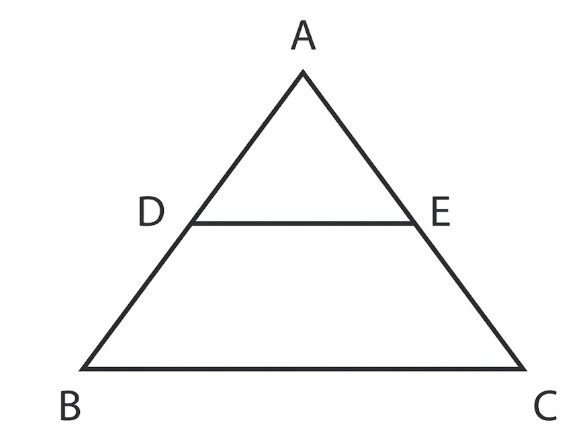
In the given figure, triangle \( \triangle ABC \) has a line segment \( DE \) parallel to \( BC \). We can use the Basic Proportionality Theorem (also known as Thales' theorem) to find the length of \( AC \).
Correct Option: D) 6.5 cm
The pH of a salt solution depends on the nature of the acid and base from which the salt is formed. When a strong base reacts with a weak acid, the resulting salt undergoes hydrolysis, which affects the pH of the solution. We need to determine if the hydrolysis leads to an excess of \(\text{H}^+\) or \(\text{OH}^-\) ions.
Correct Option: D) pH more than 7. The salt formed from a strong base and a weak acid undergoes anionic hydrolysis, producing \(\text{OH}^-\) ions, which makes the solution basic, hence its pH will be greater than 7.
This problem involves understanding directions and the movement of an hour hand on a clock. We need to determine the total angular displacement of the hour hand from 6:00 a.m. to 9:00 p.m. and then map the initial direction to the final direction.
B) North-East — After 15 hours, the hour hand moves \(450^\circ\) clockwise. Since \(450^\circ = 360^\circ + 90^\circ\), it makes one full rotation and then an additional \(90^\circ\) clockwise. If its initial direction (at 6) was North-West, then after rotating \(90^\circ\) clockwise, it will point towards North-East.
The problem describes the arrangement of six boxes (J, K, L, M, N, O) stacked one over the other. We need to determine the exact position of each box based on the given clues and then identify the box immediately below M.
Identify fixed positions:
Current arrangement (from top to bottom):
6: M
5: ?
4: ?
3: ?
2: ?
1: O
Place K and O:
Current arrangement:
6: M
5: ?
4: ?
3: K
2: ?
1: O
Place J and N:
Current arrangement:
6: M
5: J
4: N
3: K
2: ?
1: O
Place the remaining box:
Final arrangement (from top to bottom):
6: M
5: J
4: N
3: K
2: L
1: O
Answer the question:
Correct Option: A) J is immediately below M, as determined by the step-by-step placement of the boxes.
P, Q, R, S, T, U and V live on different floors of the same building. The lowermost floor in the building is numbered 1, the floor above it is numbered 2, and so on till the topmost floor is numbered 7. U lives on the floor immediately above V. T lives immediately above P and immediately below R. S does not live on any floor immediately above U or above R. P lives on the third floor, which is immediately above Q. Who lives on the first floor?
This is a logical reasoning problem involving arrangement. We need to determine the living arrangement of seven people (P, Q, R, S, T, U, V) on seven different floors of a building, numbered 1 to 7. We will use the given clues to deduce the position of each person and then identify who lives on the first floor.
Current arrangement:
| Floor 7 | |
| Floor 6 | |
| Floor 5 | |
| Floor 4 | |
| Floor 3 | P |
| Floor 2 | Q |
| Floor 1 |
Current arrangement:
| Floor 7 | |
| Floor 6 | |
| Floor 5 | R |
| Floor 4 | T |
| Floor 3 | P |
| Floor 2 | Q |
| Floor 1 |
Current arrangement:
| Floor 7 | U |
| Floor 6 | V |
| Floor 5 | R |
| Floor 4 | T |
| Floor 3 | P |
| Floor 2 | Q |
| Floor 1 |
Final arrangement:
| Floor 7 | U |
| Floor 6 | V |
| Floor 5 | R |
| Floor 4 | T |
| Floor 3 | P |
| Floor 2 | Q |
| Floor 1 | S |
The question asks who lives on the first floor. From our final arrangement, S lives on the first floor.
B) S
To find the gain percentage, we need to establish a relationship between the cost price (CP) and selling price (SP) of a single item based on the given condition. Once we have this relationship, we can calculate the profit and then the profit percentage.
Let the cost price of one pencil be \(CP_1\) and the selling price of one pencil be \(SP_1\).
According to the problem statement, the cost price of 24 pencils is equal to the selling price of 16 pencils. We can write this as an equation:
\[ 24 \times CP_1 = 16 \times SP_1 \]Now, we need to find the ratio of \(SP_1\) to \(CP_1\). Rearrange the equation:
\[ \frac{SP_1}{CP_1} = \frac{24}{16} \]Simplify the fraction:
\[ \frac{SP_1}{CP_1} = \frac{3}{2} \]From this ratio, we can infer that if \(CP_1 = 2\) units, then \(SP_1 = 3\) units. This means there is a profit.
The profit per pencil is \(SP_1 - CP_1\):
\[ \text{Profit} = 3 - 2 = 1 \text{ unit} \]The gain percentage (or profit percentage) is calculated using the formula:
\[ \text{Gain Percentage} = \frac{\text{Profit}}{\text{CP}} \times 100 \% \]Substitute the values:
\[ \text{Gain Percentage} = \frac{1}{2} \times 100 \% \] \[ \text{Gain Percentage} = 50 \% \]B) 50% is the correct gain percentage.