
The problem asks us to identify a set of three numbers that follow the same mathematical relationship as the given sets: (6, 30, 54) and (16, 80, 144). We need to find the pattern within these given sets first.
Let's check option B) (21, 105, 189):
Here, \(X=21\), \(Y=105\), \(Z=189\).
Check \(Y = 5X\):
\[ 105 = 5 \times 21 \]\[ 105 = 105 \]This is correct.
Check \(Z = 9X\):
\[ 189 = 9 \times 21 \]\[ 189 = 189 \]This is also correct.
Since both conditions are met, option B follows the same relationship.
If ‘+’ means ‘×’, ‘×’ means ‘÷’, ‘÷’ means ‘–’, and ‘–’ means ‘+’, then what will be the value of the given expression?
79 – 87 + 5 ÷ 48 × 3
This problem requires us to substitute the given symbol transformations into the expression and then evaluate it following the order of operations (BODMAS/PEMDAS).
The original expression is: \(79 - 87 + 5 \div 48 \times 3\)
Applying the transformations:
So, the new expression is: \(79 + 87 \times 5 - 48 \div 3\)
First, perform multiplication and division from left to right.
Substitute these values back into the expression:
\[ 79 + 435 - 16 \]The value of the expression is \(498\).
Correct Option: D) 498
What is the value of 53 × (125)\( \frac{-2}{3} \) × (25)\( \frac{1}{2} \)?
To solve this problem, we need to simplify the given expression by converting all numbers to powers of a common base, which in this case is 5. Then, we will apply the rules of exponents to combine the terms.
The given expression is \[5^3 \times (125)^{-\frac{2}{3}} \times (25)^{\frac{1}{2}}\].
Correct Option: D) 25
The question asks us to calculate the average speed of a journey in which three equal distances are covered at different speeds: 25 km/h, 40 km/h, and 50 km/h. Since the distances are equal, we use the harmonic mean formula to calculate the average speed.
Identify the given information:
Since all three parts cover equal distances, the average speed is calculated using the harmonic mean.
Apply the average speed formula for equal distances:
When three equal distances are travelled at speeds \(v_1\), \(v_2\), and \(v_3\), the average speed is:
\[ \text{Average Speed}= \frac{3}{\frac{1}{v_1}+\frac{1}{v_2}+\frac{1}{v_3}} \]Substituting the given speeds:
\[ =\frac{3}{\frac{1}{25}+\frac{1}{40}+\frac{1}{50}} \]Simplify the denominator:
The LCM of 25, 40, and 50 is 200.
\[ \frac{1}{25}+\frac{1}{40}+\frac{1}{50} \] \[ =\frac{8+5+4}{200} \] \[ =\frac{17}{200} \]Calculate the average speed:
\[ \text{Average Speed}=\frac{3}{\frac{17}{200}} \] \[ =\frac{3\times200}{17} \] \[ =\frac{600}{17} \] \[ =35.2941176\ldots\text{ km/h} \]Round the answer to one decimal place:
\[ 35.2941176\ldots\approx\boxed{35.3\text{ km/h}} \]Therefore, the average speed for the entire journey is 35.3 km/h.
Correct Option: B) 35.3 — Since the journey is divided into three equal distances travelled at 25 km/h, 40 km/h, and 50 km/h, the average speed is calculated using the harmonic mean. The result is approximately 35.294 km/h, which rounds to 35.3 km/h. Hence, Option B is the correct answer.
A) 25.3: This is incorrect because the harmonic mean of the three given speeds is approximately 35.3 km/h, not 25.3 km/h.
C) 30.3: This is incorrect because substituting the given speeds into the average speed formula produces approximately 35.3 km/h, not 30.3 km/h.
D) 33.3: This is incorrect because the total distance divided by the total time gives approximately 35.3 km/h, not 33.3 km/h.
This question asks about the thermal decomposition of lead nitrate. Many metal nitrates decompose upon heating to form a metal oxide, nitrogen dioxide gas, and oxygen gas. Understanding this general reaction pattern is key to identifying the correct product.
B) PbO is the correct answer because lead nitrate thermally decomposes to form lead(II) oxide, nitrogen dioxide gas, and oxygen gas. Lead(II) oxide is a solid compound.
The question asks about the advantage of the nephron's long tubular structure. To answer this, we need to recall the primary functions of different parts of the nephron, particularly the role of the renal tubule in urine formation.
Correct Option: C) Yes, the long tube gives time and space for re-absorption of excess water from the initial filtrate.
This option correctly identifies the main advantage. The long tubular structure, especially the loop of Henle and collecting ducts, is crucial for reabsorbing a significant portion of water from the initial filtrate, thereby concentrating the urine and preventing excessive water loss from the body. This process requires both time and a large surface area, which the long tube provides.
In the given figure, QS ∥ EF and RS ∥ PQ. If ∠PQS = 60°, then m∠RFE =?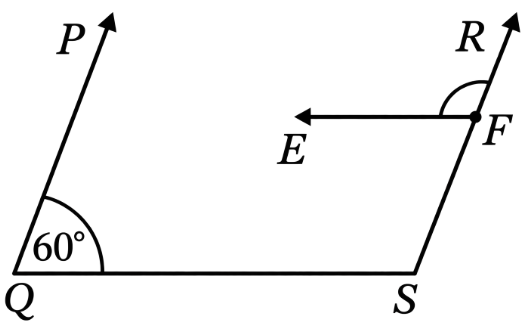
To find the measure of angle \( \angle RFE \), we can use the properties of parallel lines and corresponding angles. Given that \( QS \parallel EF \) and \( RS \parallel PQ \), we can deduce the relationships between the angles.
Correct Option: C) 120°
This problem involves setting up and solving a system of linear equations based on the given age relationships. We will define variables for the father's age and the sum of the children's ages at present, then formulate equations for the present and for 6 years later. Solving these equations will give us the father's current age.
Define variables:
Let \(F\) be the current age of the father.
Let \(S\) be the current sum of the ages of his two children.
Formulate the first equation (present age):
According to the problem, Father’s age is three times the sum of ages of his two children.
Formulate the second equation (after 6 years):
After 6 years, the father's age will be \(F + 6\).
For the children, each child's age will increase by 6 years. Since there are two children, the sum of their ages will increase by \(6 + 6 = 12\) years. So, the sum of their ages after 6 years will be \(S + 12\).
The problem states that after 6 years, his age will be twice the sum of the ages of both the children.
\[ F + 6 = 2(S + 12) \]\[ F + 6 = 2S + 24 \]\[ F = 2S + 18 \quad \text{(Equation 2)} \]Solve the system of equations:
We have two equations:
Equation 1: \(F = 3S\)
Equation 2: \(F = 2S + 18\)
Substitute Equation 1 into Equation 2:
\[ 3S = 2S + 18 \]\[ 3S - 2S = 18 \]\[ S = 18 \]Find the father's age:
Now that we have the value of \(S\), substitute it back into Equation 1 to find \(F\):
Verify the solution:
Present: Father = 54, Sum of children's ages = 18. (\(54 = 3 \times 18\), which is true)
After 6 years: Father = \(54 + 6 = 60\). Sum of children's ages = \(18 + 12 = 30\). (\(60 = 2 \times 30\), which is true)
The calculations are consistent with the problem statement.
Correct Option: C) 54 years
The question asks to identify the first Indian Reserve Forest. This requires knowledge of the history of forest conservation in India, specifically the establishment of the first such designated area.
Correct Option: A) Satpura National Park. The Satpura Forest (now part of the Satpura National Park and Tiger Reserve) was declared India's first Reserve Forest in 1865. This marked a significant step in forest conservation under British India.
The question asks to identify the festival mainly celebrated in the Vadakkunnathan temple of Kerala. This requires knowledge of prominent festivals associated with specific temples in India, particularly in Kerala.
A) Thrissur Pooram is the most famous and grandest temple festival celebrated annually at the Vadakkunnathan Temple in Thrissur, Kerala. It is a spectacular event involving various temples participating in a grand procession to the Vadakkunnathan Temple grounds.