
The problem asks us to find the sum of two consecutive odd natural numbers whose squares sum up to 74. We can solve this by representing the consecutive odd numbers algebraically, forming an equation based on the given condition, and then solving for the numbers. Finally, we calculate their sum.
A) 12 is the sum of the two consecutive odd natural numbers, 5 and 7, whose squares add up to 74.
The question asks to identify the specific flagship program launched by the Union Government to address pollution, conservation, and rejuvenation of the River Ganga. This requires knowledge of major government initiatives related to the Ganga River.
B) Namami Gange Programme: This program was launched in June 2014 by the Union Government as a flagship program with a budget outlay of Rs. 20,000 crore to accomplish the twin objectives of effective abatement of pollution, conservation, and rejuvenation of the National River Ganga. It is a comprehensive mission that integrates various efforts for cleaning and protecting the river.
To determine if washing soda is a base, an acidic salt, a neutral salt, or a basic salt, we need to understand its chemical formula and how it behaves in an aqueous solution. Washing soda is chemically known as sodium carbonate, \(\text{Na}_2\text{CO}_3\).
D) a basic salt — Washing soda (\(\text{Na}_2\text{CO}_3\)) is derived from a strong base (\(\text{NaOH}\)) and a weak acid (\(\text{H}_2\text{CO}_3\)). Salts formed from a strong base and a weak acid undergo anionic hydrolysis in water, producing hydroxide ions and making the solution basic. Therefore, washing soda is a basic salt.
This question involves understanding Mendel's laws of inheritance, specifically the Law of Dominance and the concept of a dihybrid cross. We need to identify the dominant and recessive traits for seed shape and seed color in pea plants and then determine the phenotype of the F₁ generation when two pure-breeding parents with contrasting traits are crossed.
D) round and yellow seeds. The F₁ generation will be heterozygous (RrYy) for both traits, expressing the dominant phenotypes: round seed shape and yellow seed color.
This is a logical reasoning problem involving sequencing events based on given clues. We need to determine the travel month for each of the seven colleagues (A, B, C, D, E, F, G) who travelled in seven different months (April to October 2019). We will use a table to systematically fill in the information as we deduce it from the clues.
List the months: The months are April, May, June, July, August, September, October.
Clue 1: E travelled in the month immediately before B, who travelled in the month of October.
This is a direct clue. B travelled in October. E travelled immediately before B, so E travelled in September.
| Month | Colleague |
|---|---|
| April | |
| May | |
| June | |
| July | |
| August | |
| September | E |
| October | B |
Clue 2: Exactly two people travelled after C’s trip.
Since there are 7 months, and 2 people travelled after C, C must have travelled in the \(7 - 2 = 5^{\text{th}}\) month. Counting from April, the 5th month is August.
| Month | Colleague |
|---|---|
| April | |
| May | |
| June | |
| July | |
| August | C |
| September | E |
| October | B |
Clue 3: C travelled between the trips of E and F.
We know C travelled in August and E travelled in September. For C to be between E and F, F must have travelled before C. So, F travelled in July.
| Month | Colleague |
|---|---|
| April | |
| May | |
| June | |
| July | F |
| August | C |
| September | E |
| October | B |
Clue 4: Exactly four people travelled after D’s trip.
Since there are 7 months, and 4 people travelled after D, D must have travelled in the \(7 - 4 = 3^{\text{rd}}\) month. Counting from April, the 3rd month is June.
| Month | Colleague |
|---|---|
| April | |
| May | |
| June | D |
| July | F |
| August | C |
| September | E |
| October | B |
Clue 5: G travelled in the month immediately before A’s trip.
The remaining months are April and May. The only way for G to travel immediately before A is if G travelled in April and A travelled in May.
| Month | Colleague |
|---|---|
| April | G |
| May | A |
| June | D |
| July | F |
| August | C |
| September | E |
| October | B |
Final Check: All colleagues and months are assigned, and all conditions are met.
Answer the question: Who travelled in the month of July? From our table, F travelled in July.
D) F — Based on our step-by-step deduction, F travelled in the month of July.
The question asks to identify the organism in which fermentation takes place. Fermentation is an anaerobic process where organisms convert carbohydrates into alcohol or organic acids. We need to recall which of the given options is known for carrying out fermentation.
Correct Option: C) Yeast
If the radius of a sphere is halved, then the new volume will become _________ the original volume
\( \frac{1}{8} \) times
\( \frac{1}{2} \) times
4 times
8 times
To solve this problem, we need to recall the formula for the volume of a sphere. We will then calculate the original volume and the new volume after the radius is halved, and finally, find the ratio of the new volume to the original volume.
The volume \(V\) of a sphere with radius \(r\) is given by the formula:
\[ V = \frac{4}{3} \pi r^3 \]Let the original radius be \(r_1\). The original volume \(V_1\) is:
\[ V_1 = \frac{4}{3} \pi r_1^3 \]The problem states that the radius of the sphere is halved. So, the new radius \(r_2\) will be:
\[ r_2 = \frac{r_1}{2} \]Substitute the new radius \(r_2\) into the volume formula to find the new volume \(V_2\):
\[ V_2 = \frac{4}{3} \pi r_2^3 \]\[ V_2 = \frac{4}{3} \pi \left(\frac{r_1}{2}\right)^3 \]\[ V_2 = \frac{4}{3} \pi \left(\frac{r_1^3}{2^3}\right) \]\[ V_2 = \frac{4}{3} \pi \frac{r_1^3}{8} \]\[ V_2 = \frac{1}{8} \left(\frac{4}{3} \pi r_1^3\right) \]From step 2, we know that \(V_1 = \frac{4}{3} \pi r_1^3\). Substituting this into the expression for \(V_2\) from step 4:
\[ V_2 = \frac{1}{8} V_1 \]A) \( \frac{1}{8} \) times — As derived in the step-by-step explanation, when the radius is halved, the new volume becomes \( \frac{1}{8} \) of the original volume.
The question asks to identify the Indian state where the Cathedral of Mary Help of Christians is located. This requires knowledge of prominent religious structures and their geographical locations within India.
Correct Option: B) The Cathedral of Mary Help of Christians is a prominent Roman Catholic cathedral located in Shillong, the capital city of Meghalaya. It is an important religious and architectural landmark in the Northeastern part of India.
The problem presents a letter-cluster analogy. We need to identify the pattern relating the first letter-cluster to the second, and the third to the fourth. Once the pattern is identified, we apply it to the fifth letter-cluster to find the missing sixth one.
D) IHCSPM is the correct option as it follows the identified pattern of reversing the first three letters and reversing the last three letters of the original word.
The number of people having six different types of vehicles in a city are shown in the following graph. Study the graph and answer the question.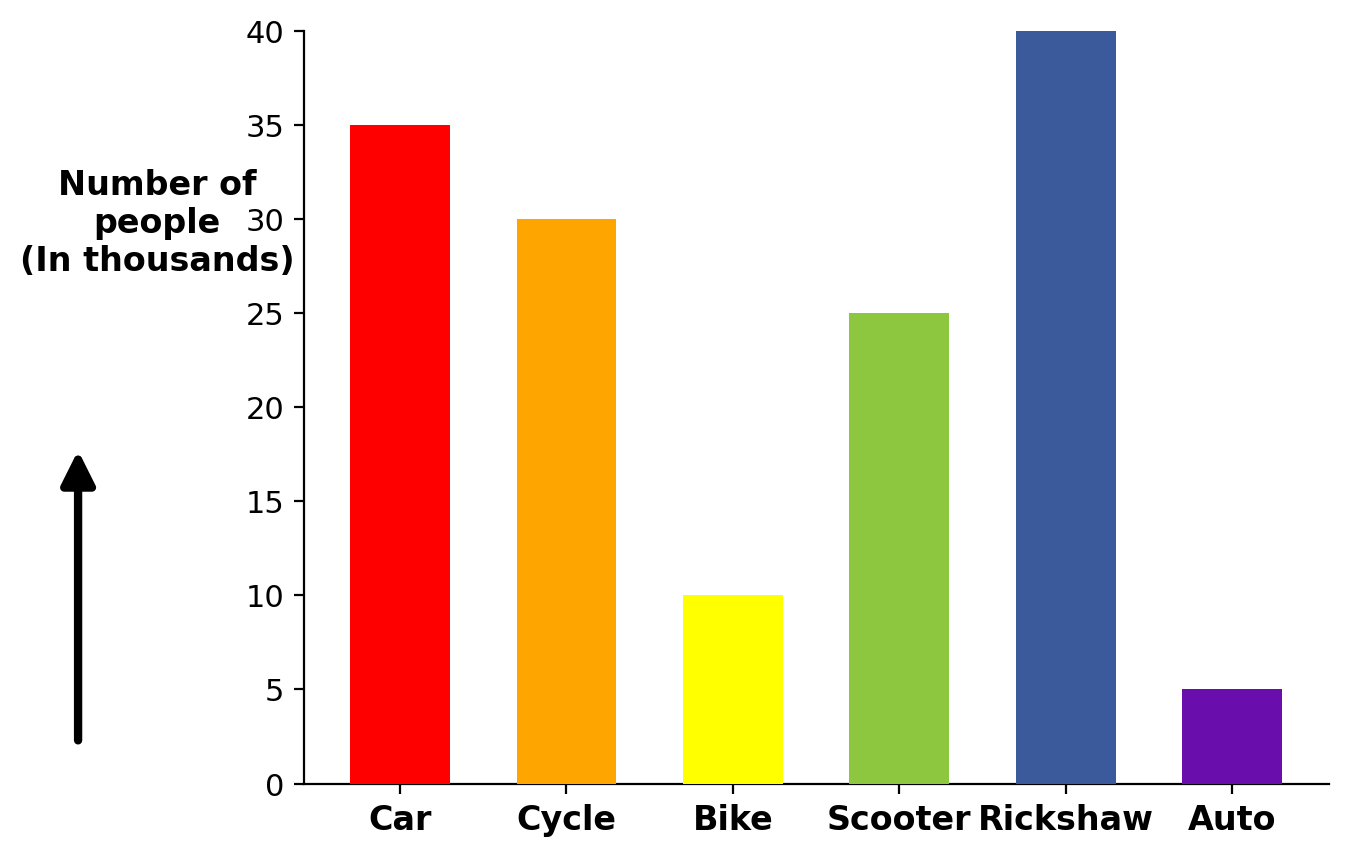
What is the percentage increase in the people having a car as compared to the people having a scooter?
To find the percentage increase in the number of people having a car compared to those having a scooter, we need to use the formula for percentage increase:
Percentage Increase = \[\frac{\text{Increase in number}}{\text{Original number}} \times 100\]
\[ \text{Percentage Increase} = \frac{10,000}{25,000} \times 100 = 40\% \]
Correct Option: A) 40%