
To solve this series problem, we need to identify the pattern or rule that generates the sequence of numbers. We will look for differences between consecutive terms, or relationships involving squares, cubes, or other mathematical operations.
The pattern of the differences is the square of consecutive odd numbers (\(1^2, 3^2, 5^2, 7^2, \dots\)).
Therefore, the missing number is 166.
Correct Option: B) 166
This question tests the understanding of Snell's Law and the behavior of light when it passes from one medium to another (refraction), specifically from air to glass and then from glass to air, as in a prism.
C) Both (a) and (b) are correct because at the air-glass interface, light bends towards the normal (angle of refraction < angle of incidence), and at the glass-air interface, light bends away from the normal (angle of refraction > angle of incidence).
To solve this problem, we need to represent the two consecutive multiples of 6 algebraically. Since they are consecutive multiples of 6, if the first multiple is \(6x\), the next consecutive multiple will be \(6(x+1)\). We can then set up an equation based on their sum being 66 and solve for \(x\).
Let the first multiple of 6 be \(6x\).
Since the multiples are consecutive, the next multiple of 6 will be \(6(x+1)\).
The sum of these two multiples is given as 66. So, we can write the equation:
\[ 6x + 6(x+1) = 66 \]First, distribute the 6 in the second term:
\[ 6x + 6x + 6 = 66 \]Combine like terms:
\[ 12x + 6 = 66 \]Subtract 6 from both sides:
\[ 12x = 66 - 6 \] \[ 12x = 60 \]Divide by 12:
\[ x = \frac{60}{12} \] \[ x = 5 \]The smaller multiple was defined as \(6x\). Substitute the value of \(x=5\):
\[ \text{Smaller multiple} = 6 \times 5 = 30 \]The larger multiple is \(6(x+1) = 6(5+1) = 6 \times 6 = 36\).
Check the sum: \(30 + 36 = 66\), which matches the given information.
Correct Option: C) 30
The problem asks us to arrange a given set of five three-digit numbers in descending order and then identify how many numbers retain their original position. We need to compare the original sequence with the sorted sequence.
The given numbers are: 429, 847, 922, 213, 757.
To arrange them in descending order, we start with the largest number and end with the smallest.
So, the numbers in descending order are: 922, 847, 757, 429, 213.
Let's list the original positions and the new positions after sorting:
| Original Position | Original Number | Sorted Number | New Position |
|---|---|---|---|
| 1st | 429 | 922 | - |
| 2nd | 847 | 847 | 2nd |
| 3rd | 922 | 757 | - |
| 4th | 213 | 429 | - |
| 5th | 757 | 213 | - |
Alternatively, we can write them side-by-side:
Original sequence: 429, 847, 922, 213, 757
Sorted sequence: 922, 847, 757, 429, 213
By comparing the numbers at each position, we can see which numbers remain unchanged:
Only one number, 847, remains in its original position.
A) 1. As determined in the step-by-step analysis, only one number (847) retains its original position after the numbers are arranged in descending order.
The question asks to identify the correct statement regarding biodegradable and non-biodegradable substances. We need to understand the definitions and characteristics of these two types of materials to evaluate each option.
Correct Option: D) Enzymes, bacteria or other saprophytes act on biodegradable substances and decompose them. This statement correctly defines how biodegradable substances are broken down in the environment by biological agents.
The question asks about the general tenure of a Gram Panchayat. This is a factual question related to the structure and functioning of local self-government in India, as enshrined in the Constitution.
Correct Option: C) five
The problem involves two numbers whose initial ratio is given. We are then provided with a scenario where these numbers are modified, leading to a new ratio. We need to set up algebraic equations based on the given ratios and solve for the original numbers, then find their sum.
A) 27 is the sum of the original two numbers.
Study the Venn diagram given below and answer the question that follows.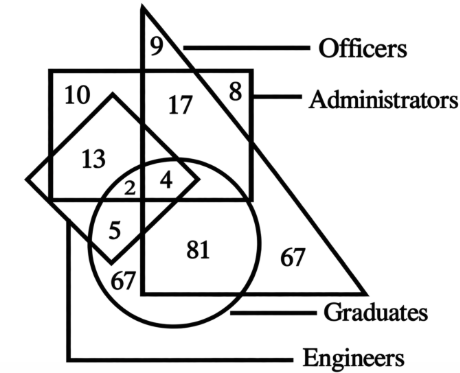
How many non-graduate officers are neither administrators nor engineers?
To determine the number of non-graduate officers who are neither administrators nor engineers, we need to analyze the Venn diagram and identify the relevant sections.
Correct Option: D) 76
We need to find the percentage by which the marked price (MP) is more than the cost price (CP). We are given information about a discount, free articles, and the overall profit percentage. We will use the relationship between Cost Price, Selling Price, and Marked Price, considering the effective number of articles sold and the discount given.
Let the Cost Price (CP) of one article be \(C\).
Let the Marked Price (MP) of one article be \(M\).
A customer buys 14 articles and gets 2 articles free. So, the customer effectively receives \(14 + 2 = 16\) articles.
The cost to the trader for these 16 articles is \(16C\).
The customer pays for 14 articles. The marked price of these 14 articles is \(14M\).
A 5% discount is given on the marked price of the articles paid for. So, the Selling Price (SP) for the 14 articles is \(14M \times (1 - 0.05) = 14M \times 0.95\).
The trader gains 33% on the entire transaction. This means the Selling Price (SP) is 33% more than the Cost Price (CP) of the articles given away.
So, \(SP = CP \times (1 + \text{Profit Percentage})\).
Substitute the values:
\[ 14M \times 0.95 = 16C \times (1 + 0.33) \]\[ 14M \times 0.95 = 16C \times 1.33 \]Now, we need to find the ratio of M to C:
\[ \frac{M}{C} = \frac{16 \times 1.33}{14 \times 0.95} \]\[ \frac{M}{C} = \frac{16 \times 133}{14 \times 95} \]\[ \frac{M}{C} = \frac{16 \times (7 \times 19)}{ (2 \times 7) \times (5 \times 19)} \]\[ \frac{M}{C} = \frac{16}{2 \times 5} \]\[ \frac{M}{C} = \frac{16}{10} \]\[ \frac{M}{C} = \frac{8}{5} \]The marked price (M) is \(\frac{8}{5}\) times the cost price (C). To find what percentage M is more than C, we calculate:
\[ \text{Percentage more} = \left( \frac{M - C}{C} \right) \times 100\% \]\[ \text{Percentage more} = \left( \frac{\frac{8}{5}C - C}{C} \right) \times 100\% \]\[ \text{Percentage more} = \left( \frac{\frac{8}{5} - 1}{1} \right) \times 100\% \]\[ \text{Percentage more} = \left( \frac{3}{5} \right) \times 100\% \]\[ \text{Percentage more} = 0.6 \times 100\% \]\[ \text{Percentage more} = 60\% \]B) 60% is the correct answer. The marked price of an article is 60% more than its cost price.
The problem asks us to identify which of the given assumptions are implicit in the statement. An implicit assumption is something that is not directly stated but must be true for the statement to make sense or be valid. We need to analyze each assumption in relation to the main statement.
D) Only assumption II is implicit
Assumption II is a direct and logical consequence of the statement that increased tax rates will "hurt the pockets" of the salaried middle class. If their pockets are hurt, it means they have less money, and a common response to having less money is to reduce extra expenditure.