
This is a logical reasoning problem involving ordering based on height. We need to deduce the relative heights of six friends (P, Q, R, S, T, U) using the given clues and identify the second tallest person.
Analyze the first clue: "S is taller than only four other friends."
This means S has exactly four friends shorter than him and one friend taller than him. If we arrange them in descending order of height, S will be the second tallest. Let's represent height with '>'.
\[ \text{Tallest} > \text{S} > \text{Friend}_1 > \text{Friend}_2 > \text{Friend}_3 > \text{Friend}_4 \]
This directly tells us S is the second tallest.
Analyze the second clue: "R is taller than only one friend."
This means R has exactly one friend shorter than him and four friends taller than him. Therefore, R is the second shortest person.
\[ \text{Friend}_1 > \text{Friend}_2 > \text{Friend}_3 > \text{Friend}_4 > \text{R} > \text{Shortest} \]
Analyze the third clue: "T is taller than U but shorter than P."
This gives us the order: \(P > T > U\).
Analyze the fourth clue: "P is not the tallest."
This confirms that P is not the absolute tallest. From step 1, we know S is the second tallest, meaning there is one person taller than S. P cannot be that person because if P were the tallest, then S would be the second tallest, and P would be taller than S. However, the clue states P is not the tallest.
Combine the information:
From step 1, we have: \( \text{Tallest} > S > \text{_} > \text{_} > \text{_} > \text{_} \)
From step 2, we have: \( \text{_} > \text{_} > \text{_} > \text{_} > R > \text{Shortest} \)
From step 3, we have: \( P > T > U \)
From step 4, we know P is not the tallest.
Since S is the second tallest, the order starts with someone taller than S. Let's denote the positions from 1 (tallest) to 6 (shortest).
Position 1: ?
Position 2: S
The remaining friends are P, Q, T, U. We know \(P > T > U\). P cannot be the tallest (Position 1). Since S is Position 2, P must be shorter than S. This means P, T, U must occupy positions 3, 4, 5, or 6.
Given \(P > T > U\), they will occupy three consecutive positions. The only remaining friend is Q. Q must be the tallest (Position 1) because P is not the tallest, and S is the second tallest.
So, the order is:
\( Q > S > P > T > U > R \)
Let's verify this with all clues:
Let's correct the order based on R being the second shortest:
\( \text{Tallest} > \text{_} > \text{_} > \text{_} > \text{R} > \text{Shortest} \)
Combining S (second tallest) and R (second shortest):
\( \text{Tallest} > S > \text{_} > \text{_} > R > \text{Shortest} \)
The remaining friends are P, Q, T, U. We know \(P > T > U\). P is not the tallest. The tallest position must be filled by Q.
So, \( Q > S > \text{_} > \text{_} > R > \text{_} \)
The remaining positions are 3rd, 4th, and 6th. The friends P, T, U must fill positions 3, 4, 5 in that order because \(P > T > U\). But R is already in position 5. This means there's a contradiction if we strictly interpret "R is taller than only one friend" as R being the 5th person in a 6-person group.
Let's re-read: "R is taller than only one friend." This means there is exactly one person shorter than R. This makes R the 5th tallest (or 2nd shortest) out of six people.
So, the height order is:
\( \text{_} > \text{_} > \text{_} > \text{_} > R > \text{_} \)
And S is taller than only four other friends, meaning S is the 2nd tallest:
\( \text{_} > S > \text{_} > \text{_} > R > \text{_} \)
The remaining people are P, Q, T, U. The remaining positions are 1st, 3rd, 4th, 6th.
We have \(P > T > U\). P is not the tallest. This means P cannot be in position 1. Since S is in position 2, P, T, U must be placed after S.
So, the order must be:
\( \text{Tallest} > S > P > T > U > R \)
This order satisfies \(P > T > U\). Now let's check all conditions for this order:
Who is the tallest? Q must be the tallest to fill the first position.
So the final order is: \( Q > S > P > T > U > R \)
The question asks for the second tallest among all friends. Based on our derived order, S is the second tallest.
B) S — As per our step-by-step deduction, S is the second tallest, being taller than P, T, U, and R, and shorter than Q (the tallest).
Study the Venn diagram given below and answer the question that follows.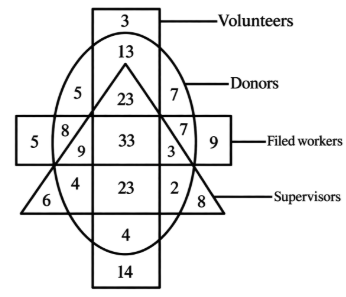
How many Volunteers are Supervisor but neither donors nor field workers?
To solve this problem, we need to identify the number of volunteers who are supervisors but neither donors nor field workers using the Venn diagram provided.
Correct Option: C) 0
The question asks to identify the highest law officer in India. This requires knowledge of the constitutional positions related to legal advisory roles in the Indian government.
Correct Option: B) Attorney General of India is the highest law officer in India. He is the chief legal advisor to the Government of India and represents the Union Government in all its legal matters before the Supreme Court and High Courts. This position is mandated by Article 76 of the Indian Constitution.
To find the missing number in the series, we need to identify the pattern or relationship between consecutive terms. This often involves looking at the differences between numbers, and then the differences of those differences (second-order differences), or identifying a mathematical operation applied to each term.
B) 502 is the correct number that replaces the question mark, as determined by the identified pattern of second-order differences.
The question asks for the term used when a government's expenses exceed its income in a budget. We need to identify the specific economic term that describes this situation.
D) Budget Deficit — A budget deficit occurs when a government's total expenditures exceed its total revenues during a specific period, typically a fiscal year. It signifies that the government is spending more money than it is collecting through taxes and other income sources.
This problem involves substituting given symbol transformations into an equation and then solving it using the order of operations (BODMAS/PEMDAS).
The original equation is: \(40 - 17 \div 3 + 25 \times 5 = ?\)
Applying the transformations:
So, the new equation is:
\[ 40 + 17 \times 3 - 25 \div 5 = ? \]First, perform multiplication and division from left to right.
Multiplication:
\[ 17 \times 3 = 51 \]Division:
\[ 25 \div 5 = 5 \]Substitute these values back into the equation:
\[ 40 + 51 - 5 = ? \]Next, perform addition and subtraction from left to right.
Addition:
\[ 40 + 51 = 91 \]Subtraction:
\[ 91 - 5 = 86 \]Therefore, the value is 86.
C) 86 is the correct answer after applying the symbol transformations and following the order of operations.
Which Fundamental Duty was added through the 86th Constitutional Amendment Act, 2002?
The 11th Fundamental Duty
The 10th Fundamental Duty
The 8th Fundamental Duty
The 9th Fundamental Duty
The question asks about a specific Fundamental Duty added by the 86th Constitutional Amendment Act, 2002. To answer this, one needs to recall the provisions of this amendment, particularly those related to Fundamental Duties.
A) The 11th Fundamental Duty
The 86th Constitutional Amendment Act, 2002, added the 11th Fundamental Duty (Article 51A(k)), which obligates parents/guardians to provide educational opportunities to their children between 6 and 14 years of age. This was done in conjunction with making education a Fundamental Right under Article 21A.
This question tests the understanding of image formation by a concave mirror, specifically when an object is placed at its focal point. We can use the mirror formula or ray tracing rules to determine the image position.
Correct Option: A) infinity
When an object is placed at the focal point (F) of a concave mirror, the reflected rays become parallel to each other. Parallel rays are considered to meet at infinity, thus forming a real, inverted, and highly magnified image at infinity.
This is a logical reasoning problem involving arrangement. We need to deduce the floor occupied by each person based on the given clues and then identify who lives on the topmost floor (floor 6).
Final Arrangement:
The person on the topmost floor is A.
Correct Option: A) A
Study the Venn Diagram given below and answer the question that follows.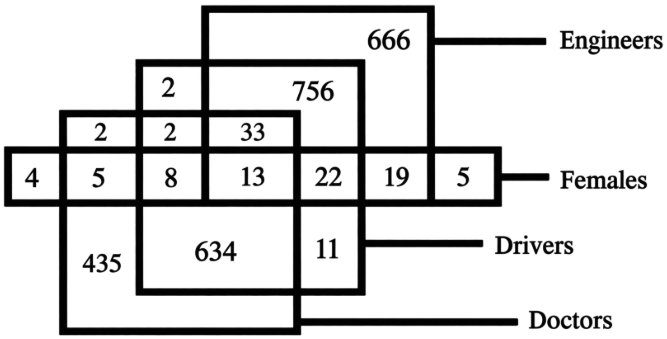
How many female engineers are drivers but NOT doctors?
To find the number of female engineers who are drivers but not doctors, we need to locate the intersection of the sets representing females, engineers, and drivers, excluding any overlap with doctors.
Correct Option: A) 22