
The following bar graph shows the number of coolers sold by shopkeepers A and B in different years. Study the graph and answer the question that follows.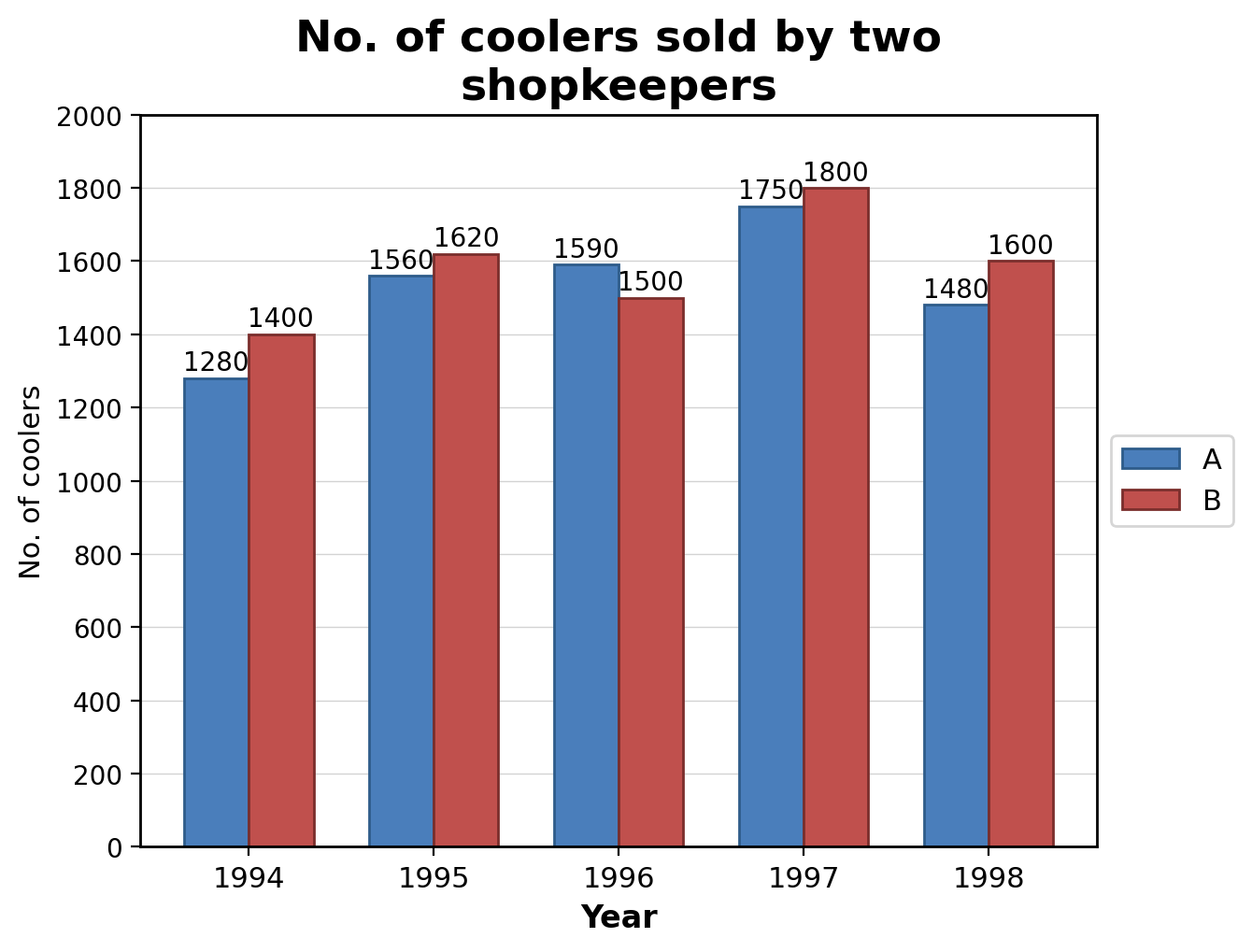
The total number of coolers sold by shopkeeper B in 1995 and 1998 together is approximately what percentage more/less than the total number of coolers sold by the shopkeeper A in 1996 and 1997 together?
To determine the percentage difference between the total number of coolers sold by shopkeeper B in 1995 and 1998 and those sold by shopkeeper A in 1996 and 1997, we need to calculate the totals for each and then find the percentage difference.
Correct Option: A) 4% less
The problem requires us to identify which two numbers, when interchanged in the given equation, will make the equation mathematically correct. We will test each option by interchanging the specified numbers and then evaluating the expression using the BODMAS/PEMDAS rule to see if it equals the right-hand side (701).
The given equation is:
\[ 87 \times 122 - 369 - 13 \div 2 = 701 \]If we interchange 369 and 2, the equation becomes:
\[ 87 \times 122 - 2 - 13 \div 369 \]\[ 10614 - 2 - 0.035 \approx 10612 \]This is not equal to 701. So, option A is incorrect.If we interchange 122 and 13, the equation becomes:
\[ 87 \times 13 - 369 - 122 \div 2 \]Now, we evaluate this expression using BODMAS/PEMDAS:Since \(701 = 701\), this option makes the equation correct.
If we interchange 87 and 2, the equation becomes:
\[ 2 \times 122 - 369 - 13 \div 87 \]\[ 244 - 369 - 0.149 \approx -125.149 \]This is not equal to 701. So, option C is incorrect.If we interchange 87 and 13, the equation becomes:
\[ 13 \times 122 - 369 - 87 \div 2 \]\[ 1586 - 369 - 43.5 \]\[ 1217 - 43.5 = 1173.5 \]This is not equal to 701. So, option D is incorrect.B) 122 and 13 — Interchanging 122 and 13 makes the equation \(87 \times 13 - 369 - 122 \div 2 = 701\), which evaluates to \(1131 - 369 - 61 = 701\), making the equation correct.
If a solid sphere of radius 10 cm is melted into 8 spherical solid balls of equal radius, then what will be the surface area of each such ball? [Use π = \( \frac{22}{7} \)]
319 \( \frac{1}{7} \) cm²
314 \( \frac{2}{7} \) cm²
335 \( \frac{5}{7} \) cm²
324 \( \frac{3}{7} \) cm²
When a solid sphere is melted and recast into smaller solid spheres, the total volume of the material remains constant. We will first calculate the volume of the original large sphere. Then, we will use this volume to find the radius of each small sphere. Finally, we will calculate the surface area of one such small sphere.
Calculate the volume of the large sphere:
Given the radius of the large sphere, \(R = 10 \text{ cm}\).
The formula for the volume of a sphere is \(V = \frac{4}{3} \pi r^3\).
\[ V_{\text{large}} = \frac{4}{3} \pi R^3 = \frac{4}{3} \pi (10)^3 = \frac{4}{3} \pi (1000) = \frac{4000}{3} \pi \text{ cm}^3 \]Calculate the volume of each small sphere:
The large sphere is melted into 8 equal spherical solid balls. Let the radius of each small ball be \(r\).
The total volume of the 8 small balls must be equal to the volume of the large sphere.
\[ 8 \times V_{\text{small}} = V_{\text{large}} \]\[ 8 \times \frac{4}{3} \pi r^3 = \frac{4000}{3} \pi \]Find the radius of each small sphere:
From the equation above, we can solve for \(r\):
\[ 8 \times \frac{4}{3} \pi r^3 = \frac{4000}{3} \pi \]\[ 32 \pi r^3 = 4000 \pi \]\[ r^3 = \frac{4000 \pi}{32 \pi} \]\[ r^3 = \frac{4000}{32} \]\[ r^3 = 125 \]\[ r = \sqrt[3]{125} \]\[ r = 5 \text{ cm} \]Calculate the surface area of each small ball:
The formula for the surface area of a sphere is \(A = 4 \pi r^2\).
Using the radius of the small ball \(r = 5 \text{ cm}\) and \(\pi = \frac{22}{7}\):
\[ A_{\text{small}} = 4 \pi r^2 = 4 \times \frac{22}{7} \times (5)^2 \]\[ A_{\text{small}} = 4 \times \frac{22}{7} \times 25 \]\[ A_{\text{small}} = \frac{88 \times 25}{7} \]\[ A_{\text{small}} = \frac{2200}{7} \]\[ A_{\text{small}} = 314 \frac{2}{7} \text{ cm}^2 \]B) 314 \frac{2}{7} \text{ cm}^2 — This matches our calculated surface area for each small ball.
The problem asks us to identify a set of three numbers that follows the same logical relationship as the given sets: (1, 6, 4) and (3, 15, 9). We need to find a pattern involving the first, second, and third numbers in each set.
Correct Option: C) (9, 25, 7)
The question asks to identify the common name for a mixture of sodium bicarbonate and a mild edible acid. This combination is widely used in cooking and baking due to its leavening properties.
C) baking powder is the correct answer because it is a mixture of sodium bicarbonate and a mild edible acid, designed to produce carbon dioxide gas for leavening when mixed with liquid.
The question asks about the energy conversion performed by an electric motor. We need to identify the output energy form when electrical energy is supplied to a motor.
Correct Option: B) mechanical
To solve this problem, we need to compare the original position of each letter in the given word with its position after arranging all the letters in alphabetical order. We will count how many letters retain their original positions.
| F | L | A | G | S | T | O | N | E |
|---|---|---|---|---|---|---|---|---|
| 1 | 2 | 3 | 4 | 5 | 6 | 7 | 8 | 9 |
| A | E | F | G | L | N | O | S | T |
|---|---|---|---|---|---|---|---|---|
| 1 | 2 | 3 | 4 | 5 | 6 | 7 | 8 | 9 |
| Position | Original Word | Alphabetical Order | Unchanged? |
|---|---|---|---|
| 1 | F | A | No |
| 2 | L | E | No |
| 3 | A | F | No |
| 4 | G | G | Yes |
| 5 | S | L | No |
| 6 | T | N | No |
| 7 | O | O | Yes |
| 8 | N | S | No |
| 9 | E | T | No |
The question asks to identify a festival associated with the Indian state of Jharkhand. This requires knowledge of regional festivals in India.
Correct Option: C) Tusu is a popular harvest festival celebrated in Jharkhand, particularly by the tribal communities in the region.
The roots of the quadratic equation x + \( \frac{20}{x} \) = 9 are:
To find the roots of the given equation, we first need to convert it into a standard quadratic equation form \(ax^2 + bx + c = 0\). Once in this form, we can solve for the roots using factorization, the quadratic formula, or by checking the given options.
The given equation is:
\[ x + \frac{20}{x} = 9 \]Multiply the entire equation by \(x\) to remove the fraction. Note that \(x \neq 0\), otherwise the term \( \frac{20}{x} \) would be undefined.
\[ x(x) + x\left(\frac{20}{x}\right) = 9(x) \]\[ x^2 + 20 = 9x \]Move all terms to one side to get the standard form \(ax^2 + bx + c = 0\).
\[ x^2 - 9x + 20 = 0 \]We need to find two numbers that multiply to \(20\) and add up to \(-9\). These numbers are \(-4\) and \(-5\).
\[ x^2 - 4x - 5x + 20 = 0 \]\[ x(x - 4) - 5(x - 4) = 0 \]\[ (x - 4)(x - 5) = 0 \]Set each factor equal to zero to find the roots.
\[ x - 4 = 0 \implies x = 4 \]\[ x - 5 = 0 \implies x = 5 \]Thus, the roots of the quadratic equation are \(4\) and \(5\).
A) 4, 5
As derived in the step-by-step solution, the roots of the equation are \(4\) and \(5\).
The question asks about the arrangement of elements in Dobereiner's Triads. We need to recall the principle behind Dobereiner's classification of elements.
C) down the group with increasing atomic masses - This accurately describes how Dobereiner arranged the elements within his triads to show the relationship between their atomic masses and properties.