
The question asks to identify the trigonometric identity that is NOT true among the given options. We need to recall the fundamental trigonometric identities and check each option against them.
The fundamental trigonometric identities are derived from the Pythagorean theorem applied to a right-angled triangle. Let's consider a right-angled triangle with sides \(a\), \(b\), and hypotenuse \(c\), and an angle \(\theta\). We have:
The Pythagorean theorem states \(a^2 + b^2 = c^2\).
Let's verify each option:
We know that \(\sin^2\theta + \cos^2\theta = 1\). Dividing this by \(\cos^2\theta\) (assuming \(\cos\theta \neq 0\)):
\[ \frac{\sin^2\theta}{\cos^2\theta} + \frac{\cos^2\theta}{\cos^2\theta} = \frac{1}{\cos^2\theta} \]\[ \tan^2\theta + 1 = \sec^2\theta \]\[ \sec^2\theta - \tan^2\theta = 1 \]This identity is true.Starting again from \(\sin^2\theta + \cos^2\theta = 1\). Dividing this by \(\sin^2\theta\) (assuming \(\sin\theta \neq 0\)):
\[ \frac{\sin^2\theta}{\sin^2\theta} + \frac{\cos^2\theta}{\sin^2\theta} = \frac{1}{\sin^2\theta} \]\[ 1 + \cot^2\theta = \csc^2\theta \]\[ \csc^2\theta - \cot^2\theta = 1 \]This identity is true.This is the fundamental Pythagorean identity in trigonometry and is always true.
Let's try to derive this or see if it holds true for any angle. We know that \(\tan\theta = \frac{\sin\theta}{\cos\theta}\) and \(\cot\theta = \frac{\cos\theta}{\sin\theta}\). So,
\[ \tan^2\theta + \cot^2\theta = \left(\frac{\sin\theta}{\cos\theta}\right)^2 + \left(\frac{\cos\theta}{\sin\theta}\right)^2 \]\[ = \frac{\sin^2\theta}{\cos^2\theta} + \frac{\cos^2\theta}{\sin^2\theta} \]\[ = \frac{\sin^4\theta + \cos^4\theta}{\sin^2\theta \cos^2\theta} \]We know that \(\sin^2\theta + \cos^2\theta = 1\). Squaring both sides gives \(( \sin^2\theta + \cos^2\theta )^2 = 1^2\), which expands to \(\sin^4\theta + \cos^4\theta + 2\sin^2\theta \cos^2\theta = 1\).So, \(\sin^4\theta + \cos^4\theta = 1 - 2\sin^2\theta \cos^2\theta\).
Substituting this back into the expression for \(\tan^2\theta + \cot^2\theta\):
\[ \tan^2\theta + \cot^2\theta = \frac{1 - 2\sin^2\theta \cos^2\theta}{\sin^2\theta \cos^2\theta} \]\[ = \frac{1}{\sin^2\theta \cos^2\theta} - 2 \]This expression is generally not equal to 1. For example, if \(\theta = 45^\circ\), then \(\tan 45^\circ = 1\) and \(\cot 45^\circ = 1\). So, \(\tan^2 45^\circ + \cot^2 45^\circ = 1^2 + 1^2 = 1 + 1 = 2\). Since \(2 \neq 1\), the identity \(\tan^2\theta + \cot^2\theta = 1\) is not true.D) \(\tan^2\theta + \cot^2\theta = 1\) is not a true trigonometric identity.
The value of {(234⁵ – 243⁸ + \( \frac{1}{72} \))⁻⁸}⁰ + 8 =
The problem asks us to evaluate a mathematical expression. The key to solving this problem lies in understanding the property of exponents, specifically that any non-zero number raised to the power of zero is equal to 1. We will apply this rule to simplify the given expression.
Identify the main structure of the expression:
\[ \left\{ \left( 234^5 - 243^8 + \frac{1}{72} \right)^{-8} \right\}^0 + 8 \]Observe the outermost exponent, which is \(0\). Recall the exponent rule: for any non-zero number \(a\), \(a^0 = 1\).
Let the entire term inside the curly braces be represented by \(X\). So, we have:
\[ X = \left( 234^5 - 243^8 + \frac{1}{72} \right)^{-8} \]The expression then becomes \(X^0 + 8\). As long as \(X\) is not equal to zero, \(X^0\) will be \(1\).
Let's check if \(X\) can be zero. The term \(234^5\) is a very large positive number. The term \(243^8\) is an even larger positive number. The term \(\frac{1}{72}\) is a small positive fraction. The difference \(234^5 - 243^8\) will be a large negative number. Raising this large negative number (plus \(\frac{1}{72}\)) to the power of \(-8\) will result in a very small positive number (or a very large positive number if the base is negative and the exponent is even, which it is). In any case, it is clear that the value inside the parentheses \(\left( 234^5 - 243^8 + \frac{1}{72} \right)\) is not zero, and therefore, \(X\) will not be zero.
Since \(X \neq 0\), we can apply the rule \(X^0 = 1\).
Substitute this back into the original expression:
\[ \left\{ \left( 234^5 - 243^8 + \frac{1}{72} \right)^{-8} \right\}^0 + 8 = 1 + 8 \]Perform the addition:
\[ 1 + 8 = 9 \]B) 9 — The entire complex expression within the outermost curly braces is raised to the power of 0. Any non-zero number raised to the power of 0 is 1. Since the base is clearly not zero, the term simplifies to 1. Adding 8 to this gives 9.
The question asks to identify the sport in which the Indian men's team won an Olympic medal in 2021. This requires knowledge of India's performance at the Tokyo 2020 Olympics (held in 2021 due to the pandemic).
Correct Option: D) Hockey
The Indian men's hockey team won a bronze medal at the Tokyo 2020 Olympics, which were held in 2021. This was a historic achievement, as it was India's first Olympic medal in hockey since 1980.
Study the given diagram carefully and answer the question. The numbers in different sections indicate the number of things.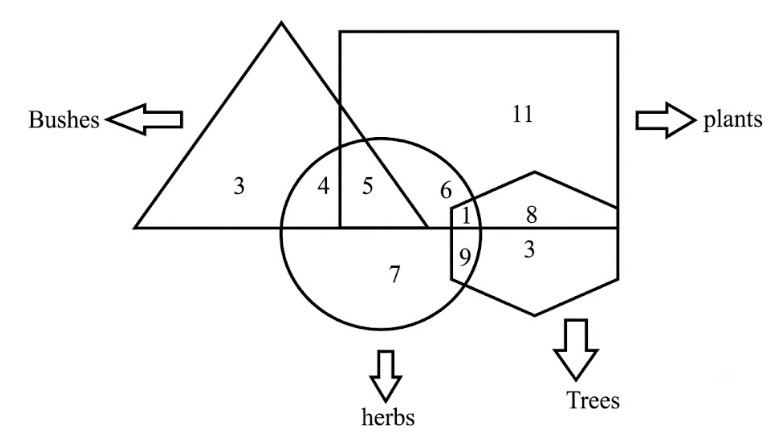
How many such trees are there that are also plants but NEITHER herbs NOR bushes?
To solve this question, we need to identify the section of the diagram that represents trees which are also plants but neither herbs nor bushes.
The number "8" represents trees that are also plants but neither herbs nor bushes.
Correct Option: C) 8
The question asks about the limit of Newlands' Law of Octaves. This law, proposed by John Newlands, arranged elements by increasing atomic weight and noted that every eighth element exhibited similar properties, much like the notes in a musical octave. We need to identify up to which element this periodicity was observed to be valid.
A) Ca (Calcium). Newlands' Law of Octaves was observed to be valid only up to Calcium. After Calcium, the periodicity of properties did not hold true.
To find the height of the image formed by a concave lens, we will use the lens formula and the magnification formula. The lens formula relates the object distance, image distance, and focal length, while the magnification formula relates the image height, object height, image distance, and object distance.
The lens formula is given by:
\[ \frac{1}{f} = \frac{1}{v} - \frac{1}{u} \]Find a common denominator, which is 48:
\[ \frac{1}{v} = -\frac{3}{48} - \frac{2}{48} \]\[ \frac{1}{v} = -\frac{5}{48} \]\[ v = -\frac{48}{5} = -9.6 \text{ cm} \]The magnification formula is given by:
\[ M = \frac{h_i}{h_o} = \frac{v}{u} \]D) 1.0 cm is the correct height of the image formed. The positive sign indicates that the image is erect.
The problem asks for the principal focus (focal length) of a convex mirror given its radius of curvature. We need to apply the relationship between the radius of curvature and focal length, and use the New Cartesian Sign Convention to determine the sign and location of the principal focus.
Correct Option: A) 7.5 cm is the correct answer because the focal length of a convex mirror is half its radius of curvature and is positive according to the New Cartesian Sign Convention, indicating it is located behind the mirror.
The problem asks us to identify the logical relationship between the letter-clusters in the given pairs and then apply the same logic to the options to find the correct one. We need to analyze the positional values of the letters in the English alphabet.
C) CNH : EJN
C = 3, N = 14, H = 8
E = 5, J = 10, N = 14
First letter: C (3) \(\to\) E (5) \((+2)\)
Second letter: N (14) \(\to\) J (10) \((-4)\)
Third letter: H (8) \(\to\) N (14) \((+6)\)
This pair follows the +2, -4, +6 logic. Therefore, option C is the correct answer.
This question is based on the concept of production in microeconomics. It asks us to identify the relationship between the quantity of a variable input and the total output produced when all other inputs are held constant. To answer this, we need to understand the concepts of total product, marginal product, the law of diminishing marginal product, and the law of variable proportions.
Step 1: Understand the production function
A production function shows the relationship between the quantities of inputs used and the maximum quantity of output that can be produced with a given technology.
In the short run, some inputs remain fixed while the quantity of a variable input can be changed.
For example, a firm may increase the number of workers while keeping the amount of machinery and land constant.
Step 2: Understand the relationship between variable input and output
When the quantity of one input changes while all other inputs remain constant, the total quantity of output produced also changes.
The relationship between the quantity of the variable input and the total output produced is called the Total Product (TP) of the variable input.
For example, if a firm employs different numbers of workers while keeping its machinery constant, the total output produced at each level of employment represents the total product of labour.
Step 3: Understand total product
Total Product (TP) refers to the total quantity of output produced by using a particular quantity of the variable input while keeping all other inputs constant.
For example:
When 1 worker produces 10 units, TP = 10 units.
When 2 workers produce 25 units, TP = 25 units.
When 3 workers produce 35 units, TP = 35 units.
These values show how total output changes as the quantity of the variable input increases.
Step 4: Distinguish total product from related concepts
Marginal Product (MP) measures the additional output produced by employing one more unit of the variable input.
MP = Change in Total Product / Change in Variable Input
The law of diminishing marginal product states that, after a certain point, the marginal product of a variable input decreases as more units of that input are employed while other inputs remain fixed.
The law of variable proportions describes how output and marginal product behave when the quantity of one input changes while other inputs remain constant.
These concepts describe changes in production, but the relationship between the variable input and the total output is called total product.
Step 5: Determine the correct answer
The relationship between the quantity of a variable input and the total output produced, keeping all other inputs constant, is called the Total Product of the variable input.
Hence, Option D is the correct answer.
D) Total product of variable input: Total product represents the total output produced at different quantities of a variable input while all other inputs remain constant. It directly describes the relationship mentioned in the question. Hence, Option D is the correct answer.
A) Marginal product: Marginal product measures the additional output obtained from employing one more unit of a variable input. It represents the change in total product rather than the total output associated with different quantities of the variable input. Therefore, this option is incorrect.
B) Law of diminishing marginal product: This law states that marginal product eventually decreases when additional units of a variable input are employed while other inputs remain constant. It describes a particular behaviour of marginal product rather than the name of the relationship between variable input and total output. Therefore, this option is incorrect.
C) Law of variable proportions: This law explains how production changes when the quantity of one input is varied while other inputs remain fixed. It describes the behaviour of production under changing input proportions. However, the specific relationship between the quantity of a variable input and total output is called total product. Therefore, this option is incorrect.
We need to determine the initial quantities of milk and water in the mixture. Then, we will set up an equation to find out how much water needs to be added to achieve the desired ratio, keeping the quantity of milk constant.
The total volume of the mixture is 10 litres.
The ratio of milk to water is 3:2.
Total parts in the ratio \( = 3 + 2 = 5 \).
Quantity of milk \( = \frac{3}{5} \times 10 \text{ litres} = 6 \text{ litres} \).
Quantity of water \( = \frac{2}{5} \times 10 \text{ litres} = 4 \text{ litres} \).
Let \(x\) be the quantity of water to be added.
The new quantity of milk will remain 6 litres.
The new quantity of water will be \( (4 + x) \) litres.
The desired new ratio of milk to water is 2:3.
So, we can write the equation:
\[ \frac{\text{Quantity of Milk}}{\text{Quantity of Water}} = \frac{2}{3} \] \[ \frac{6}{4 + x} = \frac{2}{3} \]Cross-multiply the terms:
\[ 6 \times 3 = 2 \times (4 + x) \] \[ 18 = 8 + 2x \]Subtract 8 from both sides:
\[ 18 - 8 = 2x \] \[ 10 = 2x \]Divide by 2:
\[ x = \frac{10}{2} \] \[ x = 5 \text{ litres} \]Therefore, 5 litres of water must be added to the mixture.
C) 5 litres