
The question asks for the location of the Pachmarhi Bio-reserve. To answer this, one needs to recall the geographical distribution of major bio-reserves in India.
Correct Option: D) The Pachmarhi Bio-reserve is located in the state of Madhya Pradesh. It was declared a Biosphere Reserve by UNESCO in 2009. It encompasses three wildlife conservation units: Bori Sanctuary, Pachmarhi Sanctuary, and Satpura National Park.
The problem requires us to find the correct combination of mathematical signs that, when sequentially placed in the given expression, balance the equation. We need to test each option by substituting the signs into the expression and evaluating both sides of the equation.
The given expression is: \(28 \text{ @ } 7 \text{ @ } 12 \text{ @ } 6 \text{ @ } 8\)
We need to replace the '@' signs with the operators from each option and check if the equation holds true.
Substitute the signs into the expression:
\[ 28 \div 7 \times 12 = 6 - 8 \]Evaluate the left side:
\[ 4 \times 12 = 48 \]Evaluate the right side:
\[ 6 - 8 = -2 \]Since \(48 \neq -2\), Option A is incorrect.
Substitute the signs into the expression:
\[ 28 \times 7 = 12 - 6 \div 8 \]Evaluate the left side:
\[ 28 \times 7 = 196 \]Evaluate the right side:
\[ 12 - \frac{6}{8} = 12 - \frac{3}{4} = \frac{48 - 3}{4} = \frac{45}{4} = 11.25 \]Since \(196 \neq 11.25\), Option B is incorrect.
Substitute the signs into the expression:
\[ 28 \div 7 \times 12 = 6 \times 8 \]Evaluate the left side:
\[ 4 \times 12 = 48 \]Evaluate the right side:
\[ 6 \times 8 = 48 \]Since \(48 = 48\), Option C is correct.
Substitute the signs into the expression:
\[ 28 \times 7 \div 12 = 6 - 8 \]Evaluate the left side:
\[ 196 \div 12 = \frac{196}{12} = \frac{49}{3} \approx 16.33 \]Evaluate the right side:
\[ 6 - 8 = -2 \]Since \(16.33 \neq -2\), Option D is incorrect.
C) \(\div, \times, =, \times\)
When these signs are substituted into the equation, we get:
\[ 28 \div 7 \times 12 = 6 \times 8 \]Evaluating the left side:
\[ (28 \div 7) \times 12 = 4 \times 12 = 48 \]Evaluating the right side:
\[ 6 \times 8 = 48 \]Since \(48 = 48\), the equation is balanced.
To find the profit percentage, we need to calculate the cost price (CP) and selling price (SP) of a single fruit or a common number of fruits. Then, we can use the formula for profit percentage.
Calculate the Cost Price (CP) per fruit:
The man bought 14 fruits for ₹30.
So, the cost of 1 fruit is:
\[ \text{CP per fruit} = \frac{\text{Total Cost}}{\text{Number of Fruits}} = \frac{30}{14} \text{ ₹} \]Calculate the Selling Price (SP) per fruit:
He sold 7 fruits for ₹20.
So, the selling price of 1 fruit is:
\[ \text{SP per fruit} = \frac{\text{Total Selling Price}}{\text{Number of Fruits}} = \frac{20}{7} \text{ ₹} \]Calculate the Profit per fruit:
Profit = SP - CP
\[ \text{Profit per fruit} = \frac{20}{7} - \frac{30}{14} \]To subtract, find a common denominator, which is 14.
\[ \text{Profit per fruit} = \frac{20 \times 2}{7 \times 2} - \frac{30}{14} = \frac{40}{14} - \frac{30}{14} = \frac{40 - 30}{14} = \frac{10}{14} = \frac{5}{7} \text{ ₹} \]Calculate the Profit Percentage:
The formula for profit percentage is:
\[ \text{Profit Percentage} = \left( \frac{\text{Profit}}{\text{CP}} \right) \times 100 \% \]Using the values for profit per fruit and CP per fruit:
\[ \text{Profit Percentage} = \left( \frac{\frac{5}{7}}{\frac{30}{14}} \right) \times 100 \% \]Simplify the fraction:
\[ \text{Profit Percentage} = \left( \frac{5}{7} \times \frac{14}{30} \right) \times 100 \% \] \[ \text{Profit Percentage} = \left( \frac{5 \times 14}{7 \times 30} \right) \times 100 \% \]Cancel common factors (7 into 14 is 2, 5 into 30 is 6):
\[ \text{Profit Percentage} = \left( \frac{1 \times 2}{1 \times 6} \right) \times 100 \% \] \[ \text{Profit Percentage} = \left( \frac{2}{6} \right) \times 100 \% = \left( \frac{1}{3} \right) \times 100 \% \] \[ \text{Profit Percentage} = 33.33 \% \text{ (approximately)} \]Find a common number of fruits:
LCM of 14 and 7 is 14.
Calculate CP for 14 fruits:
Cost of 14 fruits = ₹30 (given).
Calculate SP for 14 fruits:
He sold 7 fruits for ₹20.
So, for 14 fruits, the selling price would be \(2 \times 20 = 40\) ₹.
Calculate Profit:
Profit = SP - CP = ₹40 - ₹30 = ₹10.
Calculate Profit Percentage:
\[ \text{Profit Percentage} = \left( \frac{\text{Profit}}{\text{CP}} \right) \times 100 \% \] \[ \text{Profit Percentage} = \left( \frac{10}{30} \right) \times 100 \% \] \[ \text{Profit Percentage} = \left( \frac{1}{3} \right) \times 100 \% = 33.33 \% \text{ (approximately)} \]Correct Option: D) 33.33%
The question asks to identify the language declared as a 'classical language' by the Government of India in the year 2005. This requires knowledge of the timeline of classical language declarations in India.
C) Sanskrit — Sanskrit was declared a classical language by the Government of India in the year 2005, making it the second language to receive this status after Tamil.
Study the given diagram carefully and answer the question. Indicate the number of persons in different sections.
Florist, Celebrities, Teachers, Doctors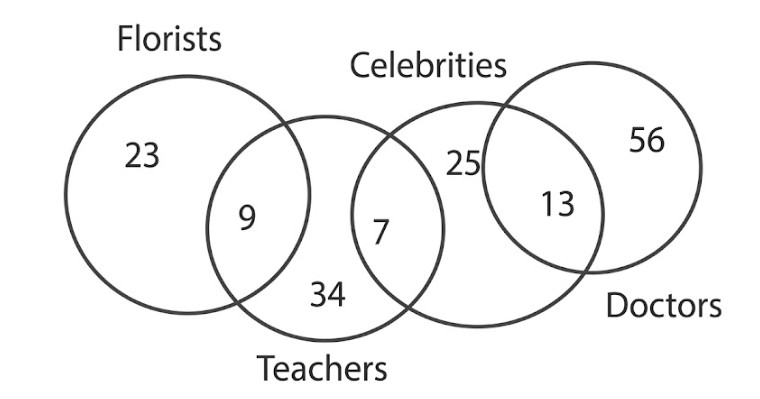
How many such persons are there who are teachers and florists?
The question requires identifying the number of persons who are both teachers and florists, using the provided Venn diagram.
Correct Option: C) 9
To solve this problem, we need to compare the original position of each letter in the given word with its position after arranging all the letters in alphabetical order. We will then count how many letters retain their original positions.
Correct Option: C) 2
The question asks to identify the head of several key governmental bodies and departments in India. This requires knowledge of the administrative structure and the roles of various high-ranking officials.
Based on the above points, the Prime Minister heads all the listed bodies and departments.
Correct Option: C) The Prime Minister is the head of the Nuclear Command Authority (Political Council), NITI Aayog, Appointments Committee of the Cabinet, Department of Atomic Energy, Department of Space, and Ministry of Personnel, Public Grievances and Pensions.
To find the current through the bulb, we can use the fundamental relationship between power, voltage, and current in an electrical circuit. The formula for electrical power is given by \(P = V \times I\), where \(P\) is power, \(V\) is voltage, and \(I\) is current. We are given the power of the bulb and the voltage of the source, so we can rearrange the formula to solve for the current.
The electrical power \(P\) is the product of voltage \(V\) and current \(I\):
\[ P = V \times I \]To find the current, divide the power by the voltage:
\[ I = \frac{P}{V} \]Substitute \(P = 200 \, \text{W}\) and \(V = 220 \, \text{V}\) into the equation:
\[ I = \frac{200 \, \text{W}}{220 \, \text{V}} \]Perform the division:
\[ I = \frac{200}{220} \approx 0.90909... \, \text{A} \]Rounding to two decimal places, the current is approximately \(0.91 \, \text{A}\).
Correct Option: D) 0.91 A
The question asks for the typical measurement of an ostrich egg. This requires general knowledge about the size of an ostrich egg and understanding common units of measurement.
C) 170 mm \(\times\) 130 mm — This measurement converts to 17 cm \(\times\) 13 cm, which is the approximate and realistic size of an ostrich egg. Ostrich eggs are typically around 15-20 cm long and 12-15 cm wide.
This problem involves analyzing inequalities to determine the truthfulness of given conclusions based on a provided statement. We need to combine the parts of the statement and then check each conclusion against the derived combined inequality.
The statement is given as: \(Z > G \geq W\), and \(L < N\).
We can combine the first part of the statement: \(Z > G \geq W\). This implies that \(Z\) is greater than \(G\), and \(G\) is greater than or equal to \(W\).
The second part, \(L < N\), is separate and does not connect to the first part with common variables.
The variable \(V\) is not present in the given statement \(Z > G \geq W\) or \(L < N\). Therefore, we cannot establish any relationship between \(V\) and \(G\) from the given information.
Thus, Conclusion I (\(V < G\)) cannot be determined as true.
From the combined statement \(Z > G \geq W\), we can deduce the relationship between \(Z\) and \(W\).
Combining these, if \(Z\) is greater than \(G\), and \(G\) is greater than or equal to \(W\), it logically follows that \(Z\) must be greater than \(W\). That is, \(Z > W\).
Conclusion II states \(Z < W\). This directly contradicts our derived relationship \(Z > W\).
Thus, Conclusion II (\(Z < W\)) is definitely false.
Since neither Conclusion I can be determined as true nor Conclusion II is true (it's false), neither conclusion is true.
Correct Option: C) Neither conclusion I nor II is true