
If the perimeter of one face of a cube is 24 cm, then its volume is:
To find the volume of a cube, we first need to determine the length of its side. We are given the perimeter of one face of the cube. Since each face of a cube is a square, we can use the perimeter formula for a square to find the side length. Once the side length is known, we can calculate the volume of the cube using the formula \(V = s^3\).
Correct Option: A) 216 cm\(^3\)
Study the given diagram carefully and answer the question. The numbers in different sections indicate the number of persons. Which of the following statements is correct on the basis of the above diagram?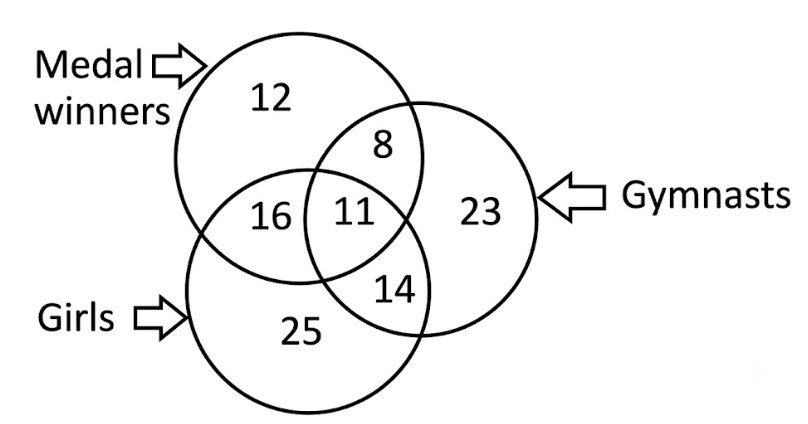
The number of girls who are also gymnasts is 41
The number of gymnasts who are also medal winners is 34.
The number of medal winners who are also girls is 27
The number of girls who are neither gymnasts nor medal winners is 23
The diagram is a Venn diagram showing the distribution of people among three categories: Girls, Gymnasts, and Medal winners. Each section of the diagram indicates the number of persons belonging to the intersecting categories.
Correct Option: C) The number of medal winners who are also girls is 27
In this question, a statement is followed by two conclusions. Which of the two conclusions is/are true with respect to the statement?
Statement:
P ≤ Q < F = R ≥ M = B
Conclusions:
I. R > P
II. F < B
Only conclusion I is true
Both conclusions I and II are true
Neither conclusion I nor II is true
Only conclusion II is true
This question involves analyzing a given inequality statement to determine the truthfulness of two conclusions. We need to combine the parts of the statement to establish relationships between the variables mentioned in the conclusions.
The given statement is: \(P \le Q < F = R \ge M = B\)
Let's break down the statement and evaluate each conclusion.
From the statement, we have the following chain:
Combining these, we get: \(P \le Q < F = R\)
This implies that \(P \le Q\) and \(Q < F\). Since \(Q < F\), it means \(Q\) is strictly less than \(F\). And since \(F = R\), we can substitute \(R\) for \(F\).
So, we have \(P \le Q\) and \(Q < R\).
If \(P \le Q\) and \(Q < R\), then it must be true that \(P < R\). For example, if \(P=5\), \(Q=5\), and \(R=6\), then \(P < R\). If \(P=4\), \(Q=5\), and \(R=6\), then \(P < R\). In all cases where \(P \le Q\) and \(Q < R\), \(P\) will always be strictly less than \(R\).
Therefore, \(R > P\) is true.
From the statement, we have the following chain:
Combining these, we get: \(F = R \ge M = B\)
This implies that \(F = R\) and \(R \ge M\) and \(M = B\).
Substituting \(B\) for \(M\) and \(F\) for \(R\), we get \(F \ge B\).
The conclusion states \(F < B\). However, our derived relationship is \(F \ge B\), which means \(F\) is greater than or equal to \(B\). This contradicts \(F < B\).
Therefore, \(F < B\) is false.
A) Only conclusion I is true
This question asks about the trends in atomic properties across a period in the periodic table, specifically from Lithium (Li) to Fluorine (F). We need to understand how atomic number, nuclear charge, force of attraction, and atomic radius change as we move from left to right in a period.
B) increases, increases, increases, decreases
This option correctly describes all the trends: atomic number increases, nuclear charge increases, force of attraction increases, and atomic radius decreases.
The question asks to identify the nodal agency responsible for releasing key economic data such as national income, consumption expenditure, savings, and capital formation in India since 1956. This requires knowledge of the functions of various government statistical and financial bodies.
D) Central Statistics Office — The Central Statistics Office (CSO), established in 1951 and later merged into the National Statistical Office (NSO) in 2019, has been the primary agency responsible for the compilation and release of national accounts statistics, including national income, consumption expenditure, savings, and capital formation, since 1956. It plays a crucial role in providing official statistics for economic planning and policy formulation in India.
This problem involves setting up equations based on the given information about the ages of Srinivas and his wife. We will use variables to represent their current ages, then use the information about their age difference and their average age after 5 years to solve for the girl's present age.
Define variables for present ages:
Let Srinivas's present age be \(S\) years.
Let the girl's present age be \(G\) years.
Formulate the first equation based on age difference:
The girl is 4 years younger than Srinivas. So, we can write:
Determine their ages after 5 years:
After 5 years, Srinivas's age will be \(S + 5\) years.
After 5 years, the girl's age will be \(G + 5\) years.
Formulate the second equation based on average age after 5 years:
Their average age after 5 years will be 33 years. The average of two people's ages is the sum of their ages divided by 2.
Simplify and solve the second equation:
Multiply both sides by 2:
Substitute Equation 1 into Equation 2:
Substitute \(S = G + 4\) into Equation 2:
Solve for G (the girl's present age):
\[ 2G = 56 - 4 \]\[ 2G = 52 \]\[ G = \frac{52}{2} \]\[ G = 26 \]Find Srinivas's present age (optional, but good for verification):
Using Equation 1: \(S = G + 4 = 26 + 4 = 30\) years.
Verify the average age after 5 years:
After 5 years, Srinivas's age will be \(30 + 5 = 35\) years.
After 5 years, the girl's age will be \(26 + 5 = 31\) years.
Average age after 5 years: \[\frac{35 + 31}{2} = \frac{66}{2} = 33\] years. This matches the given information.
Correct Option: B) 26 years
The question asks to identify which type of emergency is NOT declared by the President under the Indian Constitution. We need to recall the three types of emergencies explicitly mentioned in the Constitution and compare them with the given options.
C) Article 358 - Public health emergency. The Indian Constitution does not provide for a "Public health emergency" under Article 358 or any other article. Article 358 deals with the suspension of fundamental rights guaranteed by Article 19 during a National Emergency declared under Article 352, not with a public health emergency.
The question asks about the launch of the ICMR/DHR Policy on Biomedical Innovation in February 2022. This requires knowledge of current affairs and the portfolios of key government ministers at that time.
Correct Option: A) Mansukh Mandaviya — He was the Union Minister for Health and Family Welfare when the ICMR/DHR Policy on Biomedical Innovation was launched in February 2022. He launched the policy to promote innovation, research, and entrepreneurship in the biomedical sector.
This problem involves setting up and solving a system of linear equations based on the given ratios of ages at different points in time. We will use variables to represent the present ages and then form equations based on the information provided for one year ago and four years hence.
Let the present age of Saketh be \(S\) years.
Let the present age of Tilak be \(T\) years.
One year ago, Saketh's age was \((S-1)\) and Tilak's age was \((T-1)\).
The ratio of their ages was 5:6.
\[ \frac{S-1}{T-1} = \frac{5}{6} \]\[ 6(S-1) = 5(T-1) \]\[ 6S - 6 = 5T - 5 \]\[ 6S - 5T = 1 \quad \text{(Equation 1)} \]Four years hence (from the present), Saketh's age will be \((S+4)\) and Tilak's age will be \((T+4)\).
The ratio of their ages will be 6:7.
\[ \frac{S+4}{T+4} = \frac{6}{7} \]\[ 7(S+4) = 6(T+4) \]\[ 7S + 28 = 6T + 24 \]\[ 7S - 6T = 24 - 28 \]\[ 7S - 6T = -4 \quad \text{(Equation 2)} \]We have two linear equations:
1) \(6S - 5T = 1\)
2) \(7S - 6T = -4\)
To eliminate \(T\), multiply Equation 1 by 6 and Equation 2 by 5:
Multiply Equation 1 by 6:
\[ 6 \times (6S - 5T) = 6 \times 1 \]\[ 36S - 30T = 6 \quad \text{(Equation 3)} \]Multiply Equation 2 by 5:
\[ 5 \times (7S - 6T) = 5 \times (-4) \]\[ 35S - 30T = -20 \quad \text{(Equation 4)} \]The present age of Saketh is \(S = 26\) years.
Correct Option: D) 26 years
Which is a quadratic equation?
(x3 - 4x + 5 = 0)
x3 + 2x2 + 1 = 0
x - x3 + 3x2 - 5 = 0
(x + 3)2 = 0
A quadratic equation is a polynomial equation of the second degree, meaning it contains at least one term in which the variable is raised to the power of two, and no term with a higher power. Its general form is \(ax^2 + bx + c = 0\), where \(a\), \(b\), and \(c\) are real numbers and \(a \neq 0\). We need to examine each option to determine which one fits this definition.
Correct Option: D) \((x + 3)^2 = 0\)