
Study the given arrangement of numbers and answer the question that follows:
(LEFT) 2 8 3 6 0 8 1 5 3 7 3 4 9 6 2 4 3 2 5 6 4 0 7 (RIGHT)
Based on the arrangement given, three of the following four groups (given in options) are alike in a certain way and so form a group, which option does NOT belong to that group?
The problem asks us to identify the group of three numbers that does not follow the same pattern as the others, based on their positions in the given sequence of numbers. We need to find the positions of the numbers in each option and determine the relationship between them.
Correct Option: B) 462
The question asks for the distance between the pole and the center of curvature of a concave mirror, given its radius of curvature. This distance is a fundamental definition in spherical mirrors.
Correct Option: D) The distance between the pole and the center of curvature is defined as the radius of curvature. Given the radius of curvature is \(100 \text{ cm}\), this distance is also \(100 \text{ cm}\).
In quadrilateral ABCD, we have AD = 9 cm, BC = 8 cm and CD = 17 cm, AD ⟂ AB and diagonal BD ⟂ BC. Find the area of quadrilateral ABCD.
The problem asks for the area of a quadrilateral ABCD given specific side lengths and perpendicularity conditions. We can break down the quadrilateral into two right-angled triangles, calculate their individual areas, and sum them up to find the total area.
D) 114 cm² is the correct area of the quadrilateral ABCD.
The question asks for the specific theme adopted by the United Nations for International Women's Day in 2022. To answer this, one needs to recall or know the official UN theme for that particular year. International Women's Day themes change annually, reflecting current global priorities and challenges related to gender equality.
Correct Option: D) Gender Equality Today for a Sustainable Tomorrow
To find the median of a given set of data, we first need to arrange the data in ascending order. Then, we identify the number of observations. If the number of observations is odd, the median is the middle value. If the number of observations is even, the median is the average of the two middle values.
Correct Option: A) 21 is the median of the given data set.
Select the option that represents the letters that, when placed from left to right in the same sequence in the blanks below, will complete the letter series.
Q_T_T_BT_TQB_RT
The question asks for the term that best describes a system with multiple levels of government within a country. We need to evaluate each option based on its political definition.
Correct Option: A) Federalism is a system of government in which power is divided between a central authority and various constituent units (like states or provinces). This division ensures the existence of more than one level of government, each with its own jurisdiction.
Which of the following options is the closest approximate value which will come in place of the question mark (?) in the following equation?
?² + 157.99 = 206.01 + 1.99
The problem asks for the approximate value of a variable represented by a question mark in an equation. We need to simplify the equation by performing the given arithmetic operations and then find the square root to determine the approximate value of the variable. Since it asks for an approximate value, we can round off the numbers to the nearest whole numbers to simplify calculations.
C) 7 — As calculated, \(?^2 = 50\), and \(\sqrt{50}\) is approximately 7, since \(7^2 = 49\).
We need to determine the shortest person among six friends (A, B, C, D, E, F) based on the given height comparisons. We will deduce their relative heights step-by-step to establish the complete or partial order and identify the shortest individual.
"Only one person is shorter than E."
This implies that E is the second shortest person. If we arrange them from tallest to shortest, E will be in the 5th position.
_ _ _ _ E _
"Only two people are taller than D."
This means D is the third tallest person. If we arrange them from tallest to shortest, D will be in the 3rd position.
_ _ D _ E _
"F is not the tallest."
From step 2, we know the first two positions are taller than D. F cannot be in the 1st position. So, F must be in the 2nd position, as there are only two people taller than D, and F is one of them but not the tallest.
_ F D _ E _
Now, let's combine the information. We have 6 positions for height in decreasing order (Tallest to Shortest):
P1 > P2 > P3 > P4 > P5 > P6
From step 1, E is P5 (second shortest).
From step 2, D is P3 (third tallest).
From step 3, F is P2 (second tallest, since F is not P1 and is taller than D).
So far, the order is: _ F D _ E _
"A is shorter than F but taller than C."
We know F is P2. A is shorter than F, so A cannot be P1 or P2. A is taller than C. This means C is shorter than A.
Let's fill in the remaining positions. We have A, B, C left to place in P1, P4, P6.
The remaining positions are P1, P4, P6. The remaining friends are A, B, C.
Therefore, the order is: B > F > D > A > E > C.
From this complete order, C is the shortest among all the friends.
C) C — Based on the step-by-step deduction, C occupies the last position in the height order (shortest).
Study the figure given below carefully. Which option is correct regarding the non-appearance of blue colour in test tube ‘B’?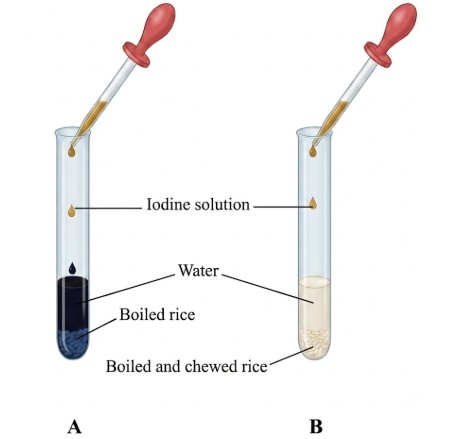
Starch was digested by pepsin in the saliva
Starch was digested by trypsin in the saliva
Starch was digested by salivary amylase in the saliva
Starch was digested by lipase in the saliva
The question involves understanding the role of enzymes in the digestion of starch. The diagram shows two test tubes: A and B. Test tube A contains boiled rice and water, while test tube B contains boiled and chewed rice. Iodine solution is added to both test tubes to test for the presence of starch.
Correct Option: C) Starch was digested by salivary amylase in the saliva