
To solve this problem, we first need to calculate the initial speed of the car using the given distance and time. Then, we will reduce the speed by 5 km/h to find the new speed. Finally, we will use this new speed to calculate the time required to cover the new distance of 250 km.
The formula for speed is:
\[ \text{Speed} = \frac{\text{Distance}}{\text{Time}} \]Given initial distance = 275 km and initial time = 5 hours.
\[ \text{Initial Speed} = \frac{275\ \text{km}}{5\ \text{h}} = 55\ \text{km/h} \]The speed is reduced by 5 km/h.
\[ \text{New Speed} = \text{Initial Speed} - 5\ \text{km/h} \]\[ \text{New Speed} = 55\ \text{km/h} - 5\ \text{km/h} = 50\ \text{km/h} \]The formula for time is:
\[ \text{Time} = \frac{\text{Distance}}{\text{Speed}} \]Given new distance = 250 km and new speed = 50 km/h.
\[ \text{Time} = \frac{250\ \text{km}}{50\ \text{km/h}} = 5\ \text{h} \]A) 5 hr is the correct answer. After reducing the speed, the car will take 5 hours to cover a distance of 250 km.
The question asks for the specific period for which the Scheme of Assistance to National Sports Federations (NSFs) has been extended. This is a factual question related to government schemes and policies in the sports sector.
Correct Option: D) 2022 and 2026
The Union Cabinet approved the continuation of the "Scheme of Assistance to National Sports Federations (NSFs)" for the 15th Finance Commission Cycle, which spans from 2022-23 to 2025-26. This translates to the period between 2022 and 2026.
In this question, a group of numbers/symbols is coded using letters as per the table given below and the conditions which follow. The correct combination of codes following the conditions is your answer.
| Number/Symbol | 4 | % | 7 | 3 | # | * | 9 | @ | 6 |
| Code | X | N | B | J | H | L | Y | F | R |
Conditions:
1. If the first element is an even number and the last an odd number, the codes for these two (the first and the last elements) are to be interchanged.
2. If the first element is an odd number and the last an even number, the first and last elements are to be retained as it is (i.e., first and last elements won’t get coded).
Question: 7 * % 3 @ 6
The problem requires us to code a given sequence of numbers/symbols based on a provided table and two conditions. We need to first identify the codes for each element and then apply the conditions based on the first and last elements of the sequence.
Analyze the given sequence: The sequence to be coded is 7 * % 3 @ 6.
Identify the first and last elements: The first element is 7 (an odd number) and the last element is 6 (an even number).
Apply Condition 2: Condition 2 states: "If the first element is an odd number and the last an even number, the first and last elements are to be retained as it is (i.e., first and last elements won’t get coded)."
Since the first element (7) is odd and the last element (6) is even, this condition applies. Therefore, 7 and 6 will not be coded and will remain as they are in the final code.
Code the middle elements using the table:
Combine the coded and uncoded elements:
Starting element: 7 (retained as per condition 2)
Coded elements: L N J F
Ending element: 6 (retained as per condition 2)
Combining these gives: 7 L N J F 6.
A) 7LNJF6 is the correct combination of codes following the given conditions.
Match the following:
| Substance | pH |
| i. Lemon juice | a. 14 |
| ii. Gastric juice | b. 1.2 |
| iii. Milk of magnesia | c. 2.2 |
| iv. Sodium hydroxide solution | d. 10 |
i - c, ii - b, iii - d, iv - a
i - d, ii - b, iii - c, iv - a
i - c, ii - b, iii - a, iv - d
i - a, ii - b, iii - c, iv - d
The question asks us to match common substances with their approximate pH values. Understanding the pH scale and the nature (acidic, neutral, or basic) of these substances is key to solving this problem.
Based on these matches, we get:
Comparing this with the given options, option A matches our findings.
Correct Option: A) i - c, ii - b, iii - d, iv - a
The question asks for the rule used to determine the direction of the force experienced by a current-carrying conductor placed in a magnetic field. This is a fundamental concept in electromagnetism, specifically related to the motor effect.
Correct Option: B) Fleming's left-hand rule is used to determine the direction of the force on a current-carrying conductor kept inside a magnetic field. This rule is crucial for understanding the working principle of electric motors.
As of July 2022, PM-VIKAS is aligned to the 15th Finance Commission cycle period up to _______ and is a Central Sector (CS) scheme under the Ministry of Minority Affairs.
The question asks for the end year of the 15th Finance Commission cycle, to which the PM-VIKAS scheme is aligned. This requires knowledge of the tenure of the 15th Finance Commission.
B) 2025-26 — The 15th Finance Commission's recommendations are for the period 2021-22 to 2025-26. Thus, PM-VIKAS, being aligned with this cycle, will run up to 2025-26.
Find the roots of the equation 6p2 - 5p - 6 = 0.
\( \frac{3}{4} \) and \( \frac{3}{2} \)
\( \frac{-2}{3} \) and \( \frac{3}{2} \)
\( \frac{-1}{3} \) and \( \frac{4}{3} \)
\( \frac{2}{3} \) and \( \frac{2}{3} \)
To find the roots of a quadratic equation of the form \(ax^2 + bx + c = 0\), we can use either factorization (splitting the middle term) or the quadratic formula. In this case, we will use the factorization method.
B) \( \frac{-2}{3} \) and \( \frac{3}{2} \) — This matches the roots calculated by factorization.
Study the given diagram carefully and answer the following question. The numbers in different sections indicate the number of people who like different flavors of ice-cream.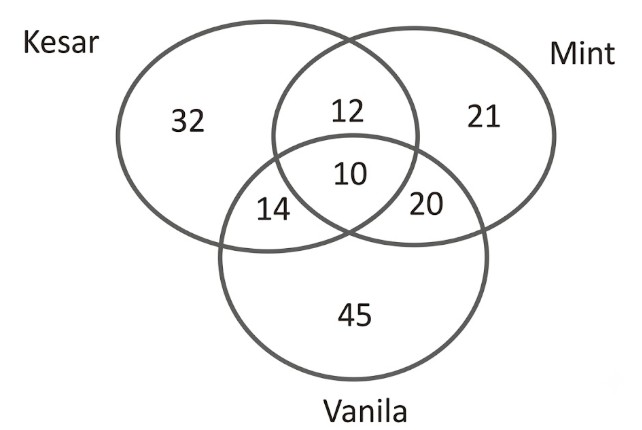
How many people like Mint but NOT Kesar flavored ice-cream?
To find the number of people who like Mint but NOT Kesar flavored ice-cream, we need to analyze the Venn diagram provided.
The number 21 is in the Mint circle but outside the intersection with the Kesar circle.
Correct Option: D) 41