
A magnesium ribbon burns with a dazzling flame in air (oxygen) and changes into a white substance 'X'. The X is:
The question describes a chemical reaction where magnesium ribbon burns in air (oxygen) to form a white substance. We need to identify this white substance, 'X', based on the principles of chemical reactions, specifically combustion.
Correct Option: D) MgO
When magnesium ribbon burns in air (oxygen), it undergoes a combustion reaction to form magnesium oxide. This is a common chemical reaction demonstrated in chemistry, and magnesium oxide is a white powdery substance.
To determine the direction of the magnetic field around a current-carrying straight wire, we use the Right-Hand Thumb Rule (also known as Maxwell's Corkscrew Rule). This rule helps visualize the direction of the magnetic field lines when the direction of the current is known.
A) anticlockwise in a plane perpendicular to the wire. As per the Right-Hand Thumb Rule, with the current flowing from west to east (away from the observer at the east end), the magnetic field lines will be anticlockwise in a plane perpendicular to the wire.
To determine which element has the largest atomic radius, we need to understand the trends in atomic radius across the periodic table. Atomic radius generally increases down a group and decreases across a period from left to right.
C) Iodine has the largest atomic radius. It is in Period 5, Group 17, meaning it has 5 electron shells, which is more than any other element listed, thus resulting in the largest atomic size.
The question asks to identify the first Indian state to launch an AVGC (Animation, Visual Effects, Gaming, and Comics) Centre of Excellence. This is a factual question related to current affairs and state-level initiatives in the technology and creative sectors.
A) Karnataka — Karnataka launched India's first AVGC Centre of Excellence (CoE) in Bengaluru. This initiative aims to promote skill development, entrepreneurship, and job creation in the Animation, Visual Effects, Gaming, and Comics sector, which is a rapidly growing industry globally and in India.
The twinkling of stars is a phenomenon caused by atmospheric refraction. To understand why planets do not twinkle, we need to compare how stars and planets appear from Earth and how their light is affected by the Earth's atmosphere.
Correct Option: B) they act as extended sources of light. This is the primary reason why planets do not twinkle. Their larger apparent size means that atmospheric disturbances average out, preventing noticeable fluctuations in brightness.
The question asks to identify the specific Article in the Constitution of India that outlines the duties of the Prime Minister regarding furnishing information to the President. This requires knowledge of the Articles related to the Union Executive.
Correct Option: A) Article 78 of the Constitution of India explicitly deals with the duties of the Prime Minister as respects the furnishing of information to the President, etc. It mandates the Prime Minister to communicate all decisions of the Council of Ministers relating to the administration of the affairs of the Union and proposals for legislation to the President, and to provide any information that the President may request.
To determine which pair is NOT coprime, we need to understand the definition of coprime numbers. Two numbers are coprime (or relatively prime) if their greatest common divisor (GCD) is 1. We will find the GCD for each given pair of numbers.
Correct Option: A) (17, 34) is the pair that is NOT coprime because their greatest common divisor is 17, not 1.
Study the given diagram carefully and answer the following question. The numbers in different sections indicate the number of persons who have suffered from different diseases.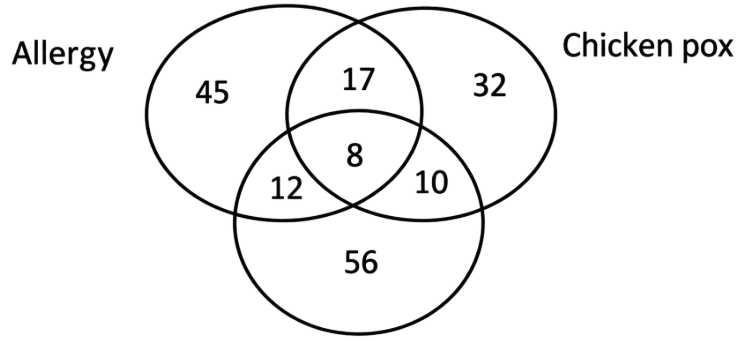
How many people have suffered from both Allergy and Chickenpox but NOT Common Cold?
To solve this problem, we need to identify the number of people who have suffered from both Allergy and Chickenpox but not from Common Cold. This involves analyzing the Venn diagram and identifying the correct section.
Correct Option: D) 17
This question asks about the consequences for a plant if its rate of respiration exceeds its rate of photosynthesis. To answer this, we need to understand the fundamental processes of photosynthesis and respiration in plants and their relationship to energy production, food synthesis, and growth.
Correct Option: C) More food will be oxidized than that produced, and the plant will starve and die