
The problem presents a series of number pairs and asks us to find the missing number in the last pair based on the relationship observed in the previous pairs. We need to identify a consistent mathematical operation or pattern that relates the first number to the second number in each given pair.
Correct Option: D) 323
Select the number from among the given options that can replace the question mark (?) in the following series.
12, 10, 11.5, 10.5, 11, 11, 10.5, 11.5, 10,?
The given series appears to be an alternating series or a combination of two interleaved series. We will analyze the pattern by looking at alternate terms or by finding the difference/ratio between consecutive terms.
Let's write down the series:
12, 10, 11.5, 10.5, 11, 11, 10.5, 11.5, 10, ?
Upon closer inspection, we can identify two interleaved series:
Let's extract the terms for each series:
Series 1: 12, 11.5, 11, 10.5, 10
Let's find the pattern in Series 1:
This series is decreasing by 0.5 each time. The next term in this series would be \(10 - 0.5 = 9.5\), but this is not the term we are looking for.
Series 2: 10, 10.5, 11, 11.5, ?
Let's find the pattern in Series 2:
This series is increasing by 0.5 each time. The question mark (?) is the next term in Series 2 (the 10th term in the original sequence).
Therefore, the next term in Series 2 will be:
\(11.5 + 0.5 = 12\)
So, the number that replaces the question mark is 12.
Correct Option: D) 12
Select the number from among the given options that can replace the question mark (?) in the following series.
1.6, 2.3, 3, 3.7, 4.4, 5.1, 5.8, 6.5, ?, 7.9, 8.6
The problem presents a series of numbers and asks us to find the missing number. We need to identify the pattern or relationship between consecutive numbers in the series.
\(6.5 + 0.7 = 7.2\)
B) 7.2 — The common difference between consecutive terms is \(0.7\). Adding \(0.7\) to \(6.5\) gives \(7.2\).
To find the quadratic equation when its roots are given, we can use the relationship between the roots and the coefficients of a quadratic equation. If \(\alpha\) and \(\beta\) are the roots of a quadratic equation, the equation can be written as \(x^2 - (\alpha + \beta)x + \alpha\beta = 0\).
Identify the given roots: The roots of the quadratic equation are given as \(3\) and \(-7\). Let \(\alpha = 3\) and \(\beta = -7\).
Calculate the sum of the roots: The sum of the roots is \(\alpha + \beta\). \[ \alpha + \beta = 3 + (-7) = 3 - 7 = -4 \]
Calculate the product of the roots: The product of the roots is \(\alpha\beta\). \[ \alpha\beta = (3) \times (-7) = -21 \]
Form the quadratic equation: The general form of a quadratic equation with roots \(\alpha\) and \(\beta\) is: \[ x^2 - (\alpha + \beta)x + \alpha\beta = 0 \] Substitute the sum and product of the roots into this equation: \[ x^2 - (-4)x + (-21) = 0 \] \[ x^2 + 4x - 21 = 0 \]
Thus, the quadratic equation is \(x^2 + 4x - 21 = 0\).
D) \(x^2 + 4x - 21 = 0\) is the correct equation derived from the given roots.
If the numerator of a fraction be increased by 10% and its denominator be reduced by 5%, then the fraction becomes \( \frac{4}{5} \). Find the original fraction.
\(\frac{22}{55}\)
\(\frac{38}{55}\)
\(\frac{17}{25}\)
\(\frac{19}{25}\)
To find the original fraction, we will represent it with variables for the numerator and denominator. Then, we will apply the given percentage changes to these variables to form a new fraction. This new fraction will be equated to the given resulting fraction, and we will solve the resulting equation to find the original fraction.
Correct Option: B) \( \frac{38}{55} \)
Let the longer side of the rectangle be \(L\) and the shorter side be \(W\). We are given two conditions: first, the shorter side is 10 cm less than the longer side, and second, the numerical value of its area is equal to 6 times the numerical value of its perimeter. We will set up equations based on these conditions and solve for \(L\).
Let the length of the longer side be \(L\) cm.
According to the problem, the shorter side is 10 cm less than the longer side. So, the width \(W\) will be:
\[ W = L - 10 \text{ cm} \]The area of a rectangle is given by \( \text{Area} = L \times W \).
Substituting \(W = L - 10\):
\[ \text{Area} = L(L - 10) = L^2 - 10L \text{ cm}^2 \]The perimeter of a rectangle is given by \( \text{Perimeter} = 2(L + W) \).
Substituting \(W = L - 10\):
\[ \text{Perimeter} = 2(L + L - 10) = 2(2L - 10) = 4L - 20 \text{ cm} \]The numerical value of its area is equal to 6 times the numerical value of its perimeter.
\[ \text{Area} = 6 \times \text{Perimeter} \]\[ L^2 - 10L = 6(4L - 20) \]Expand the right side:
\[ L^2 - 10L = 24L - 120 \]Rearrange the terms to form a standard quadratic equation \(ax^2 + bx + c = 0\):
\[ L^2 - 10L - 24L + 120 = 0 \]\[ L^2 - 34L + 120 = 0 \]Solve this quadratic equation. We can use factorization. We need two numbers that multiply to 120 and add up to -34. These numbers are -30 and -4.
\[ L^2 - 30L - 4L + 120 = 0 \]\[ L(L - 30) - 4(L - 30) = 0 \]\[ (L - 30)(L - 4) = 0 \]This gives two possible values for \(L\):
\[ L - 30 = 0 \implies L = 30 \text{ cm} \]\[ L - 4 = 0 \implies L = 4 \text{ cm} \]If \(L = 4\) cm, then the shorter side \(W = L - 10 = 4 - 10 = -6\) cm. A length cannot be negative, so \(L = 4\) cm is not a valid solution.
If \(L = 30\) cm, then the shorter side \(W = L - 10 = 30 - 10 = 20\) cm. Both lengths are positive, which is valid.
The length of the longer side is 30 cm.
C) 30
The problem presents a series of alphanumeric terms. Each term consists of a number followed by three letters. We need to identify the pattern in the numbers and the letters separately to find the missing term.
The numbers in the series are 17, 20, 23, 26. Let's find the difference between consecutive numbers:
The numerical sequence is an arithmetic progression with a common difference of 3. So, the next number will be \(26 + 3 = 29\).
The first letters are K, T, C, L. Let's find their positions in the alphabet (A=1, B=2, ...):
Let's look at the difference between their positions, considering a 26-letter alphabet cycle:
The first letter follows a pattern of adding 9 to its alphabetical position, cycling through the alphabet. So, the next first letter will be 9 positions after L:
The second letters are D, M, V, E. Let's find their positions in the alphabet:
Let's look at the difference between their positions:
The second letter also follows a pattern of adding 9 to its alphabetical position, cycling through the alphabet. So, the next second letter will be 9 positions after E:
The third letters are P, Y, H, Q. Let's find their positions in the alphabet:
Let's look at the difference between their positions:
The third letter also follows a pattern of adding 9 to its alphabetical position, cycling through the alphabet. So, the next third letter will be 9 positions after Q:
The next number is 29. The next first letter is U. The next second letter is N. The next third letter is Z.
Therefore, the complete term is 29UNZ.
Correct Option: B) 29UNZ
Study the Venn diagram given below and answer the question that follows.
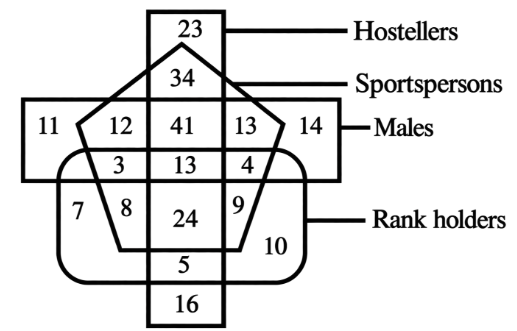
How many hosteller sportspersons are NOT males but rank holders?
To solve this problem, we need to identify the individuals who are hostellers, sportspersons, rank holders, but not males, using the Venn diagram provided.
The correct answer is the number of individuals in this specific region, which is 24.
Correct Option: C) 24
Three pipes, A, B and C can fill a tank in 5 hours, 8 hours and 12 hours, respectively. If all the pipes are opened at the same time, then the time taken to fill the tank is:
4 \( \frac{22}{49} \) hours
2 \( \frac{22}{49} \) hours
5 \( \frac{22}{49} \) hours
3 \( \frac{22}{49} \) hours
To find the time taken to fill the tank when all pipes are opened together, we first calculate the individual work rate (fraction of the tank filled per hour) for each pipe. Then, we sum these individual rates to get the combined work rate. Finally, the total time taken is the reciprocal of the combined work rate.
When all pipes are opened together, their work rates add up.
\[ \text{Combined work rate} = \frac{1}{5} + \frac{1}{8} + \frac{1}{12} \]To add these fractions, find the least common multiple (LCM) of the denominators (5, 8, 12). The LCM of 5, 8, and 12 is 120.
\[ \text{Combined work rate} = \frac{1 \times 24}{5 \times 24} + \frac{1 \times 15}{8 \times 15} + \frac{1 \times 10}{12 \times 10} \]\[ \text{Combined work rate} = \frac{24}{120} + \frac{15}{120} + \frac{10}{120} \]\[ \text{Combined work rate} = \frac{24 + 15 + 10}{120} = \frac{49}{120} \text{ (of the tank per hour)} \]The time taken is the reciprocal of the combined work rate.
\[ \text{Time taken} = \frac{1}{\text{Combined work rate}} = \frac{1}{\frac{49}{120}} = \frac{120}{49} \text{ hours} \]Divide 120 by 49:
\[ 120 \div 49 = 2 \text{ with a remainder of } 120 - (49 \times 2) = 120 - 98 = 22 \]So, the time taken is \(2 \frac{22}{49}\) hours.
B) The calculated time taken to fill the tank is \(2 \frac{22}{49}\) hours, which matches option B.
Study the graph and answer the question.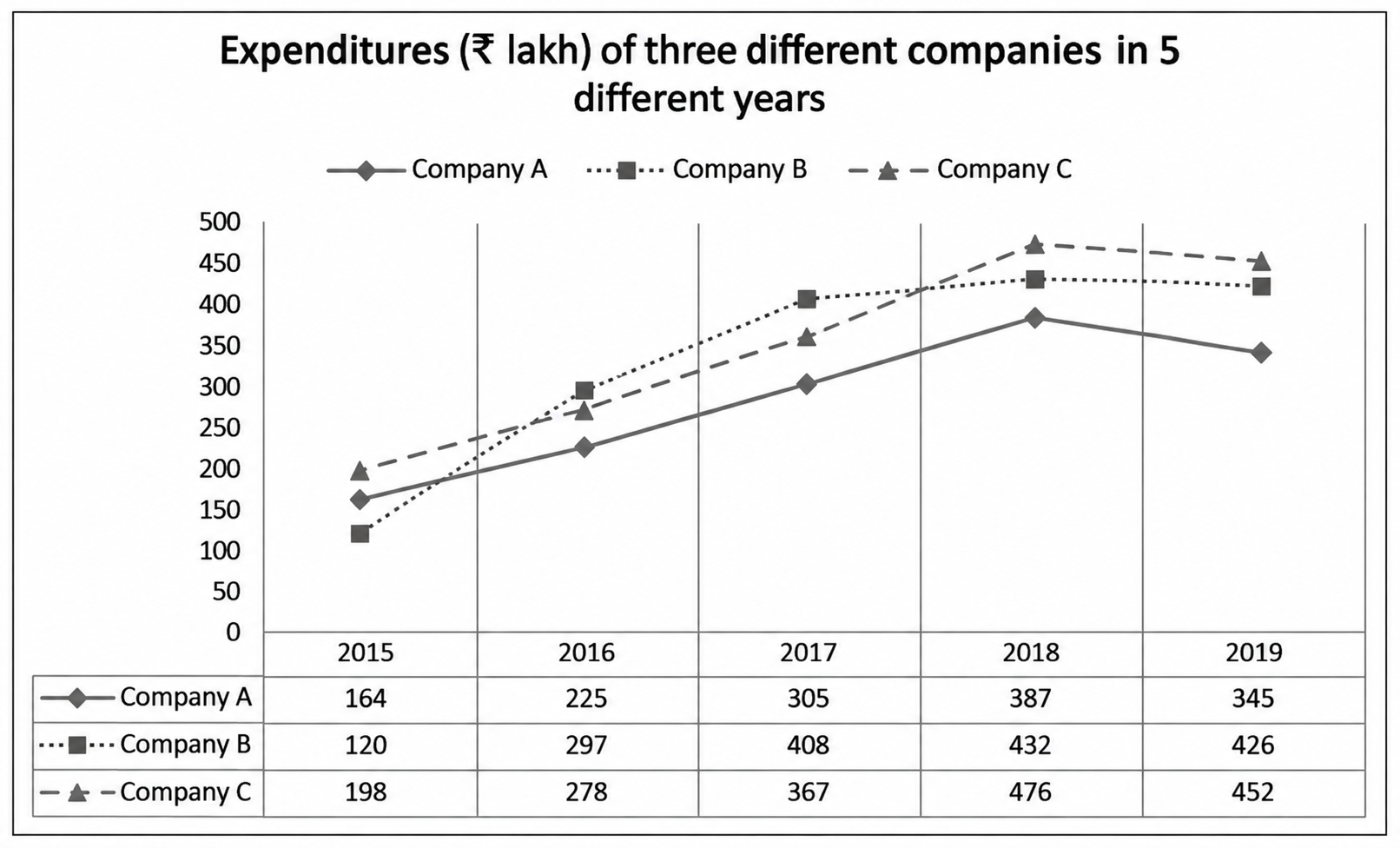
Total expenditure of all three companies together in the year 2018 was what percentage of the total expenditure of company B over all the years together?
To find the percentage of the total expenditure of all three companies together in 2018 relative to the total expenditure of Company B over all the years, we need to calculate the total expenditures and then find the percentage.
The percentage is approximately 76.95%.
Correct Option: C) 76.95%