
To determine the correctness of the statements, we need to recall the properties of salts formed from different combinations of strong/weak acids and bases, specifically focusing on their pH values.
When a strong acid (e.g., HCl) reacts with a strong base (e.g., NaOH), they completely dissociate in water. The resulting salt (e.g., NaCl) consists of ions that do not hydrolyze significantly. For example, \(\text{Na}^+\) is a very weak conjugate acid of a strong base, and \(\text{Cl}^-\) is a very weak conjugate base of a strong acid. Therefore, these ions do not react with water to produce \(\text{H}^+\) or \(\text{OH}^-\) ions in excess. As a result, the solution remains neutral, and its pH value is 7 at \(25^\circ \text{C}\).
Thus, Statement-I is true.
When a strong acid (e.g., HCl) reacts with a weak base (e.g., \(\text{NH}_4\text{OH}\)), the resulting salt (e.g., \(\text{NH}_4\text{Cl}\)) will contain the conjugate acid of the weak base (\(\text{NH}_4^+\)) and the conjugate base of the strong acid (\(\text{Cl}^-\)). The conjugate acid of the weak base (\(\text{NH}_4^+\)) is relatively strong and will hydrolyze in water to produce \(\text{H}^+\) ions:
\[ \text{NH}_4^+ (\text{aq}) + \text{H}_2\text{O} (\text{l}) ightleftharpoons \text{NH}_3 (\text{aq}) + \text{H}_3\text{O}^+ (\text{aq}) \]The conjugate base of the strong acid (\(\text{Cl}^-\)) is very weak and does not hydrolyze significantly. The production of \(\text{H}_3\text{O}^+\) (or \(\text{H}^+\)) ions makes the solution acidic, meaning its pH value will be less than 7.
Thus, Statement-II is true.
Correct Option: B) Both the statements are true.
The question asks for the compounds required to manufacture baking soda. This refers to the Solvay process (also known as the ammonia-soda process), which is the industrial method for producing sodium carbonate, and from which baking soda (sodium bicarbonate) can be obtained.
Correct Option: D) Common salt, carbon dioxide, and ammonia are the essential compounds required for the manufacture of baking soda (\( \text{NaHCO}_3 \)) via the Solvay process.
The problem asks us to find the value of \(x\) given a set of numbers and their mean. We will use the formula for the mean (average) of a set of numbers, which is the sum of all numbers divided by the count of numbers. We will set up an equation and solve for \(x\).
\[ \text{Mean} = \frac{\text{Sum of all observations}}{\text{Number of observations}} \]
\[ 30 = \frac{(22.5 + 56 + 42.5 + (2x+1) + (x-2) + 3x + 36)}{7} \]
\[ 22.5 + 56 + 42.5 + 1 - 2 + 36 = 156 \]
Then, sum the terms involving \(x\):\[ 2x + x + 3x = 6x \]
So the numerator becomes \(156 + 6x\).\[ 30 = \frac{156 + 6x}{7} \]
\[ 30 \times 7 = 156 + 6x \]
\[ 210 = 156 + 6x \]
Subtract 156 from both sides:\[ 210 - 156 = 6x \]
\[ 54 = 6x \]
Divide by 6:\[ x = \frac{54}{6} \]
\[ x = 9 \]
A) 9 is the correct value for \(x\) as derived from the mean formula.
This question tests the understanding of periodic trends, specifically how atomic radius and nuclear charge change across a period in the periodic table. We need to evaluate each statement individually and then determine the relationship between them.
Analyze Statement-I: Atomic radius increases in moving from left to right along a period.
Analyze Statement-II: Nuclear charge increases in moving from left to right along a period.
Evaluate the relationship between the statements.
Correct Option: B) Only Statement-II is correct.
The question asks to identify which of the given diseases is NOT sexually transmitted. We need to recall the modes of transmission for each disease listed in the options.
D) Tuberculosis — Tuberculosis is an airborne disease, primarily affecting the lungs, and is spread through respiratory droplets. It is not classified as a sexually transmitted disease.
Which of the following reactions will be considered as a double displacement reaction?
Zn + FeCl2 → ZnCl2 + Fe
H2CO3 → CO2 + H2O
HCl + KOH → KCl + H2O
MgO + H2O → Mg(OH)2
A double displacement reaction is a type of chemical reaction where two compounds react, and the positive ions (cations) and negative ions (anions) of the two reactants switch places, forming two new compounds. This is often represented by the general equation: \( AB + CD \rightarrow AD + CB \).
Correct Option: C) \( \text{HCl} + \text{KOH} \rightarrow \text{KCl} + \text{H}_2\text{O} \)
To find the total energy supplied by the battery, we first need to calculate the equivalent resistance of the parallel combination of resistors. Then, we can find the total current drawn from the battery using Ohm's Law. Finally, the energy supplied can be calculated using the formula \(E = VIt\) or \(E = \frac{V^2}{R_{eq}}t\).
Correct Option: A) 2.25 J
The question asks to identify the non-metallic form of a mineral from the given options. This requires understanding the classification of minerals into metallic and non-metallic categories.
Correct Option: D) Mica is a non-metallic mineral, characterized by its layered structure and lack of metallic properties. It is used in various industrial applications due to its insulating properties.
The problem presents a series of terms, each consisting of three letters and a number. We need to identify the pattern in both the letters and the numbers to find the missing term.
The numbers in the series are 4, 9, 16, 25. These are perfect squares:
Following this pattern, the next number in the series should be \(6^2 = 36\).
The first letters are T, X, B, F.
Following this pattern, the next first letter should be F + 4 = J (6th + 4 = 10th letter).
The second letters are D, H, L, P.
Following this pattern, the next second letter should be P + 4 = T (16th + 4 = 20th letter).
The third letters are K, O, S, W.
Following this pattern, the next third letter should be W + 4 = A (23rd + 4 = 27th letter, which is A after wrapping around Z).
The next term will have the first letter J, the second letter T, the third letter A, and the number 36. So, the complete term is JTA-36.
A) JTA-36 is correct because it follows all the established patterns for the letters and the number.
In the following diagram, the circle represents girls, the triangle represents science students, and the rectangle represents PG students. The numbers in different sections indicate the number of persons.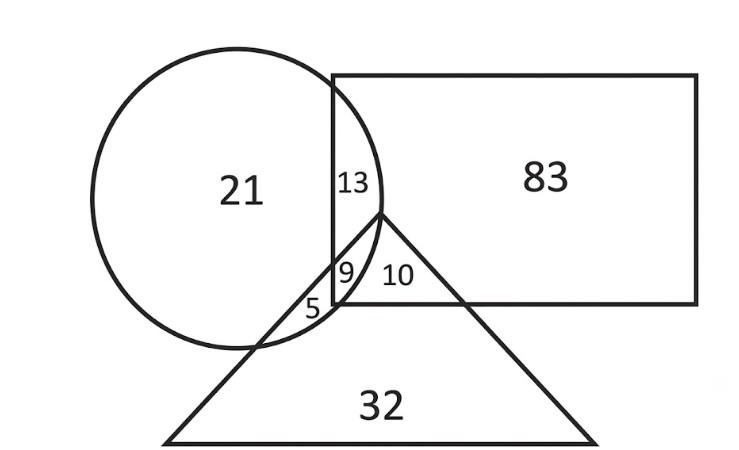
How many PG students are girls who are NOT science students?
To find the number of PG students who are girls but not science students, we need to identify the section of the diagram that overlaps only between the circle (girls) and the rectangle (PG students), excluding the triangle (science students).
Correct Option: D) 13