
Consider two wires, A and B, of same thickness but lengths L and 5L, respectively. If the resistances of A and B are 1.0 Ω and 2.5 Ω, respectively, the ratio of the resistivity of A to the resistivity of B is:
The resistance of a wire is directly proportional to its resistivity and length, and inversely proportional to its cross-sectional area. Since the wires have the same thickness, their cross-sectional areas are equal. We can use the formula for resistance to find the ratio of resistivities.
Recall the formula for resistance:
\[ R = \rho \frac{L}{A} \]where \(R\) is resistance, \(\rho\) is resistivity, \(L\) is length, and \(A\) is the cross-sectional area.
For wire A, we are given:
So, for wire A:
\[ 1.0 = \rho_A \frac{L}{A} \quad \text{(Equation 1)} \]For wire B, we are given:
So, for wire B:
\[ 2.5 = \rho_B \frac{5L}{A} \quad \text{(Equation 2)} \]We need to find the ratio of the resistivity of A to the resistivity of B, i.e., \( \frac{\rho_A}{\rho_B} \).
From Equation 1, we can express \(\rho_A\):
\[ \rho_A = \frac{1.0 \cdot A}{L} \]From Equation 2, we can express \(\rho_B\):
\[ \rho_B = \frac{2.5 \cdot A}{5L} = \frac{0.5 \cdot A}{L} \]Now, calculate the ratio \( \frac{\rho_A}{\rho_B} \):
\[ \frac{\rho_A}{\rho_B} = \frac{\frac{1.0 \cdot A}{L}}{\frac{0.5 \cdot A}{L}} \]The terms \( \frac{A}{L} \) cancel out:
\[ \frac{\rho_A}{\rho_B} = \frac{1.0}{0.5} = 2 \]D) The ratio of the resistivity of A to the resistivity of B is 2.
The value of 20 + \( \frac{24}{7} \) × {(1 ÷ 2) + (2 ÷ 3)} is:
To solve this problem, we need to follow the order of operations, often remembered by the acronym BODMAS/PEMDAS (Brackets/Parentheses, Orders/Exponents, Division and Multiplication, Addition and Subtraction). We will first evaluate the expression inside the curly braces, then perform multiplication, and finally addition.
First, evaluate the expression inside the curly braces: \({(1 \div 2) + (2 \div 3)}\).
\[ (1 \div 2) + (2 \div 3) = \frac{1}{2} + \frac{2}{3} \]To add these fractions, find a common denominator, which is 6.
\[ \frac{1}{2} + \frac{2}{3} = \frac{1 \times 3}{2 \times 3} + \frac{2 \times 2}{3 \times 2} = \frac{3}{6} + \frac{4}{6} = \frac{3+4}{6} = \frac{7}{6} \]Now substitute this value back into the original expression:
\[ 20 + \frac{24}{7} \times \left( \frac{7}{6} \right) \]Next, perform the multiplication:
\[ \frac{24}{7} \times \frac{7}{6} \]The 7 in the numerator and denominator cancel out, and 24 divided by 6 is 4.
\[ \frac{24}{\cancel{7}} \times \frac{\cancel{7}}{6} = \frac{24}{6} = 4 \]Finally, perform the addition:
\[ 20 + 4 = 24 \]Correct Option: C) 24 is the correct value of the given expression.
The question asks about the number of oxygen molecules required to completely oxidize one molecule of glucose during aerobic respiration. This can be determined by looking at the balanced chemical equation for aerobic respiration.
C) Six — The balanced chemical equation for aerobic respiration shows that one molecule of glucose combines with six molecules of oxygen.
The question asks to identify the name of an alkane with 5 carbon atoms, given its general formula. We need to recall the general formula for alkanes and the naming convention for hydrocarbons based on the number of carbon atoms.
Therefore, the compound containing 5 carbon atoms with the general formula \(C_n H_{2n+2}\) is pentane.
B) pentane is correct because it is an alkane with 5 carbon atoms, fitting the general formula \(C_n H_{2n+2}\) for \(n=5\).
To find the value of the given expression, we will convert all trigonometric ratios into their sine and cosine forms. Then, we will simplify the expression using algebraic identities and basic trigonometric identities.
The given expression is \( (\text{cosec } A + \text{cot } A)(1 – \text{cos } A) \).
Recall the fundamental trigonometric identities:
Substitute these identities into the expression:
\[ \left( \frac{1}{\text{sin } A} + \frac{\text{cos } A}{\text{sin } A} \right)(1 – \text{cos } A) \]Combine the terms inside the first parenthesis:
\[ \left( \frac{1 + \text{cos } A}{\text{sin } A} \right)(1 – \text{cos } A) \]Multiply the terms:
\[ \frac{(1 + \text{cos } A)(1 – \text{cos } A)}{\text{sin } A} \]Use the algebraic identity \( (a+b)(a-b) = a^2 - b^2 \). Here, \(a=1\) and \(b=\text{cos } A\):
\[ \frac{1^2 – (\text{cos } A)^2}{\text{sin } A} = \frac{1 – \text{cos}^2 A}{\text{sin } A} \]Recall the Pythagorean identity: \( \text{sin}^2 A + \text{cos}^2 A = 1 \). From this, we can write \( 1 – \text{cos}^2 A = \text{sin}^2 A \).
Substitute this into the expression:
\[ \frac{\text{sin}^2 A}{\text{sin } A} \]Simplify the expression by canceling out one \( \text{sin } A \) term from the numerator and denominator:
\[ \text{sin } A \]A) The simplified value of the expression \( (\text{cosec } A + \text{cot } A)(1 – \text{cos } A) \) is \( \text{sin } A \).
The pH scale is used to measure the acidity or alkalinity of a solution. It ranges from 0 to 14. A pH of 7 is neutral, a pH less than 7 indicates acidity, and a pH greater than 7 indicates alkalinity (basicity).
B) Solution A is acidic, and Solution B is basic. This aligns with our analysis based on the pH values.
This problem involves setting up and solving a system of two linear equations based on the given information about the ages of P and Q. We will define variables for their present ages, translate the word problem into algebraic equations, and then solve these equations simultaneously to find Q's present age.
Thus, Q's present age is 17 years.
Correct Option: C) 17
The question asks about the state of the Indian economy at the time of independence in 1947. To answer this, one needs to recall the economic conditions prevalent during British colonial rule, which were characterized by exploitation and a lack of indigenous industrial development.
C) underdeveloped and stagnant — This accurately describes the Indian economy on the eve of independence. It was 'underdeveloped' due to a lack of industrialization, low productivity in agriculture, and poor infrastructure, and 'stagnant' because there was minimal economic growth or progress over a long period, leading to persistent poverty and backwardness.
Study the Venn Diagram given below and answer the question that follows.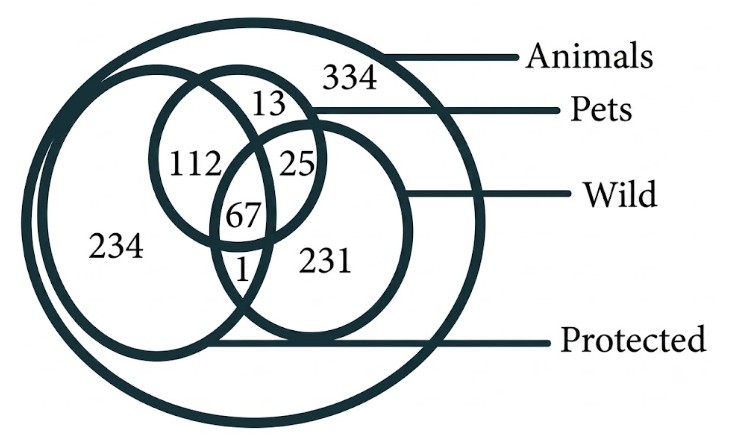
How many animals are pets but not protected?
To find the number of animals that are pets but not protected, we need to analyze the Venn diagram and identify the relevant section.
Correct Option: B) 38
The problem asks us to identify the largest and smallest numbers from a given set of three-digit numbers, then extract specific digits from them, and finally perform an addition operation. We need to follow the steps carefully to avoid errors.
A) 9 is the correct answer because the second digit of the largest number (675) is 7, and the first digit of the smallest number (253) is 2. Their sum is \(7 + 2 = 9\).