
Study the diagram of a dicot seed given below. Select the correct option regarding the functions of the parts labelled A, B and C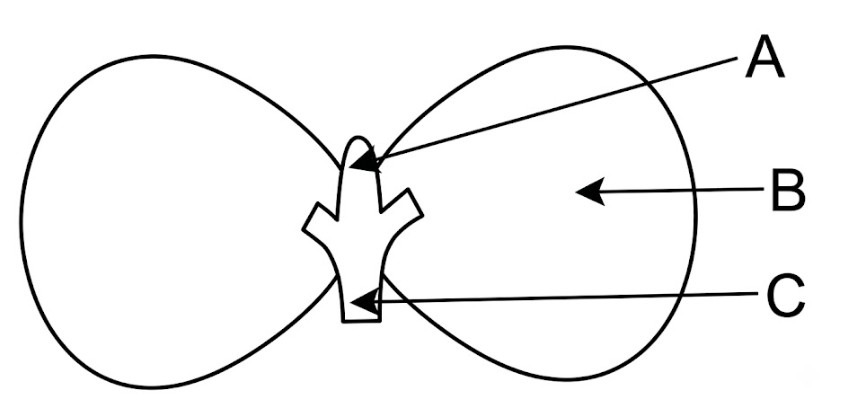
A - Stores food, B - Stores food, C - Future root
A - Future shoot, B - Future root, C - Stores food
A - Future root, B - Stores food, C - Future shoot
A - Future shoot, B - Stores food, C - Future root
To answer this question, we need to identify the parts of a dicot seed and understand their functions. The diagram labels parts of the seed as A, B, and C. We will match these parts with their correct functions.
By matching these parts with their functions, we can determine that the correct option is D: A - Future shoot, B - Stores food, C - Future root.
Correct Option: D) A - Future shoot, B - Stores food, C - Future root
If a and b are the roots of the equation x² - 7x + 12 = 0, then the value of \( \frac{a^3+b^3}{a^2+b^2+1} \) is:
The problem asks us to find the value of an algebraic expression involving the roots of a quadratic equation. We can use Vieta's formulas to find the sum and product of the roots, and then use algebraic identities to simplify the given expression and substitute the values.
C) 3.5 is the calculated value of the expression.
The question asks to identify the tissue responsible for the hardness and stiffness of a coconut husk. This requires knowledge of plant tissues and their functions, specifically focusing on structural support tissues.
B) Sclerenchyma is the tissue that provides hardness and stiffness to plant parts. The coconut husk is rich in sclerenchymatous fibers, which are dead cells with thick, lignified walls, giving it its characteristic tough and fibrous nature.
This problem involves work and wages. The share of payment received by each person is directly proportional to the amount of work they do. We need to calculate the individual work rates, then the combined work rate, and finally determine the fraction of work done by C to find C's share of the total payment.
Calculate the work rate of A:
A alone can complete the work in 4 days. So, A's one day's work is:
\[ \text{A's work rate} = \frac{1}{4} \text{ work/day} \]Calculate the work rate of B:
B alone can complete the work in 6 days. So, B's one day's work is:
\[ \text{B's work rate} = \frac{1}{6} \text{ work/day} \]Calculate the combined work rate of A, B, and C:
With the help of C, they finish the work in 2 days. This means A, B, and C together complete 1 work in 2 days. So, their combined one day's work is:
\[ \text{(A+B+C)'s work rate} = \frac{1}{2} \text{ work/day} \]Calculate C's work rate:
C's one day's work can be found by subtracting A's and B's work rates from the combined work rate of A, B, and C:
\[ \text{C's work rate} = \text{(A+B+C)'s work rate} - \text{A's work rate} - \text{B's work rate} \]\[ \text{C's work rate} = \frac{1}{2} - \frac{1}{4} - \frac{1}{6} \]\[ \text{C's work rate} = \frac{6}{12} - \frac{3}{12} - \frac{2}{12} \]\[ \text{C's work rate} = \frac{6 - 3 - 2}{12} = \frac{1}{12} \text{ work/day} \]Determine the share of work done by each person in 2 days:
Since they worked for 2 days:
As a check, total work done = \[\frac{1}{2} + \frac{1}{3} + \frac{1}{6} = \frac{3+2+1}{6} = \frac{6}{6} = 1\] (complete work).
Calculate C's share in the payment:
The total payment is Rs 600. C's share will be proportional to the work done by C.
\[ \text{C's share} = \text{Total payment} \times \text{Fraction of work done by C} \]\[ \text{C's share} = 600 \times \frac{1}{6} \]\[ \text{C's share} = 100 \]C) Rs 100
The question asks about the number of countries from which features were borrowed for the Indian Constitution. To answer this, we need to recall the major sources of the Indian Constitution.
C) 10 — As listed in the step-by-step explanation, the Indian Constitution borrowed significant features from 10 different countries.
The problem requires us to evaluate two conclusions based on given survey data. We need to determine if each conclusion logically follows directly from the provided percentages without introducing external assumptions or personal opinions.
The statement provides the following preferences from a survey:
The total percentage is \(65 + 28 + 5 + 2 = 100\%\), so all preferences are accounted for.
The statement only provides data on people's preferences (what they preferred), not on the inherent quality or health benefits of the drinks. The fact that more people preferred tea does not objectively make it a "better" drink. The term "better" is subjective and cannot be concluded from preference statistics alone.
From the statement, the percentage of people who preferred coffee is 28%, and the percentage of people who preferred milk is 5%. Comparing these two percentages:
\[ 28\% > 5\% \]This clearly indicates that a higher percentage of people preferred coffee compared to milk. Therefore, this conclusion logically follows from the given data.
B) Only conclusion II follows
The given series is 3, 6, 8, 16, 18, 36, ?. We need to identify the pattern in the series to find the missing number.
The pattern observed is an alternating sequence of multiplying by 2 and adding 2.
Following the established pattern, the next operation after multiplying by 2 (which resulted in 36) should be adding 2.
B) 38 — The series follows an alternating pattern of multiplying by 2 and adding 2. After 36, the next operation is adding 2, so \(36 + 2 = 38\).
The problem presents a series of number pairs and asks us to find the missing number in the last pair based on the relationship observed in the previous pairs. We need to identify a consistent mathematical operation or pattern that transforms the first number into the second number in each given pair.
B) 38 is the correct answer because it follows the established pattern where the second number is obtained by multiplying the first number by 2 and then adding 2.
The question asks about the religious association of the "Easter basket." To answer this, one needs to identify the religion that celebrates Easter and uses symbols like the Easter basket.
Correct Option: A) Christianity — Easter is the most important festival in Christianity, celebrating the resurrection of Jesus Christ. The Easter basket is a common tradition associated with this holiday, often containing Easter eggs, which symbolize new life and resurrection.
Which of the following reactants will come in place of A and give a neutralisation reaction?
Ca(OH)2 + 2A → CaCl2 + 2H2O
Hydrochloric acid
Nitric acid
Sulphuric acid
Acetic acid
The question asks to identify reactant 'A' in a given neutralization reaction. A neutralization reaction involves an acid and a base reacting to form a salt and water. We are given calcium hydroxide, \(\text{Ca(OH)}_2\), which is a base, and the products calcium chloride, \(\text{CaCl}_2\), and water, \(\text{H}_2\text{O}\). We need to find an acid that reacts with \(\text{Ca(OH)}_2\) to produce \(\text{CaCl}_2\) and \(\text{H}_2\text{O}\), and also balances the given equation.
A) Hydrochloric acid is the correct reactant. As determined in the step-by-step analysis, \(\text{HCl}\) is a monoprotic acid that provides the chloride ions needed for \(\text{CaCl}_2\) and balances the reaction stoichiometry.