
The question asks to identify which of the given languages is NOT one of the four largest languages belonging to the Dravidian language family. To answer this, we need to recall the major languages of the Dravidian family and their classifications.
Correct Option: C) Sanskrit
Sanskrit is an ancient Indo-Aryan language, which belongs to the Indo-European family of languages. It is not a part of the Dravidian language family. While it has influenced many Indian languages, including Dravidian ones, it is fundamentally distinct in its origin and linguistic classification.
To find the total number of three-digit numbers divisible by 2 or 5, we will use the Principle of Inclusion-Exclusion. This principle states that for two sets A and B, the number of elements in their union is given by \(|A \cup B| = |A| + |B| - |A \cap B|\). Here, A will be the set of three-digit numbers divisible by 2, and B will be the set of three-digit numbers divisible by 5. The intersection \(A \cap B\) will be the set of three-digit numbers divisible by both 2 and 5 (i.e., divisible by 10).
B) 540 is the correct answer, calculated by applying the Principle of Inclusion-Exclusion to find the count of three-digit numbers divisible by 2 or 5.
The problem involves setting up a system of linear equations based on the given relationships between the ages of the mother, son, and daughter. We will assign variables to their ages, form equations, and then solve for the mother's age.
Define variables:
Let the son's age be \(S\) years.
Let the mother's age be \(M\) years.
Let the daughter's age be \(D\) years.
Formulate equations from the given information:
The sum of their ages is 70 years:
The mother is thrice as old as her son:
\[ M = 3S \quad \text{(Equation 2)} \]The daughter is 5 years older than her brother (son):
\[ D = S + 5 \quad \text{(Equation 3)} \]Substitute Equation 2 and Equation 3 into Equation 1:
Replace \(M\) with \(3S\) and \(D\) with \(S + 5\) in Equation 1:
Solve for \(S\):
Combine like terms:
Calculate the mother's age:
Using Equation 2, \(M = 3S\):
(Optional) Calculate the daughter's age to verify:
Using Equation 3, \(D = S + 5\):
Verify the sum of ages:
\(M + S + D = 39 + 13 + 18 = 70\). This matches the given total, so our calculations are correct.
Correct Option: C) 39 years
Study the following bar graph carefully and answer the question.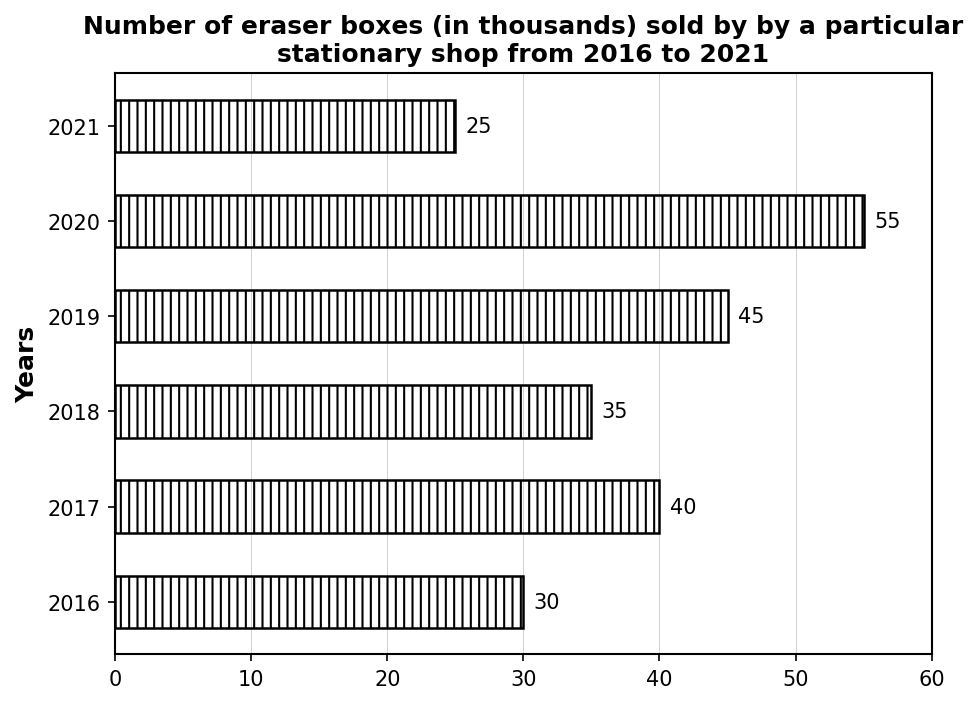
What is the approximate percentage increase in the number of the eraser boxes sold from 2018 to 2020?
To find the percentage increase in the number of eraser boxes sold from 2018 to 2020, we need to calculate the difference in sales between these years and express it as a percentage of the 2018 sales.
Correct Option: C) 57%
The question asks to identify the type of leaves traditionally used for making bidis. This is a factual question related to common knowledge about Indian products and their raw materials.
A) Tendu leaves are widely known and used for wrapping bidis. The leaves are collected, dried, and then used to roll tobacco, forming bidis. This practice is a significant source of livelihood for many tribal and rural communities in central India.
In this question, a group of numbers/symbols is coded using letters as per the table given below and the conditions which follow. The correct combination of codes following the conditions is your answer.
| Number/Symbol | & | 5 | 9 | # | 6 | % | 8 |
| Codes | S | D | M | U | T | L | A |
Conditions:
(i) If the first element is an even number and the last element is also an even number, the codes for these two (the first and the last elements) are to be interchanged.
(ii) If the second element is an even number and the fifth element is a symbol, the codes for these two (the second and the fifth elements) are to be interchanged.
(iii) If the fourth element is a symbol and the sixth element is also a symbol, both these elements (the fourth and the sixth elements) are to be coded as N.
Question: 85 &%9#69
The question asks for the normal systolic and diastolic blood pressure values in humans. This is a fundamental concept in human physiology and is often tested in competitive exams. We need to recall the standard healthy range for blood pressure.
C) 120 and 80 mm of Hg — This option correctly states the normal systolic (120 mm of Hg) and diastolic (80 mm of Hg) blood pressure values for a healthy human adult.
The value of 42 + \(\sqrt{64}\) − 4\(\sqrt{25}\) − 10 =
To solve this problem, we need to evaluate the given expression by following the order of operations (PEMDAS/BODMAS). First, calculate the square roots, then perform multiplication, and finally, addition and subtraction from left to right.
\(4^2 + \sqrt{64} - 4\sqrt{25} - 10\)
First, evaluate \(4^2\):
\[ 4^2 = 4 \times 4 = 16 \]Next, evaluate \(\sqrt{64}\):
\[ \sqrt{64} = 8 \quad (\text{since } 8 \times 8 = 64) \]Then, evaluate \(\sqrt{25}\):
\[ \sqrt{25} = 5 \quad (\text{since } 5 \times 5 = 25) \]The expression becomes:
\[ 16 + 8 - 4(5) - 10 \]Multiply \(4\) by \(5\):
\[ 4(5) = 20 \]Substitute this back:
\[ 16 + 8 - 20 - 10 \]First, \(16 + 8\):
\[ 16 + 8 = 24 \]The expression is now:
\[ 24 - 20 - 10 \]Next, \(24 - 20\):
\[ 24 - 20 = 4 \]Finally, \(4 - 10\):
\[ 4 - 10 = -6 \]Correct Option: B) -6
The question asks to identify the true statements regarding the magnetic field produced by a current-carrying straight conductor. We need to evaluate each statement based on the principles of electromagnetism, specifically Ampere's law and the right-hand thumb rule.
D) Both (i) and (iii) are true statements, as determined from our analysis.
The problem requires us to find the correct sequence of mathematical signs to replace 'Y' in the given equation to make it balanced. We will test each option by substituting the signs into the equation and performing the calculations according to the order of operations (BODMAS/PEMDAS).
The given equation structure is: \(32 \text{ Y } 8 \text{ Y } 16 \text{ Y } 8 \text{ Y } 20\)
We need to find the combination of signs that makes the equation true.
Let's test each option:
B) +, x, =, x
When these signs are substituted, the equation becomes \(32 + 8 \times 16 = 8 \times 20\). Evaluating both sides:
\[ 32 + (8 \times 16) = 32 + 128 = 160 \]\[ 8 \times 20 = 160 \]\[ 160 = 160 \]The equation balances, so this is the correct combination.