
To find the day of the week for a future date, we need to calculate the total number of days between the given date and the target date. Then, we find the remainder when this total number of days is divided by 7 (since there are 7 days in a week). This remainder, known as "odd days," will tell us how many days forward from the starting day of the week the target day will be.
Calculate the number of days remaining in May 2016:
May has 31 days. The given date is 9 May. So, the remaining days in May are:
\[ 31 - 9 = 22 \text{ days} \]Calculate the number of days in June 2016:
June has 30 days.
Calculate the number of days in July 2016:
July has 31 days.
Calculate the number of days in August 2016:
August has 31 days.
Calculate the number of days in September 2016 up to the target date:
The target date is 2 September. So, 2 days.
Calculate the total number of days between 9 May 2016 and 2 September 2016:
\[ \text{Total days} = 22 (\text{May}) + 30 (\text{June}) + 31 (\text{July}) + 31 (\text{August}) + 2 (\text{September}) = 116 \text{ days} \]Calculate the number of odd days:
Divide the total number of days by 7:
\[ 116 \div 7 \]The quotient is 16, and the remainder is 4.
\[ 116 = (7 \times 16) + 4 \]So, there are 4 odd days.
Determine the day of the week:
The given day, 9 May 2016, was a Monday. We need to move forward 4 days from Monday.
Therefore, 2 September 2016 was a Friday.
Correct Option: C) Friday
Amit steps out of his house and walks 76 m towards the north. He takes a right turn and walks 23 m. He takes a right turn again and walks 61 m. Then he takes a left turn and walks 20 m. Then he takes a right turn and walks 34 m. He takes a final right turn and walks 43 m to reach a library. How far and in which direction is the library from Amit’s house? (All turns are 90-degree turns only.)
To solve this problem, we need to track Amit's movements in the North-South and East-West directions separately. We will consider North as positive for the North-South axis and East as positive for the East-West axis. We will sum up all movements in each direction to find the net displacement from the starting point.
Correct Option: C) 19 m, South
The question asks for the definition of Real National Income. Real National Income is a measure of a country's total economic output adjusted for inflation. It reflects the true volume of goods and services produced, independent of price changes.
B) GDP at constant price — This is the correct definition of Real National Income. By valuing goods and services at the prices of a base year, it removes the impact of inflation and reflects the actual change in the volume of production.
The problem involves finding an angle within a triangle where two angle bisectors meet. We will use the property that the sum of angles in a triangle is 180 degrees, and the specific formula for the angle formed by the intersection of two internal angle bisectors.
Both methods yield the same result.
C) 127.5° is the correct answer, as calculated using the properties of angle bisectors in a triangle.
To find the minimum possible value of \(x\), we first need to calculate the Greatest Common Divisor (GCD) of 108 and 36. Then, we will use this GCD to find the possible values of \(x\) such that GCD(\(x\), 72) equals the calculated GCD. Finally, we will identify the minimum value among these possibilities.
Calculate GCD(108, 36):
We can find the GCD by listing factors or using prime factorization.
The greatest common factor is 36. So, GCD(108, 36) = 36.
Alternatively, using prime factorization:
\[ 108 = 2^2 \times 3^3 \] \[ 36 = 2^2 \times 3^2 \]GCD is the product of the lowest powers of common prime factors:
\[ \text{GCD}(108, 36) = 2^2 \times 3^2 = 4 \times 9 = 36 \]Set up the equation:
Given GCD(108, 36) = GCD(\(x\), 72), we have:
\[ 36 = \text{GCD}(x, 72) \]Find possible values of \(x\):
For GCD(\(x\), 72) to be 36, \(x\) must be a multiple of 36. Also, 72 is a multiple of 36 (\(72 = 2 \times 36\)).
Let \(x = 36k\) for some positive integer \(k\).
Then, GCD(\(36k\), 72) = 36.
We can write this as \(36 \times \text{GCD}(k, 2) = 36\).
This implies GCD(\(k\), 2) = 1.
For GCD(\(k\), 2) to be 1, \(k\) must be an odd integer.
Possible values for \(k\) are 1, 3, 5, ...
Determine the minimum possible value of \(x\):
Since \(x = 36k\) and \(k\) must be an odd integer, the smallest possible value for \(k\) is 1.
Therefore, the minimum possible value of \(x\) is \(36 \times 1 = 36\).
Correct Option: B) 36
To find the percentage decrease in the curved surface area of a cylinder, we will first define the initial radius and height. Then, we will calculate the new radius and height based on the given percentage changes. Next, we will calculate the initial and final curved surface areas. Finally, we will use these values to determine the percentage decrease.
Define initial dimensions:
Let the initial radius of the cylinder be \(r\) and the initial height be \(h\).
Calculate initial curved surface area:
The formula for the curved surface area (CSA) of a cylinder is \(2\pi rh\).
So, the initial curved surface area is:
Calculate new dimensions:
The radius is increased by 10%.
New radius \(r' = r + 0.10r = 1.10r\)
The height is decreased by 40%.
New height \(h' = h - 0.40h = 0.60h\)
Calculate new curved surface area:
Using the new dimensions, the new curved surface area is:
Calculate the percentage change:
The percentage change is given by the formula:
B) 34%
To find the average speed for the whole journey, we need to calculate the total distance covered and the total time taken. The average speed is then the total distance divided by the total time.
Correct Option: B) 48 km/h
The phenomenon of electromagnetic induction, as described by Faraday's Law, states that an electromotive force (EMF) is induced in a coil whenever there is a change in the magnetic flux linked with it. This change in magnetic flux can occur due to a changing current in a nearby coil or a changing magnetic field.
where \(N\) is the number of turns in the coil and \(\frac{d\Phi_B}{dt}\) is the rate of change of magnetic flux. This means induction only happens when the magnetic flux is changing, not when it is constant.
C) Only (b). Electromagnetic induction is observed when the magnetic flux through coil B changes. This happens when the current in coil A is changing. Taking the key out causes the current in coil A to rapidly decrease to zero, leading to a change in magnetic flux and thus induction.
The given circle graph shows the specialists in a well-recognised private hospital during a particular year (in the form of central angle). Study the circle graph and answer the question.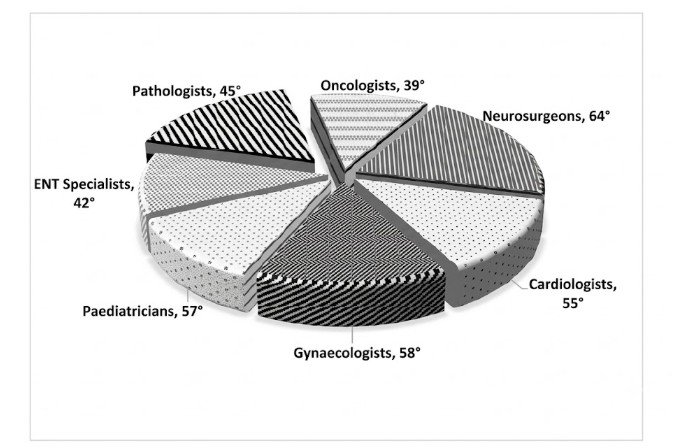
If the total number of all the mentioned specialists during the year in the hospital was 120, then how many pathologists were there in the hospital?
To find the number of pathologists in the hospital, we need to use the information from the circle graph, which shows the central angles corresponding to each specialist group. The total number of specialists is given, and we will calculate the number of pathologists using the proportion of the circle they represent.
Therefore, the number of pathologists in the hospital is 15.
Correct Option: B) 15
Each of D, E, G, H, S, T, and Y has an exam on a different day of a week starting from Monday and ending on Sunday of the same week. G’s exam is on one of the days before H. E has the exam on Thursday. Only two persons have exams between S and E. D has the exam on the day immediately after S. T has the exam on the day immediately before Y, but not on Saturday. G does not have the exam on Sunday. Who among the following has the exam on Friday?
This is a scheduling puzzle. We need to assign each person (D, E, G, H, S, T, Y) to a specific day of the week (Monday to Sunday) based on the given clues. We will create a table and fill it step-by-step.
Current schedule:
Let's check the second possibility (T on Friday, Y on Saturday):
Let's verify all conditions:
All conditions are met.
Correct Option: B) T