
To determine the type of quadrilateral, we need to find the actual measures of its angles. We know that the sum of the interior angles of any quadrilateral is 360 degrees. We can use the given ratio to set up an equation and solve for the angles. Once the angles are known, we can identify the properties of the quadrilateral.
Correct Option: C) parallelogram
The quadrilateral has opposite angles equal (\(45^\circ, 135^\circ, 45^\circ, 135^\circ\)), which is a defining property of a parallelogram.
Find x and y in the equivalent fraction given below.
\( \frac{x}{9} \) = \( \frac{105}{63} \) = \( \frac{5}{y} \)
x = 3, y = 5
x = 15, y = 9
x = 12, y = 3
x = 15, y = 3
To find the values of \(x\) and \(y\) in the given equivalent fractions, we will use the property that if fractions are equivalent, their values are equal. We will equate each unknown fraction to the known complete fraction \(\frac{105}{63}\) and solve for the respective variables.
First, simplify the fraction \(\frac{105}{63}\) to its lowest terms. Both 105 and 63 are divisible by common factors.
So, the simplified equivalent fraction is \(\frac{5}{3}\).
Equate the first fraction \(\frac{x}{9}\) to the simplified fraction \(\frac{5}{3}\):
\[ \frac{x}{9} = \frac{5}{3} \]To solve for \(x\), multiply both sides by 9:
\[ x = \frac{5}{3} \times 9 \]\[ x = 5 \times 3 \]\[ x = 15 \]Equate the third fraction \(\frac{5}{y}\) to the simplified fraction \(\frac{5}{3}\):
\[ \frac{5}{y} = \frac{5}{3} \]Since the numerators are equal (both are 5), the denominators must also be equal for the fractions to be equivalent.
\[ y = 3 \]D) From our calculations, we found \(x = 15\) and \(y = 3\). This matches option D.
The question asks to identify the only permanent unit in the Panchayati Raj System. To answer this, we need to understand the structure and functioning of the Panchayati Raj Institutions in India, particularly which bodies are subject to elections and which are continuous.
D) Gram Sabha — The Gram Sabha is the only permanent unit in the Panchayati Raj System because it consists of all adult members registered in the electoral rolls of a village. Its existence is continuous and not subject to elections or dissolution, unlike the elected bodies at various levels.
Study the given line graph and answer the following question.
The given line graph depicts the number of visitors in four parks – A, B, C and D.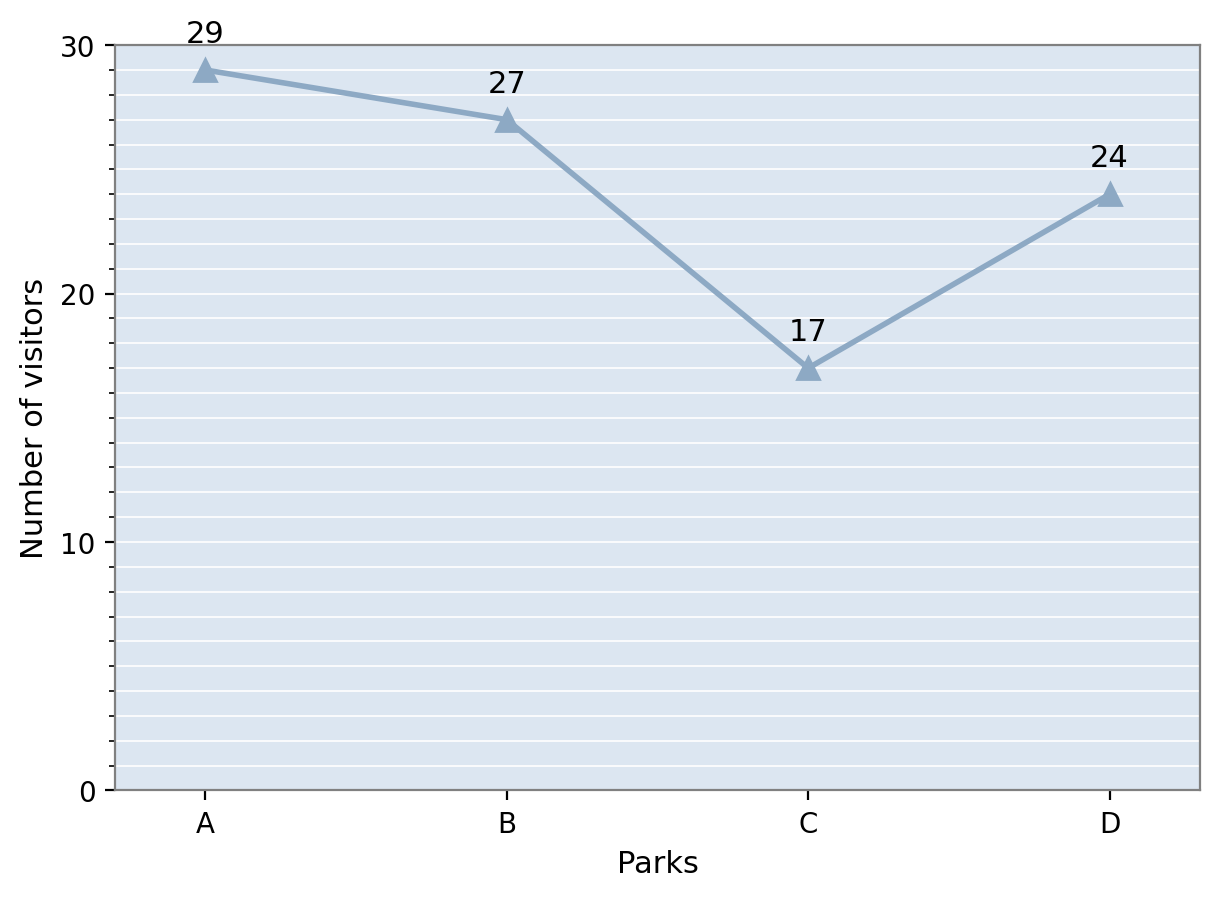
If out of the total number of visitors in parks A and C, 50% were females, what was the total number of male visitors in parks A and C?
We need to calculate the total number of male visitors in parks A and C, given that 50% of the total visitors in these parks are females.
\[ \text{Total visitors in A and C} = 29 + 17 = 46 \]
\[ \text{Female visitors} = \frac{50}{100} \times 46 = 23 \]
\[ \text{Male visitors} = 46 - 23 = 23 \]
Correct Option: A) 23
To determine which of the given numbers is divisible by 17, we can perform division for each option. A number is divisible by another if the remainder of their division is zero.
Divide 1887 by 17:
\[ 1887 \div 17 \]\[ 17 \times 100 = 1700 \]\[ 1887 - 1700 = 187 \]\[ 17 \times 10 = 170 \]\[ 187 - 170 = 17 \]\[ 17 \times 1 = 17 \]\[ 17 - 17 = 0 \]So, \(1887 \div 17 = 111\) with a remainder of 0. Thus, 1887 is divisible by 17.Divide 2989 by 17:
\[ 2989 \div 17 \]\[ 17 \times 100 = 1700 \]\[ 2989 - 1700 = 1289 \]\[ 17 \times 70 = 1190 \]\[ 1289 - 1190 = 99 \]\[ 17 \times 5 = 85 \]\[ 99 - 85 = 14 \]The remainder is 14. Thus, 2989 is not divisible by 17.Divide 991 by 17:
\[ 991 \div 17 \]\[ 17 \times 50 = 850 \]\[ 991 - 850 = 141 \]\[ 17 \times 8 = 136 \]\[ 141 - 136 = 5 \]The remainder is 5. Thus, 991 is not divisible by 17.Divide 2022 by 17:
\[ 2022 \div 17 \]\[ 17 \times 100 = 1700 \]\[ 2022 - 1700 = 322 \]\[ 17 \times 10 = 170 \]\[ 322 - 170 = 152 \]\[ 17 \times 8 = 136 \]\[ 152 - 136 = 16 \]The remainder is 16. Thus, 2022 is not divisible by 17.A) 1887 is divisible by 17 because when 1887 is divided by 17, the remainder is 0.
If each of the letters in the word ‘LEUCOMA’ is arranged in alphabetical order, how many letters are there in the English alphabetical order between the letter which is third from the left and the one which is second from the right?
The problem requires us to first arrange the letters of the given word in alphabetical order. Then, we need to identify the letter that is third from the left and the letter that is second from the right in this new arrangement. Finally, we count the number of letters in the English alphabet that fall between these two identified letters.
The letters are L, E, U, C, O, M, A.
When arranged alphabetically, the letters become: A, C, E, L, M, O, U.
In the alphabetically ordered list (A, C, E, L, M, O, U), the third letter from the left is E.
In the alphabetically ordered list (A, C, E, L, M, O, U), the second letter from the right is O.
The letters between E and O in the English alphabet are F, G, H, I, J, K, L, M, N.
Counting these letters, we find there are 9 letters.
C) Nine
As determined in step 5, there are 9 letters between 'E' and 'O' in the English alphabetical order.
The question asks to identify the physical quantity whose unit is volt/ampere. This requires knowledge of fundamental electrical quantities and their units, particularly Ohm's Law.
D) resistance — As derived from Ohm's Law, resistance is defined as the ratio of voltage to current, and its unit is volt/ampere, also known as ohm (\(\Omega\)).
The problem involves determining the total number of people in a row based on the position of one person (Hari) from one end and his relative position to the exact center of the row. We need to consider two possible scenarios for the center person's position relative to Hari and then calculate the total number of people for each scenario to find a consistent answer.
Identify Hari's position: Hari is 7th from the left end of the row.
Understand the relationship with the center: There are three people between Hari and the person standing at the exact center of the row.
Case 1: The center person is to Hari's left.
Case 2: The center person is to Hari's right.
Correct Option: C) 21
The question asks us to evaluate two arguments in relation to a given statement. We need to determine if each argument strengthens or weakens the statement. The statement is: "Eating junk food is not good for health."
C) Both I and II strengthen the statement. This is correct because both arguments provide valid reasons and negative health consequences that support the claim that eating junk food is not good for health.
To identify the homologue of ethanol, we need to understand the concept of a homologous series in organic chemistry. A homologous series is a series of compounds with the same functional group and similar chemical properties, in which each successive member differs by a \(-CH_2\) group.
Correct Option: A) methanol is the immediate lower homologue of ethanol. Ethanol is \(C_2H_5OH\) and methanol is \(CH_3OH\). They both belong to the alcohol homologous series and differ by a \(-CH_2\) group.