
The question asks for the name of India's first privately developed fully cryogenic rocket engine. This requires knowledge of recent developments in India's private space sector.
Correct Option: A) Dhawan-1 is the correct answer. It is India's first privately developed fully cryogenic rocket engine, developed by Skyroot Aerospace.
This problem involves calculating a total amount when a percentage of it is spent, and the remaining amount is given. We can represent the total salary as 100% and then find the percentage of salary remaining after the expenditure. By equating this remaining percentage to the given remaining amount, we can find the total salary.
Let the total salary of the man be \(S\).
The man spends 30% of his salary on groceries. So, the amount spent is \(30\%\) of \(S\).
The percentage of salary remaining after spending on groceries is:
\[ \text{Remaining Percentage} = 100\% - 30\% = 70\% \]We are given that the man is left with ₹3,500. This amount corresponds to the 70% of his total salary that remained.
So, we can set up the equation:
\[ 70\% \text{ of } S = \text{₹}3,500 \]Convert the percentage to a decimal or fraction:
\[ 0.70 \times S = 3,500 \]Now, solve for \(S\):
\[ S = \frac{3,500}{0.70} \] \[ S = \frac{3,500}{\frac{7}{10}} \] \[ S = 3,500 \times \frac{10}{7} \] \[ S = 500 \times 10 \] \[ S = \text{₹}5,000 \]Thus, the total salary of the man is ₹5,000.
The question asks about the purpose of the eSHRAM portal developed by the Ministry of Labour and Employment. This requires knowledge of recent government initiatives related to labor welfare.
Correct Option: A) creating a National Database of Unorganised Workers (NDUW)
This is a syllogism problem. We will use Venn diagrams to represent the given statements and then check if the conclusions logically follow from these diagrams. We must assume the statements are true, even if they contradict common knowledge.
A) Neither conclusion (I) nor (II) follows. As explained in the step-by-step analysis, based on the Venn diagrams, we cannot definitively conclude that "Some Rabbits are Bears" or "All Teddies are Soft."
Which of the following diagrams depicts the positions of the ureters (shown as blue lines) and the urinary bladder in the human excretory system?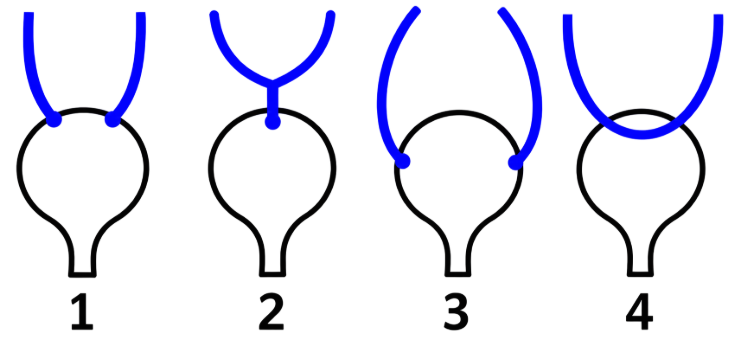
The human excretory system includes the ureters and urinary bladder. The ureters are tubes that carry urine from the kidneys to the bladder. Proper anatomical understanding is crucial to identify the correct diagram depicting these structures.
Correct Option: B) Diagram 1
The question asks to define what 'Maternal Health' covers. Maternal health is a broad term encompassing the health of women during various stages related to reproduction. We need to identify the option that provides the most comprehensive definition.
Correct Option: A) Care during prenatal, natal and post-natal period. This option provides the most comprehensive definition of maternal health, covering the entire continuum of care from before conception through pregnancy, childbirth, and the postpartum period.
To find the speed of the cyclist, we need to use the formula for speed, which is distance divided by time. The given distance is in kilometers and time in hours. The question asks for the speed in meters per second (m/s), so we will need to convert the units after calculating the speed in km/h.
The formula for speed is:
\[ \text{Speed} = \frac{\text{Distance}}{\text{Time}} \]Given:
Substitute the values into the formula:
\[ \text{Speed} = \frac{900\ \text{km}}{25\ \text{hours}} = 36\ \text{km/h} \]To convert km/h to m/s, we use the conversion factor:
\[ 1\ \text{km/h} = \frac{5}{18}\ \text{m/s} \]So, multiply the speed in km/h by \(\frac{5}{18}\):
\[ \text{Speed (in m/s)} = 36 \times \frac{5}{18}\ \text{m/s} \]Simplify the expression:
\[ \text{Speed (in m/s)} = 2 \times 5\ \text{m/s} = 10\ \text{m/s} \]Correct Option: C) The speed of the cyclist is 10 m/s.
If α and β are the roots of the equation x² + 5x + 6 = 0, then the value of αβ − \(\left(\frac{1}{\alpha}+\frac{1}{\beta}\right)\) is:
−\( \frac{31}{6} \)
\( \frac{31}{6} \)
\( \frac{41}{6} \)
−\( \frac{41}{6} \)
The problem asks us to find the value of an expression involving the roots of a quadratic equation. We can use Vieta's formulas to find the sum and product of the roots directly from the coefficients of the quadratic equation. Then, we substitute these values into the given expression and simplify.
The given quadratic equation is \(x^2 + 5x + 6 = 0\).
Comparing this with the standard form \(ax^2 + bx + c = 0\), we have:
If \(\alpha\) and \(\beta\) are the roots of the quadratic equation, then:
Substituting the values of \(a\), \(b\), and \(c\):
The expression we need to evaluate is \[\alpha\beta - \left(\frac{1}{\alpha} + \frac{1}{\beta}\right)\].
First, simplify the term inside the parenthesis:
\[ \frac{1}{\alpha} + \frac{1}{\beta} = \frac{\beta + \alpha}{\alpha\beta} \]Now, substitute \(\alpha + \beta = -5\) and \(\alpha\beta = 6\) into the simplified expression:
\[ \alpha\beta - \left(\frac{\alpha + \beta}{\alpha\beta}\right) = 6 - \left(\frac{-5}{6}\right) \]Perform the arithmetic operations:
\[ 6 - \left(-\frac{5}{6}\right) = 6 + \frac{5}{6} \]\[ = \frac{6 \times 6}{6} + \frac{5}{6} \]\[ = \frac{36}{6} + \frac{5}{6} \]\[ = \frac{36 + 5}{6} \]\[ = \frac{41}{6} \]Correct Option: C) \(\frac{41}{6}\)
To calculate the compound interest, we can use the formula for the amount compounded annually or calculate the interest year by year. The formula for the amount \(A\) after \(t\) years with principal \(P\) and rate \(r\) compounded annually is \(A = P \left(1 + \frac{r}{100}\right)^t\). The compound interest (CI) is then \(A - P\).
The formula for the amount is:
\[ A = P \left(1 + \frac{r}{100}\right)^t \]Compound Interest = Amount - Principal
\[ \text{CI} = A - P \]\[ \text{CI} = 34347 - 30000 \]\[ \text{CI} = 4347 \]C) ₹4,347 is the correct compound interest.
In the word ‘BACKGROUND’, if each vowel is changed to the letter immediately following it and each consonant is changed to the letter immediately following it in the English alphabetical order, then how many vowels will be there in the group of letters thus formed?
The problem requires us to transform each letter in the word 'BACKGROUND' based on specific rules: vowels change to the next letter, and consonants change to the next letter. After this transformation, we need to count how many vowels are present in the new sequence of letters.
B) Two. After applying the given rules, the new group of letters is 'CBDLHSPVOE'. The vowels in this group are 'O' and 'E', making a total of two vowels.