
The question asks to identify the specific part of the Indian Constitution that deals with Panchayats. This requires knowledge of the structure and contents of the Indian Constitution.
Correct Option: B) Part IX of the Constitution of India deals with Panchayats. It was added by the 73rd Constitutional Amendment Act, 1992, and contains provisions for the establishment, powers, and functions of Panchayati Raj institutions.
The money multiplier indicates how much the money supply will change for a given change in the monetary base. It is inversely related to the Cash Reserve Ratio (CRR). The formula for the money multiplier is \( \frac{1}{\text{CRR}} \).
Correct Option: C) 6.67
Which of the following is the standard representation of quadratic equation
(x2+1)(x−1)=(x2−3)(x+3)?
To find the standard representation of a quadratic equation, we need to expand both sides of the given equation, simplify it, and rearrange the terms into the standard form \(ax^2 + bx + c = 0\).
The left side is \((x^2 + 1)(x - 1)\). We use the distributive property (FOIL method) to expand this expression:
\[ (x^2 + 1)(x - 1) = x^2 \cdot x + x^2 \cdot (-1) + 1 \cdot x + 1 \cdot (-1) \]\[ = x^3 - x^2 + x - 1 \]The right side is \((x^2 - 3)(x + 3)\). This is a difference of squares pattern \((a-b)(a+b) = a^2 - b^2\), where \(a = x\) and \(b = 3\). However, the first term is \(x^2\), so we expand it directly:
\[ (x^2 - 3)(x + 3) = x^2 \cdot x + x^2 \cdot 3 - 3 \cdot x - 3 \cdot 3 \]\[ = x^3 + 3x^2 - 3x - 9 \]Now we have:
\[ x^3 - x^2 + x - 1 = x^3 + 3x^2 - 3x - 9 \]To get the standard form \(ax^2 + bx + c = 0\), we move all terms to one side of the equation. Let's move all terms from the left side to the right side to keep the \(x^2\) coefficient positive if possible, or vice versa.
Subtract \(x^3\) from both sides:
\[ -x^2 + x - 1 = 3x^2 - 3x - 9 \]Move all terms to one side. Let's move the terms from the left to the right side:
\[ 0 = 3x^2 + x^2 - 3x - x - 9 + 1 \]\[ 0 = 4x^2 - 4x - 8 \]Rewrite in standard form:
\[ 4x^2 - 4x - 8 = 0 \]This is the standard representation of the given equation.
Correct Option: D) \(4x^2 - 4x - 8 = 0\)
This problem involves analyzing logical statements and conclusions, a common type of question in competitive exams. We will use Venn diagrams or the rules of syllogism to determine which conclusions logically follow from the given statements.
From (2) and (3), if all rats are dogs and all dogs are monkeys, then all rats are also monkeys. So, the set of 'rats' is inside 'dogs', which is inside 'monkeys'.
From (1), some cats are rats. Since all rats are monkeys, the 'cats' that are 'rats' are also 'monkeys'. This implies that some cats are monkeys.
As established in step 2, since some cats are rats, and all rats are dogs, and all dogs are monkeys, it logically follows that the portion of cats that are rats must also be monkeys. Therefore, some monkeys are cats. This conclusion follows.
From the statements, we know that all rats are dogs, and all dogs are monkeys. This means 'rats' is a subset of 'dogs', and 'dogs' is a subset of 'monkeys'. However, this does not imply that all monkeys are rats. There could be monkeys that are not dogs, or dogs that are not rats. For example, if there are 10 rats, 20 dogs (10 of which are rats), and 50 monkeys (20 of which are dogs), it's clear that not all monkeys are rats. This conclusion does not follow.
B) Only conclusion I follows
If \(\left(\frac{25}{9}\right)^{x+1}\left(\frac{81}{625}\right)^{x-1}\)= \( \frac{9}{25} \), then find the value of x.
To solve this problem, we need to simplify the given equation by expressing all terms with the same base. We will use the properties of exponents, specifically \((a/b)^m = a^m / b^m\), \((a/b)^{-m} = (b/a)^m\), and \((a^m)^n = a^{mn}\). Once all terms have the same base, we can equate the exponents to find the value of \(x\).
We know that \(25 = 5^2\), \(9 = 3^2\), \(81 = 3^4\), and \(625 = 5^4\).
\[ \frac{25}{9} = \left(\frac{5}{3}\right)^2 \] \[ \frac{81}{625} = \left(\frac{3}{5}\right)^4 = \left(\frac{5}{3}\right)^{-4} \] \[ \frac{9}{25} = \left(\frac{3}{5}\right)^2 = \left(\frac{5}{3}\right)^{-2} \]Correct Option: D) 4
Find the value of \(\frac{\cos45^\circ}{\sec30^\circ+\mathrm{cosec}30^\circ}\)
\(\frac{\sqrt{3}}{\sqrt{2}(1+\sqrt{3})}\)
\(\frac{\sqrt{2}}{2\sqrt{2}(1+\sqrt{3})}\)
\(\frac{\sqrt{3}}{2\sqrt{2}(1+\sqrt{3})}\)
\(\frac{\sqrt{3}}{2\sqrt{3}(1+\sqrt{2})}\)
To solve this problem, we need to recall the standard trigonometric values for common angles like \(30^\circ\) and \(45^\circ\). We will substitute these values into the given expression and then simplify it algebraically.
The given expression is \[\frac{\cos45^\circ}{\sec30^\circ+\mathrm{cosec}30^\circ}\].
Substitute the values:
\[ \frac{\frac{1}{\sqrt{2}}}{\frac{2}{\sqrt{3}} + 2} \]Correct Option: C) \(\frac{\sqrt{3}}{2\sqrt{2}(1+\sqrt{3})}\)
The question asks about the number of sex chromosome pairs in humans. To answer this, we need to recall the basic structure of the human karyotype, specifically the distinction between autosomes and sex chromosomes.
B) 1 pair is correct. Humans have 22 pairs of autosomes and 1 pair of sex chromosomes, making a total of 23 pairs (46 individual chromosomes).
Which of the following is always true?
a) The bisectors of angles of a parallelogram form a rectangle.
b) A parallelogram is a trapezium.
c) Diagonals of a rhombus are equal and bisect each other at right angles.
Only (a) and (b)
Only (b)
Only (a)
All of (a), (b), (c)
We need to evaluate each statement (a), (b), and (c) to determine which one is always true. We will use the definitions and properties of parallelograms, rectangles, rhombuses, and trapeziums.
Based on our analysis, statements (a) and (b) are always true, while statement (c) is not always true.
Correct Option: A) Only (a) and (b)
Study the given diagram carefully and answer the question. The numbers in different sections indicate the number of persons.
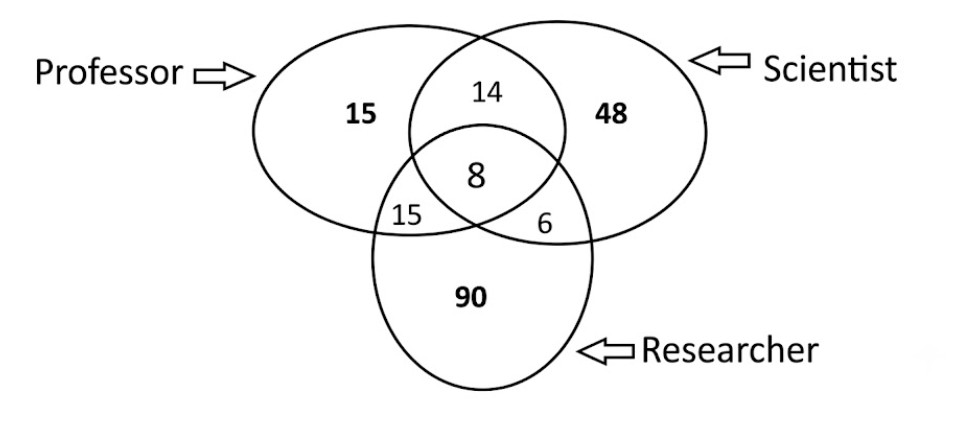
How many people are Researchers and Scientists but Not Professors?
To find the number of people who are Researchers and Scientists but not Professors, we need to analyze the Venn diagram provided. The diagram consists of three overlapping circles representing Professors, Scientists, and Researchers.
Correct Option: B) 6
Consider two circuits, A and B, each of which has 12 resistors each of resistance RA and RB, respectively. In each circuit the resistors are connected in such a way that the net resistance of each circuit is the minimum. Now a 30 V battery with negligible internal resistance is connected across each circuit separately, and the current drawn by circuit A and circuit B are 10 A and 18 A, respectively. Then RA and RB will be:
RA=26 Ω and RB=20 Ω
RA=26 Ω and RB=25 Ω
RA=36 Ω and RB=20 Ω
RA=36 Ω and RB=15 Ω
To find the resistance values \(R_A\) and \(R_B\), we need to determine the equivalent resistance of each circuit when the total resistance is minimum. The minimum resistance for a given number of identical resistors is achieved when all resistors are connected in parallel. We will then use Ohm's Law to relate voltage, current, and equivalent resistance for each circuit.
Determine the equivalent resistance for minimum resistance:
For \(N\) identical resistors, each of resistance \(R\), connected in parallel, the equivalent resistance \(R_{eq}\) is given by:
In this problem, there are 12 resistors in each circuit, so \(N=12\).
Calculate \(R_A\):
For circuit A, there are 12 resistors each of resistance \(R_A\). When connected for minimum resistance (i.e., in parallel), the equivalent resistance \(R_{eq,A}\) is:
Given that the battery voltage \(V = 30 \text{ V}\) and the current drawn \(I_A = 10 \text{ A}\). Using Ohm's Law (\(V = I R_{eq}\)):
\[ 30 = 10 \times \frac{R_A}{12} \] \[ \frac{R_A}{12} = \frac{30}{10} \] \[ \frac{R_A}{12} = 3 \] \[ R_A = 3 \times 12 \] \[ R_A = 36 \ \Omega \]Calculate \(R_B\):
For circuit B, there are 12 resistors each of resistance \(R_B\). When connected for minimum resistance (i.e., in parallel), the equivalent resistance \(R_{eq,B}\) is:
Given that the battery voltage \(V = 30 \text{ V}\) and the current drawn \(I_B = 18 \text{ A}\). Using Ohm's Law (\(V = I R_{eq}\)):
\[ 30 = 18 \times \frac{R_B}{12} \] \[ \frac{R_B}{12} = \frac{30}{18} \] \[ \frac{R_B}{12} = \frac{5}{3} \] \[ R_B = \frac{5}{3} \times 12 \] \[ R_B = 5 \times 4 \] \[ R_B = 20 \ \Omega \]Thus, \(R_A = 36 \ \Omega\) and \(R_B = 20 \ \Omega\).
Correct Option: C) R A =36 Ω and R B =20 Ω