
We are given two conditions about two numbers: their sum and the sum of their squares. We can solve this problem by either setting up a system of equations or by testing the given options.
Let the two numbers be \(x\) and \(y\).
Formulate equations from the given information:
The sum of two numbers is 9:
\[ x + y = 9 \quad \text{(Equation 1)} \]The sum of their squares is 41:
\[ x^2 + y^2 = 41 \quad \text{(Equation 2)} \]Solve the system of equations (Method 1: Algebraic Solution):
From Equation 1, we can express \(y\) in terms of \(x\):
\[ y = 9 - x \]Substitute this into Equation 2:
\[ x^2 + (9 - x)^2 = 41 \]Expand the equation:
\[ x^2 + (81 - 18x + x^2) = 41 \] \[ 2x^2 - 18x + 81 = 41 \]Rearrange into a quadratic equation:
\[ 2x^2 - 18x + 81 - 41 = 0 \] \[ 2x^2 - 18x + 40 = 0 \]Divide by 2 to simplify:
\[ x^2 - 9x + 20 = 0 \]Factor the quadratic equation:
\[ (x - 4)(x - 5) = 0 \]This gives two possible values for \(x\):
\[ x = 4 \quad \text{or} \quad x = 5 \]If \(x = 4\), then from \(y = 9 - x\), \(y = 9 - 4 = 5\).
If \(x = 5\), then from \(y = 9 - x\), \(y = 9 - 5 = 4\).
So, the two numbers are 4 and 5.
Alternatively, test the options (Method 2: Option Testing):
We check each option against both conditions.
This option satisfies both conditions.
Correct Option: A) 5, 4
The question asks about the number of hymns in the Rigveda. This is a factual question related to ancient Indian history and literature, specifically the Vedas. Knowledge of the structure and content of the Rigveda is required to answer this question.
Correct Option: A) 1028 hymns
The given series is 105, 107, 103, ?, 101, 111. We need to identify the pattern in the series to find the missing number. Let's analyze the differences between consecutive terms or look for alternating patterns.
The series is: 105, 107, 103, ?, 101, 111
The differences are \(+2, -4, ?, ?, +10\). This doesn't immediately reveal a simple arithmetic progression.
Let's consider two interleaved series:
Series 1 (Odd positions): 105, 103, 101
This sub-series is decreasing by 2 each time.
Series 2 (Even positions): 107, ?, 111
The series becomes: 105, 107, 103, 109, 101, 111
The pattern holds true.
Correct Option: C) 109
The following pie chart shows the percentage distribution of the expenditure incurred in manufacturing a certain product. Study the pie chart and answer the question.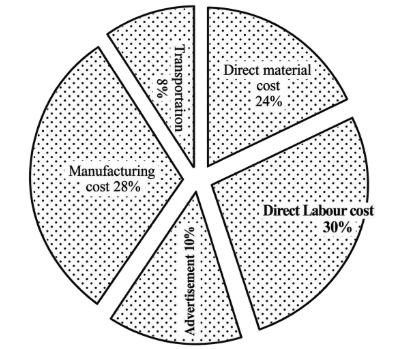
If 500 products are manufactured and the direct labour cost on them amounts to Rs 62,500, then what should be the selling price of the product so that the manufacturer can earn a profit of 50%?
To determine the selling price that includes a 50% profit, we first need to calculate the total cost of manufacturing one product. Using the given direct labour cost, we can find the total cost and then calculate the selling price.
Correct Option: C) Rs 625
The question asks about the general nature of oxides formed by non-metals. To answer this, we need to recall the chemical properties of non-metal oxides, particularly how they react with water or bases.
D) acidic — As explained above, most non-metal oxides react with water to form acids or react with bases, thereby exhibiting acidic properties. For example, carbon dioxide, sulfur dioxide, and nitrogen dioxide are common acidic oxides of non-metals.
The problem asks us to identify a triad of letter pairs that follows the same pattern as the two given triads. We need to analyze the positional differences of the letters within each pair and between consecutive pairs in the given triads.
C) AV – ZW – YX
To solve this problem, we will use trigonometric identities for complementary angles. Specifically, we will use the identities:
We also use the reciprocal identities \( \text{sec} \, \theta = 1/\text{cos} \, \theta \), \( \text{cosec} \, \theta = 1/\text{sin} \, \theta \), \( \text{cot} \, \theta = 1/\text{tan} \, \theta \), and the fact that \( \text{tan} \, \theta \cdot \text{cot} \, \theta = 1 \).
Consider the first part of the expression: \( (\text{sec} \, 33^\circ \text{cosec} \, 57^\circ – \text{cot} \, 57^\circ \text{tan} \, 33^\circ) \).
Apply complementary angle identities to simplify terms. We know that \( 57^\circ = 90^\circ - 33^\circ \).
Convert \( \text{cosec} \, 57^\circ \):
\[ \text{cosec} \, 57^\circ = \text{cosec} \, (90^\circ - 33^\circ) = \text{sec} \, 33^\circ \]Convert \( \text{cot} \, 57^\circ \):
\[ \text{cot} \, 57^\circ = \text{cot} \, (90^\circ - 33^\circ) = \text{tan} \, 33^\circ \]Substitute these simplified terms back into the first part of the expression:
\[ (\text{sec} \, 33^\circ \cdot \text{sec} \, 33^\circ – \text{tan} \, 33^\circ \cdot \text{tan} \, 33^\circ) \]\[ = (\text{sec}^2 \, 33^\circ – \text{tan}^2 \, 33^\circ) \]Recall the Pythagorean identity \( \text{sec}^2 \, \theta – \text{tan}^2 \, \theta = 1 \). Therefore,
\[ \text{sec}^2 \, 33^\circ – \text{tan}^2 \, 33^\circ = 1 \]Now, consider the second part of the expression: \( (\text{cot} \, 47^\circ \text{cot} \, 43^\circ) \).
Apply complementary angle identities. We know that \( 43^\circ = 90^\circ - 47^\circ \).
Convert \( \text{cot} \, 43^\circ \):
\[ \text{cot} \, 43^\circ = \text{cot} \, (90^\circ - 47^\circ) = \text{tan} \, 47^\circ \]Substitute this back into the second part of the expression:
\[ (\text{cot} \, 47^\circ \cdot \text{tan} \, 47^\circ) \]Recall the reciprocal identity \( \text{cot} \, \theta \cdot \text{tan} \, \theta = 1 \). Therefore,
\[ \text{cot} \, 47^\circ \cdot \text{tan} \, 47^\circ = 1 \]Finally, multiply the results from step 4 and step 8:
\[ (1) \times (1) = 1 \]B) The value of the given expression is 1.
The question asks for the implementation period of India's first Five Year Plan. This is a factual question related to India's economic history and planning.
D) 1951–1956. The First Five Year Plan was indeed implemented from 1951 to 1956. It was based on the Harrod-Domar model and focused on agricultural development, irrigation, and power projects.
The question asks to identify the main river to which the Banas River is a tributary. This requires knowledge of the major river systems and their tributaries in India, particularly in the northern and central regions.
Correct Option: A) The Banas River is a major tributary of the Chambal River. It is an important river in the state of Rajasthan, known for its seasonal flow and significant contribution to the Chambal basin.
The question asks for the percentage of the Indian population that speaks Hindi, according to the 2011 Census. This requires recalling specific demographic data related to language prevalence in India.
C) 43.63% is the correct percentage of the Indian population that speaks Hindi, as per the 2011 Census data.