
The question asks to identify which item is NOT included in the financial budget of India. The financial budget primarily deals with the government's receipts and expenditures, and the resulting deficits. We need to evaluate each option based on its relevance to the government's budgetary statements.
Correct Option: C) Credit control is NOT included in the financial budget of India as it pertains to monetary policy managed by the Reserve Bank of India, not fiscal policy managed by the government.
This problem can be solved by setting up a system of linear equations based on the given information about the present ages and the ages 5 years ago. We will define variables for the present ages and then translate the given conditions into equations.
Let my present age be \(x\) years.
Let my father's present age be \(y\) years.
From the first statement, "My father is presently 25 years older than me", we can write the equation:
\[ y = x + 25 \quad \text{(Equation 1)} \]Now, consider the ages 5 years ago:
From the second statement, "The sum of our ages 5 years ago was 39 years", we can write the equation:
\[ (x - 5) + (y - 5) = 39 \quad \text{(Equation 2)} \]Simplify Equation 2:
\[ x + y - 10 = 39 \]\[ x + y = 39 + 10 \]\[ x + y = 49 \quad \text{(Equation 3)} \]Now we have a system of two linear equations:
\[ y = x + 25 \]\[ x + y = 49 \]Substitute Equation 1 into Equation 3:
\[ x + (x + 25) = 49 \]\[ 2x + 25 = 49 \]Solve for \(x\):
\[ 2x = 49 - 25 \]\[ 2x = 24 \]\[ x = \frac{24}{2} \]\[ x = 12 \]So, my present age is 12 years.
C) 12 years. This is derived directly from our calculations, where \(x\) represents my present age.
The equivalent resistance between points A and B shown in the figure below is: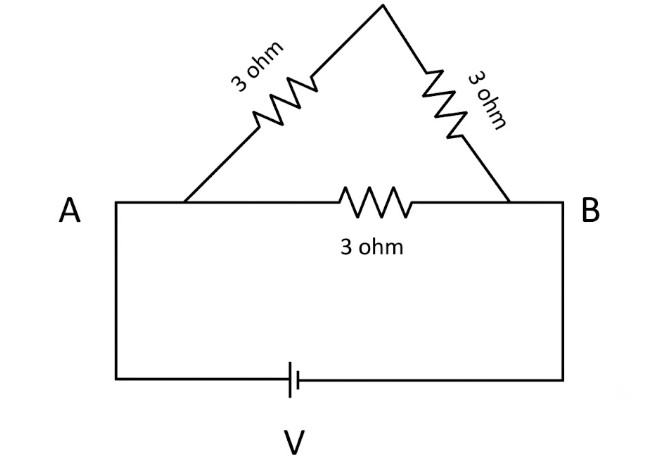
To find the equivalent resistance between points A and B, we need to analyze the circuit configuration and calculate the combined resistance using series and parallel resistor formulas.
\[ R_{\text{series}} = R_1 + R_2 = 3 \Omega + 3 \Omega = 6 \Omega \]
\[ \frac{1}{R_{\text{parallel}}} = \frac{1}{R_1} + \frac{1}{R_2} = \frac{1}{6 \Omega} + \frac{1}{3 \Omega} \]
Calculating the parallel resistance:
\[ \frac{1}{R_{\text{parallel}}} = \frac{1}{6} + \frac{1}{3} = \frac{1}{6} + \frac{2}{6} = \frac{3}{6} = \frac{1}{2} \]
Thus, \( R_{\text{parallel}} = 2 \Omega \).
The equivalent resistance between points A and B is 2 Ω.
Correct Option: A) 2 Ω
The question asks about the number of states where the first round of Mission Indradhanush (IMI) 4.0 was organized in February 2022. This requires factual knowledge about the implementation details of the program.
Correct Option: B) 11
To find the simple interest, we use the standard formula for simple interest, which involves the principal amount, the annual interest rate, and the time period in years.
The formula for Simple Interest (\(SI\)) is:
\[ SI = \frac{P \times R \times T}{100} \]Substitute \(P = 1280\), \(R = 5\), and \(T = 3\) into the formula:
\[ SI = \frac{1280 \times 5 \times 3}{100} \]First, multiply the numbers in the numerator:
\[ 1280 \times 5 = 6400 \]\[ 6400 \times 3 = 19200 \]Now, divide by 100:
\[ SI = \frac{19200}{100} \]\[ SI = 192 \]So, the simple interest is Rs 192.
B) 192 — The calculation shows that the simple interest is Rs 192.
The table below shows the differences between the structure and function of plants and animals.
Which option shows the INCORRECT statement?
| Sr. no. | Plants | Animals |
| a. | Do not move | Move in search of food, mate and shelter |
| b. | Most tissues are dead | Most tissues are living |
| c. | Need less energy | Need more energy |
| d. | Growth is limited to certain regions | Growth is limited to certain regions |
This is a syllogism problem. We will use Venn diagrams or logical deductions to determine which conclusions logically follow from the given statements. We must assume the statements are true, even if they contradict common knowledge.
From (Couriers \(\subset\) Shipments) and (Shipments \(\subset\) Transports), we can deduce:
From Statement 2, "All shipments are transports." This implies that some transports are shipments. Therefore, "No transport is shipment" is false.
From Statement 1 ("All couriers are shipments") and Statement 2 ("All shipments are transports"), it logically follows that all couriers are transports. This conclusion is true.
From Statement 2, "All shipments are transports." If all shipments are transports, then it must be true that some transports are shipments. This conclusion is true.
We know that "All couriers are transports" (from Step 2 deduction) and "No haul is transport" (from Statement 3). If no haul is transport, and all couriers are a type of transport, then no courier can be a haul. This conclusion is true.
Conclusions II, III, and IV are true.
A) Only conclusions II, III and IV follow.
Study the following line graph carefully and answer the given question.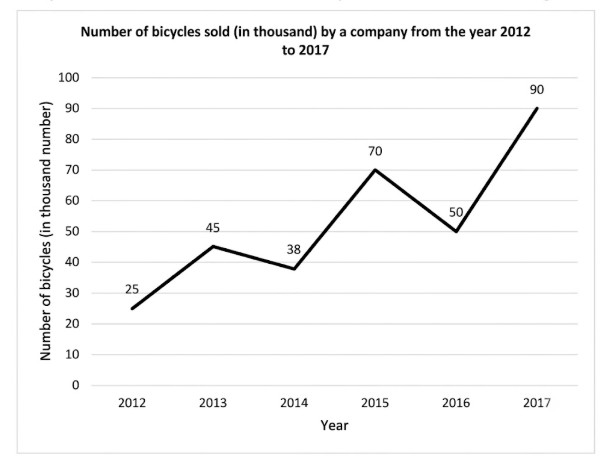
The number of bicycles sold in 2013 is approximately what percent of the number of bicycles sold in 2017?
To find the percentage of bicycles sold in 2013 relative to 2017, we need to use the formula for percentage calculation. The line graph provides the number of bicycles sold in each year, which we will utilize to calculate the percentage.
\[ \text{Percentage} = \left( \frac{\text{Number in 2013}}{\text{Number in 2017}} \right) \times 100 \]
Substitute the values:
\[ \text{Percentage} = \left( \frac{45000}{90000} \right) \times 100 \]
\[ \text{Percentage} = \left( \frac{1}{2} \right) \times 100 = 50\% \]
Thus, the number of bicycles sold in 2013 is 50% of those sold in 2017.
Correct Option: D) 50%
2.666… + 2.77… in fraction form is:
\(\frac{31}{9}\)
\(\frac{47}{9}\)
\(\frac{49}{9}\)
\(\frac{29}{9}\)
To solve this problem, we need to convert the given repeating decimals into their fractional forms first and then add them. A repeating decimal of the form \(x.yyy\dots\) can be written as \(x + \frac{y}{9}\) if only one digit repeats, or \(x + \frac{yz}{99}\) if two digits repeat, and so on. Alternatively, we can use the algebraic method to convert repeating decimals to fractions.
Let \(A = 2.666\dots\)
Multiply by 10:
\[ 10A = 26.666\dots \quad \text{(Equation 1)} \]\[ A = 2.666\dots \quad \text{(Equation 2)} \]Subtract Equation 2 from Equation 1:\[ 10A - A = 26.666\dots - 2.666\dots \]\[ 9A = 24 \]\[ A = \frac{24}{9} \]This fraction can be simplified by dividing the numerator and denominator by their greatest common divisor, which is 3:\[ A = \frac{24 \div 3}{9 \div 3} = \frac{8}{3} \]Let \(B = 2.77\dots\)
Multiply by 10:
\[ 10B = 27.77\dots \quad \text{(Equation 3)} \]\[ B = 2.77\dots \quad \text{(Equation 4)} \]Subtract Equation 4 from Equation 3:\[ 10B - B = 27.77\dots - 2.77\dots \]\[ 9B = 25 \]\[ B = \frac{25}{9} \]Now, add the fractional forms of \(A\) and \(B\):
\[ A + B = \frac{8}{3} + \frac{25}{9} \]To add these fractions, find a common denominator, which is 9. Convert \(\frac{8}{3}\) to an equivalent fraction with a denominator of 9:\[ \frac{8}{3} = \frac{8 \times 3}{3 \times 3} = \frac{24}{9} \]Now, add the fractions:\[ \frac{24}{9} + \frac{25}{9} = \frac{24 + 25}{9} = \frac{49}{9} \]C) \(\frac{49}{9}\) is the correct sum of the two given repeating decimals in fraction form.