
The boiling point of ionic compounds is primarily determined by the strength of the electrostatic forces between the ions in their crystal lattice. Stronger electrostatic forces require more energy to overcome, leading to higher boiling points. The strength of these forces is governed by Coulomb's Law, which states that the force is directly proportional to the product of the charges of the ions and inversely proportional to the square of the distance between their centers.
C) CaO has \( \text{Ca}^{2+} \) and \( \text{O}^{2-} \) ions. The product of the charges is \( |(+2) \times (-2)| = 4 \). This is the highest charge product among the given options, leading to the strongest electrostatic forces and thus the highest boiling point. The boiling point of CaO is approximately \( 2850^\circ \text{C} \).
The problem presents a series of number pairs and asks us to find the missing number in the last pair based on the relationship observed in the previous pairs. We need to identify a consistent mathematical operation or pattern that transforms the first number of each pair into the second number.
Correct Option: D) 38
The relationship between the numbers in each pair is that the second number is obtained by multiplying the first number by 2 and then subtracting 2. Applying this rule to 20, we get \((20 \times 2) - 2 = 40 - 2 = 38\).
To solve this problem, we need to follow the order of operations, often remembered by the acronym PEMDAS/BODMAS (Parentheses/Brackets, Exponents/Orders, Multiplication and Division (from left to right), Addition and Subtraction (from left to right)).
Let's execute the steps:
Division:
\[ 529 \div 23 \]We know that \(23 \times 23 = 529\). So,
\[ 529 \div 23 = 23 \]Multiplication:
Now, substitute the result back into the expression:
\[ 23 \times 61 \]Calculating this product:
\[ 23 \times 61 = 1403 \]Subtraction:
Substitute this result back into the original expression:
\[ 1403 - 1403 \]Performing the subtraction:
\[ 1403 - 1403 = 0 \]Thus, the value of the expression \(529 \div 23 \times 61 - 1403\) is \(0\).
D) 0 — Following the order of operations (BODMAS/PEMDAS), we first divide \(529\) by \(23\) to get \(23\). Then, we multiply \(23\) by \(61\) to get \(1403\). Finally, we subtract \(1403\) from \(1403\), which results in \(0\).
The problem asks us to evaluate how two given statements relate to a decision made by the state government. We need to determine if each statement strengthens, weakens, or is neutral to the decision. The decision is to start free education programs for uneducated females in villages to provide basic education.
D) Statement I strengthens the decision but statement II is neutral.
The question asks to identify the Indian state where the Sumi Baptist Church is located. This requires knowledge of the geographical distribution of significant religious and cultural landmarks in India, particularly those associated with specific tribal communities or denominations.
Correct Option: B) Nagaland is the correct answer because the Sumi Baptist Church is a significant religious establishment for the Sumi Naga tribe, who are predominantly found in Nagaland.
If the ratio of two numbers is 4 : 3 and the product of their LCM and their HCF is 432, then the sum of the reciprocals of the LCM and the HCF is:
\( \frac{13}{72} \)
\( \frac{13}{27} \)
\( \frac{13}{7} \)
\( \frac{13}{2} \)
We are given the ratio of two numbers and the product of their LCM and HCF. We need to find the sum of the reciprocals of their LCM and HCF. We will use the fundamental property that for any two positive integers, the product of the numbers is equal to the product of their LCM and HCF.
Let the two numbers be \(a\) and \(b\). Given that their ratio is \(4:3\), we can write them as:
\[ a = 4x \]\[ b = 3x \]where \(x\) is a common factor.
We know that for any two positive integers \(a\) and \(b\), the product of the numbers is equal to the product of their LCM and HCF:
\[ a \times b = \text{LCM}(a,b) \times \text{HCF}(a,b) \]We are given that the product of their LCM and HCF is 432:
\[ \text{LCM}(a,b) \times \text{HCF}(a,b) = 432 \]Substitute the expressions for \(a\) and \(b\) into the product equation:
\[ (4x) \times (3x) = 432 \]\[ 12x^2 = 432 \]Solve for \(x^2\):
\[ x^2 = \frac{432}{12} \]\[ x^2 = 36 \]Solve for \(x\):
\[ x = \sqrt{36} \]\[ x = 6 \](Since \(x\) is a common factor of positive numbers, it must be positive).
Now, find the two numbers:
\[ a = 4x = 4 \times 6 = 24 \]\[ b = 3x = 3 \times 6 = 18 \]Calculate the HCF (Highest Common Factor) of 24 and 18:
The HCF is 6.
Calculate the LCM (Least Common Multiple) of 24 and 18:
\[ \text{LCM}(24, 18) = \frac{24 \times 18}{\text{HCF}(24, 18)} = \frac{24 \times 18}{6} = 4 \times 18 = 72 \]Alternatively, using prime factorization:
LCM is \(2^3 \times 3^2 = 8 \times 9 = 72\).
Verify the product of LCM and HCF:
\[ 72 \times 6 = 432 \]This matches the given information.
Finally, calculate the sum of the reciprocals of the LCM and HCF:
\[ \frac{1}{\text{LCM}} + \frac{1}{\text{HCF}} = \frac{1}{72} + \frac{1}{6} \]To add these fractions, find a common denominator, which is 72:
\[ \frac{1}{72} + \frac{1 \times 12}{6 \times 12} = \frac{1}{72} + \frac{12}{72} \]\[ = \frac{1 + 12}{72} = \frac{13}{72} \]Correct Option: A) \( \frac{13}{72} \)
To find the selling price per kilogram, we first need to calculate the average cost price per kilogram of the mixed apples. This involves calculating the total cost of the apples and dividing it by the total weight. Once the average cost price is determined, we can apply the given profit percentage to find the selling price.
Correct Option: B) 45.9/kg
The problem involves setting up and solving a system of two linear equations with two variables, representing the current ages of A and B. Once the current ages are found, we need to calculate their sum 4 years from now.
D) 51 years. This is the sum of the ages of A and B, 4 years from now, calculated as \(27 + 24 = 51\).
To find the value of 'x', we will use the formula for average speed. Average speed is defined as the total distance covered divided by the total time taken. We need to calculate the time taken for each segment of the journey and then sum them up to find the total time. The total distance is the sum of all individual distances. Finally, we will set up an equation using the given average speed and solve for 'x'.
Correct Option: D) The value of x is 18 km/h.
An optical device X forms an image CD for an object AB as shown in the figure. The device X is a: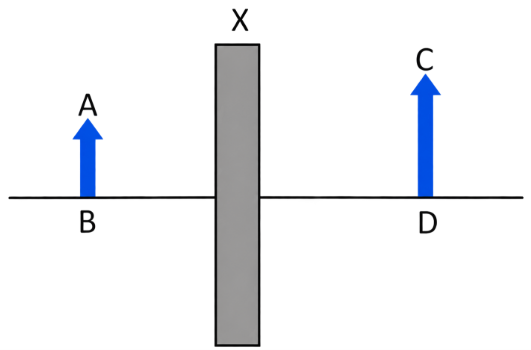
concave mirror
convex lens
convex mirror
concave lens
To determine the optical device X, we need to analyze the image formation characteristics shown in the diagram.
Correct Option: A) concave mirror