
In the given figure, ABCD and APQR are two parallelograms. If ∠APQ = 100°, find ∠CDR.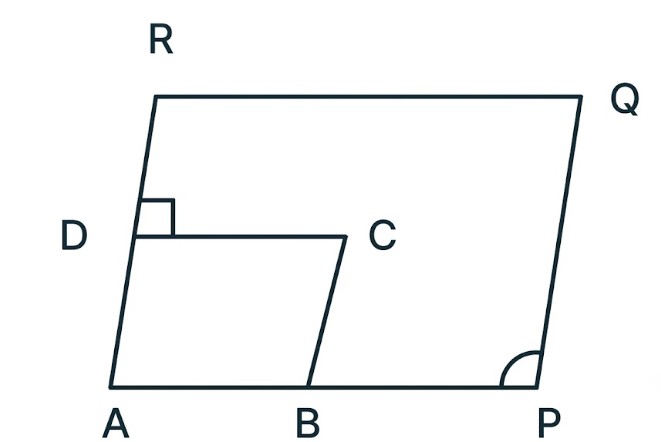
To find the angle ∠CDR in the parallelogram ABCD, we need to use properties of parallelograms and the given angle ∠APQ.
Correct Option: B) 80°
Simplify the following:
\(\frac{(3x^2)^5}{(6x^{-2})^2}\)
\(\frac{81x^{14}}{36}\)
\(\frac{27x^{14}}{4}\)
\(\frac{81x^6}{36}\)
\(\frac{27x^6}{36}\)
To simplify the given expression, we will use the rules of exponents. Specifically, we will apply the power of a product rule \((ab)^n = a^n b^n\), the power of a power rule \((a^m)^n = a^{mn}\), and the negative exponent rule \(a^{-n} = \frac{1}{a^n}\) or \frac{1}{a^{-n}} = a^n\).
The numerator is \((3x^2)^5\). Using the power of a product rule, we raise each factor inside the parenthesis to the power of 5:
\[ (3x^2)^5 = 3^5 \cdot (x^2)^5 \]Now, calculate \(3^5\) and use the power of a power rule for \( (x^2)^5 \):
\[ 3^5 = 3 \times 3 \times 3 \times 3 \times 3 = 243 \]\[ (x^2)^5 = x^{2 \times 5} = x^{10} \]So, the simplified numerator is:
\[ 243x^{10} \]The denominator is \((6x^{-2})^2\). Using the power of a product rule, we raise each factor inside the parenthesis to the power of 2:
\[ (6x^{-2})^2 = 6^2 \cdot (x^{-2})^2 \]Now, calculate \(6^2\) and use the power of a power rule for \( (x^{-2})^2 \):
\[ 6^2 = 36 \]\[ (x^{-2})^2 = x^{-2 \times 2} = x^{-4} \]So, the simplified denominator is:
\[ 36x^{-4} \]Now, substitute the simplified numerator and denominator back into the original expression:
\[ \frac{(3x^2)^5}{(6x^{-2})^2} = \frac{243x^{10}}{36x^{-4}} \]Separate the numerical coefficients and the variables:
\[ \frac{243}{36} \cdot \frac{x^{10}}{x^{-4}} \]Simplify the numerical fraction \(\frac{243}{36}\) by dividing both the numerator and the denominator by their greatest common divisor, which is 9:
\[ \frac{243 \div 9}{36 \div 9} = \frac{27}{4} \]Simplify the variable term \(\frac{x^{10}}{x^{-4}}\) using the quotient rule of exponents \(\frac{a^m}{a^n} = a^{m-n}\) or by moving the negative exponent to the numerator:
\[ \frac{x^{10}}{x^{-4}} = x^{10 - (-4)} = x^{10+4} = x^{14} \]Alternatively, using the negative exponent rule:
\[ \frac{x^{10}}{x^{-4}} = x^{10} \cdot x^4 = x^{10+4} = x^{14} \]Combine the simplified numerical and variable parts:
\[ \frac{27}{4} x^{14} \]B) \(\frac{27x^{14}}{4}\) is the correct simplified expression, matching our step-by-step calculation.
The problem asks us to identify the number of odd digits in a given series that satisfy two conditions: they must be immediately preceded by an even digit and immediately followed by an odd digit. We need to scan the series digit by digit and check for this specific pattern.
A) Two. As identified in the step-by-step analysis, there are exactly two odd digits (the two '3's) that satisfy the given conditions.
What is the discount percentage in the scheme of ‘buy 5 get 3 free’?
To find the discount percentage in a 'buy X get Y free' scheme, we need to determine the total number of items received and the number of items for which payment was made. The discount is calculated as the free items divided by the total items, expressed as a percentage.
In the scheme 'buy 5 get 3 free',
Total items received = Items bought + Free items
\[ \text{Total items} = 5 + 3 = 8 \]The discount percentage is the ratio of free items to the total items received, multiplied by 100.
\[ \text{Discount Percentage} = \left( \frac{\text{Number of free items}}{\text{Total number of items received}} \right) \times 100 \% \]\[ \text{Discount Percentage} = \left( \frac{3}{8} \right) \times 100 \% \]\[ \text{Discount Percentage} = 0.375 \times 100 \% \]\[ \text{Discount Percentage} = 37.5 \% \]C) 37.5% is the correct discount percentage calculated based on the scheme.
This problem can be solved by setting up a system of two linear equations with two variables. Let the cost of 1 kg of apples be \(x\) and the cost of 1 kg of oranges be \(y\). We can then form two equations based on the given information and solve for \(x\).
Let \(x\) be the cost of 1 kg of apples (in Rs).
Let \(y\) be the cost of 1 kg of oranges (in Rs).
From the first statement: "3 kg of apples and 4 kg of oranges cost Rs 210"
\[ 3x + 4y = 210 \quad \text{(Equation 1)} \]From the second statement: "5 kg of apples and 2 kg of oranges cost Rs 175"
\[ 5x + 2y = 175 \quad \text{(Equation 2)} \]We want to find \(x\). We can use the elimination method. Multiply Equation 2 by 2 to make the coefficient of \(y\) the same as in Equation 1:
\[ 2 \times (5x + 2y) = 2 \times 175 \]\[ 10x + 4y = 350 \quad \text{(Equation 3)} \]Subtracting Equation 1 from Equation 3 will eliminate \(y\):
\[ (10x + 4y) - (3x + 4y) = 350 - 210 \]\[ 10x - 3x + 4y - 4y = 140 \]\[ 7x = 140 \]Divide by 7 to find the value of \(x\):
\[ x = \frac{140}{7} \]\[ x = 20 \]So, the cost of 1 kg of apples is Rs 20.
B) 20
To find the Highest Common Factor (HCF) of a set of numbers, we need to find the largest number that divides all the given numbers without leaving a remainder. This can be done by listing the factors of each number or by using the prime factorization method.
The numbers that appear in all three lists of factors are the common factors. In this case, the common factors are 1, 2, and 4.
Among the common factors (1, 2, 4), the largest one is 4. Therefore, the HCF of 16, 20, and 24 is 4.
Alternatively, using prime factorization:
The only common prime factor among 16, 20, and 24 is 2. The lowest power of 2 that appears in all factorizations is \(2^2\).
HCF is the product of these common prime factors raised to their lowest powers.
\[ \text{HCF} = 2^2 = 4 \]Correct Option: A) 4
The question asks to identify the festival during which the Puli Kali (Tiger dance) event is a main attraction. This requires knowledge of Indian festivals and their associated cultural performances.
A) Onam — Puli Kali is a famous folk art performed primarily in the Thrissur district of Kerala during the annual harvest festival of Onam. Performers paint their bodies to resemble tigers and hunters and dance to the rhythm of traditional percussion instruments.
If the length l of a room is reduced by 10% and breadth b is increased by 10%, then find the positive change in its perimeter.
\( \frac{l-b}{5} \)
\( \frac{2}{5}(l - b) \)
\( \frac{2}{5}(l + b) \)
\( \frac{l+b}{5} \)
To find the positive change in the perimeter of a room when its length and breadth are altered, we need to calculate the initial perimeter, the new perimeter after changes, and then find the difference between them. The perimeter of a rectangle is given by the formula \(2(l+b)\).
Let the original length of the room be \(l\) and the original breadth be \(b\).
The initial perimeter \(P_1\) is given by:
\[ P_1 = 2(l + b) \]The length \(l\) is reduced by 10%.
New length \[l' = l - 10\% \text{ of } l = l - \frac{10}{100}l = l - 0.1l = 0.9l\]
The breadth \(b\) is increased by 10%.
New breadth \[b' = b + 10\% \text{ of } b = b + \frac{10}{100}b = b + 0.1b = 1.1b\]
The new perimeter \(P_2\) is given by:
\[ P_2 = 2(l' + b') \]\[ P_2 = 2(0.9l + 1.1b) \]The change in perimeter is \(P_2 - P_1\).
\[ \text{Change} = 2(0.9l + 1.1b) - 2(l + b) \]\[ \text{Change} = 1.8l + 2.2b - 2l - 2b \]\[ \text{Change} = (1.8l - 2l) + (2.2b - 2b) \]\[ \text{Change} = -0.2l + 0.2b \]\[ \text{Change} = 0.2(b - l) \]The question asks for the positive change. If \(b > l\), then \(0.2(b-l)\) is positive. If \(l > b\), then \(0.2(b-l)\) is negative, and the positive change would be \(0.2(l-b)\).
We can write \(0.2\) as \(\frac{2}{10}\) or \(\frac{1}{5}\).
So, the positive change is \(\frac{1}{5}(l - b)\) or \(\frac{l-b}{5}\) (assuming \(l > b\)) or \(\frac{1}{5}(b - l)\) (assuming \(b > l\)).
Looking at the options, option A is \(\frac{l-b}{5}\). This implies that we are considering the magnitude of the change, or that \(l\) is greater than \(b\), which would result in a positive value for \((l-b)\).
A) \( \frac{l-b}{5} \)
The calculated change in perimeter is \(0.2(b-l)\). If we are looking for the positive change, it means the absolute value of the change, or we assume \(l>b\) for the expression \(\frac{l-b}{5}\) to be positive. If \(l>b\), then \(0.2(b-l) = -0.2(l-b)\), and the positive change is \[0.2(l-b) = \frac{1}{5}(l-b) = \frac{l-b}{5}\].
The given pie chart shows the percentage of expenditure on electricity by a family in different months. Study the chart and answer the question.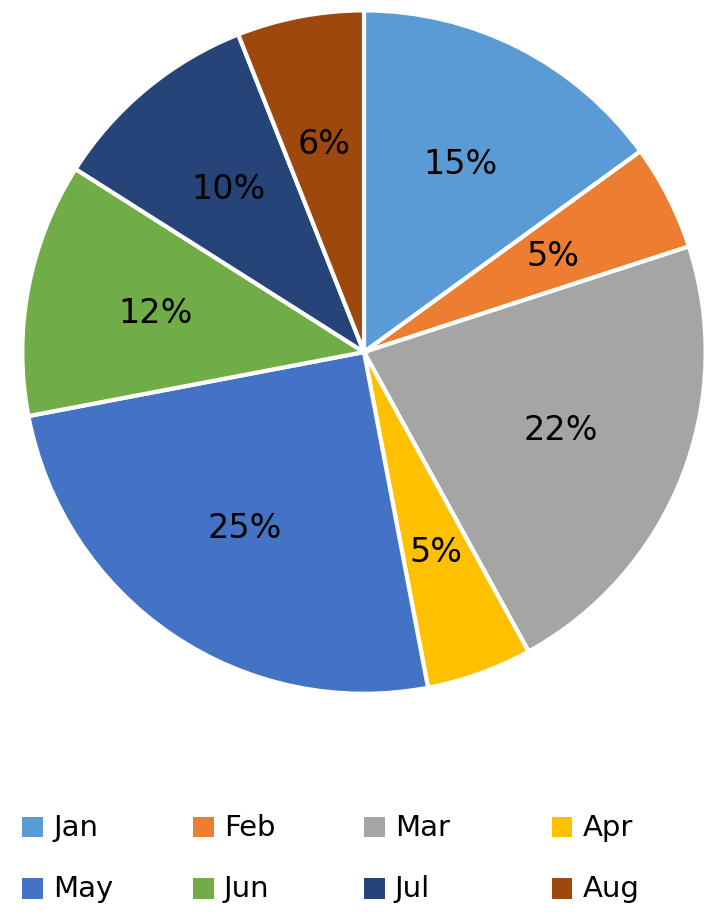
What is the central angle for the total expenditure on electricity in all the months together, EXCEPT May and August?
To find the central angle for the total expenditure on electricity in all the months except May and August, we need to calculate the sum of the percentages for the remaining months and then convert this sum into a central angle.
Correct Option: A) 248.4°
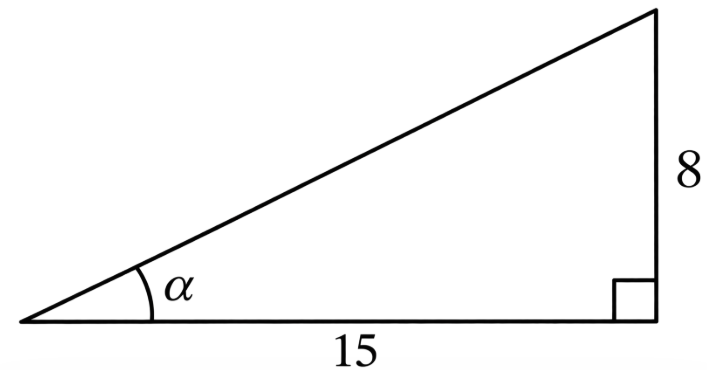
In the given right-angled triangle, where the lengths of the sides given are in cm, find the value of cos α + cot α.
\(\frac{333}{136}\)
\(\frac{375}{136}\)
\(\frac{15}{17}\)
\(\frac{19}{8}\)
To find the value of \( \cos \alpha + \cot \alpha \), we need to use the given right-angled triangle with sides labeled in the diagram.
\[ c = \sqrt{15^2 + 8^2} = \sqrt{225 + 64} = \sqrt{289} = 17 \]
\[ \cos \alpha = \frac{\text{Adjacent}}{\text{Hypotenuse}} = \frac{15}{17} \]
\[ \cot \alpha = \frac{\text{Adjacent}}{\text{Opposite}} = \frac{15}{8} \]
\[ \cos \alpha + \cot \alpha = \frac{15}{17} + \frac{15}{8} \]
To add these fractions, find the common denominator:
\[ \cos \alpha + \cot \alpha = \frac{15 \times 8 + 15 \times 17}{17 \times 8} = \frac{120 + 255}{136} = \frac{375}{136} \]
Thus, the value of \( \cos \alpha + \cot \alpha \) is \( \frac{375}{136} \).
Correct Option: B) \( \frac{375}{136} \)