
To find the median of a set of numbers, we first need to arrange the numbers in ascending order. Then, we determine if the number of observations is odd or even. If odd, the median is the middle value. If even, the median is the average of the two middle values.
The given data set is: 4, 6, 6, 8, 8, 8, 10, 12.
It is already arranged in ascending order.
There are 8 numbers in the data set. So, \(n = 8\).
Since \(n = 8\), which is an even number, the median will be the average of the two middle values.
For an even number of observations, the middle values are the \((\frac{n}{2})\)-th term and the \((\frac{n}{2} + 1)\)-th term.
Looking at the ordered data (4, 6, 6, 8, 8, 8, 10, 12):
The median is the average of these two middle terms:
\[ \text{Median} = \frac{\text{4th term} + \text{5th term}}{2} = \frac{8 + 8}{2} = \frac{16}{2} = 8 \]Correct Option: A) 8
The problem asks us to find the next number in a given series: 12, 14, 18, 26, 42, ?. We need to identify the pattern or rule governing the sequence by examining the differences between consecutive terms.
The differences are 2, 4, 8, 16. This is a geometric progression where each term is double the previous term (\(2^1, 2^2, 2^3, 2^4\)).
Following this pattern, the next difference should be \(16 \times 2 = 32\).
Add the predicted difference to the last term of the given series:
\[ 42 + 32 = 74 \]The next number in the series is 74.
A) 74 is the correct answer because it follows the established pattern of differences where each difference is double the previous one.
The question asks to identify the compound used for faster cooking. This refers to a common kitchen additive that helps reduce cooking time, especially for legumes and other hard-to-cook foods. We need to evaluate the properties and common uses of each given chemical compound.
C) NaHCO₃ (Sodium bicarbonate) is commonly known as baking soda. It is added to foods like chickpeas, kidney beans, and other legumes during cooking to soften them and significantly reduce cooking time. It works by making the cooking water alkaline, which helps in breaking down the pectin and other components in the food more quickly.
If cosθ = \( \frac{x}{\sin\theta} \), then the value of sin⁶θ + cos⁶θ = ________.
The problem asks for the value of \(\sin^6\theta + \cos^6\theta\) given the relation \(\cos\theta = \frac{x}{\sin\theta}\). We will first simplify the given relation to find an expression for \(x\) in terms of trigonometric functions. Then, we will use the algebraic identity \(a^3 + b^3 = (a+b)(a^2 - ab + b^2)\) or \(a^3 + b^3 = (a+b)^3 - 3ab(a+b)\) to simplify \(\sin^6\theta + \cos^6\theta\) and substitute the value of \(x\).
Given the relation:
\[ \cos\theta = \frac{x}{\sin\theta} \]Multiply both sides by \(\sin\theta\) to get an expression for \(x\):
\[ x = \sin\theta \cos\theta \]We need to find the value of \(\sin^6\theta + \cos^6\theta\). We can write this as \((\sin^2\theta)^3 + (\cos^2\theta)^3\).
Using the algebraic identity \(a^3 + b^3 = (a+b)^3 - 3ab(a+b)\), where \(a = \sin^2\theta\) and \(b = \cos^2\theta\):
\[ \sin^6\theta + \cos^6\theta = (\sin^2\theta + \cos^2\theta)^3 - 3(\sin^2\theta)(\cos^2\theta)(\sin^2\theta + \cos^2\theta) \]We know the fundamental trigonometric identity \(\sin^2\theta + \cos^2\theta = 1\). Substitute this into the equation:
\[ \sin^6\theta + \cos^6\theta = (1)^3 - 3(\sin^2\theta)(\cos^2\theta)(1) \]\[ \sin^6\theta + \cos^6\theta = 1 - 3\sin^2\theta\cos^2\theta \]From step 2, we have \(x = \sin\theta \cos\theta\). Squaring both sides gives:
\[ x^2 = (\sin\theta \cos\theta)^2 \]\[ x^2 = \sin^2\theta \cos^2\theta \]Substitute \(x^2\) for \(\sin^2\theta \cos^2\theta\) in the expression from step 5:
\[ \sin^6\theta + \cos^6\theta = 1 - 3x^2 \]Thus, the value of \(\sin^6\theta + \cos^6\theta\) is \(1 - 3x^2\).
Correct Option: A) \(1 - 3x^2\)
What is the value of k if \(\frac{2^{-2k}\times4^{k+3}}{4^{-k+2}}\) = 2k-2?
To find the value of \(k\), we need to simplify the given equation by expressing all terms with the same base (base 2 in this case) and then equate the exponents. We will use the laws of exponents: \((a^m)^n = a^{mn}\), \(a^m \times a^n = a^{m+n}\), and \(\frac{a^m}{a^n} = a^{m-n}\).
The given equation is:
\[ \frac{2^{-2k} \times 4^{k+3}}{4^{-k+2}} = 2^{k-2} \]We can express \(4\) as \(2^2\). Substitute this into the equation:
\[ \frac{2^{-2k} \times (2^2)^{k+3}}{(2^2)^{-k+2}} = 2^{k-2} \]Simplify the terms in the numerator and denominator:
\[ \frac{2^{-2k} \times 2^{2(k+3)}}{2^{2(-k+2)}} = 2^{k-2} \]\[ \frac{2^{-2k} \times 2^{2k+6}}{2^{-2k+4}} = 2^{k-2} \]Combine the terms in the numerator:
\[ \frac{2^{-2k + (2k+6)}}{2^{-2k+4}} = 2^{k-2} \]\[ \frac{2^{6}}{2^{-2k+4}} = 2^{k-2} \]Simplify the left side of the equation:
\[ 2^{6 - (-2k+4)} = 2^{k-2} \]\[ 2^{6 + 2k - 4} = 2^{k-2} \]\[ 2^{2k+2} = 2^{k-2} \]Since the bases are the same, we can equate the exponents:
\[ 2k+2 = k-2 \]Subtract \(k\) from both sides:
\[ 2k - k + 2 = -2 \]\[ k + 2 = -2 \]Subtract \(2\) from both sides:
\[ k = -2 - 2 \]\[ k = -4 \]B) -4 is the correct value of \(k\).
The question asks to identify which group of animals possesses a two-chambered heart. This requires knowledge of the circulatory systems and heart structures across different vertebrate classes.
Correct Option: D) Fishes — Fishes have a two-chambered heart consisting of one atrium and one ventricle. In their single circulatory system, deoxygenated blood from the body enters the atrium, then moves to the ventricle, which pumps it to the gills for oxygenation. The oxygenated blood then flows directly to the rest of the body without returning to the heart.
To solve this problem, we need to perform the subtraction operation for each digit of the given number from 9. After forming the new number, we will count how many of its digits are even.
Correct Option: D) 4
The question asks to identify the genetic components responsible for sex determination. This involves understanding the basic principles of genetics, specifically the roles of different types of chromosomes in humans and other sexually reproducing organisms.
Correct Option: C) Allosomes are the sex chromosomes (X and Y in humans) that determine the biological sex of an individual. For example, in humans, the presence of a Y chromosome typically leads to male development, while its absence (i.e., two X chromosomes) leads to female development.
The given pie chart shows the sales of a company over five years. Study the chart and answer the question.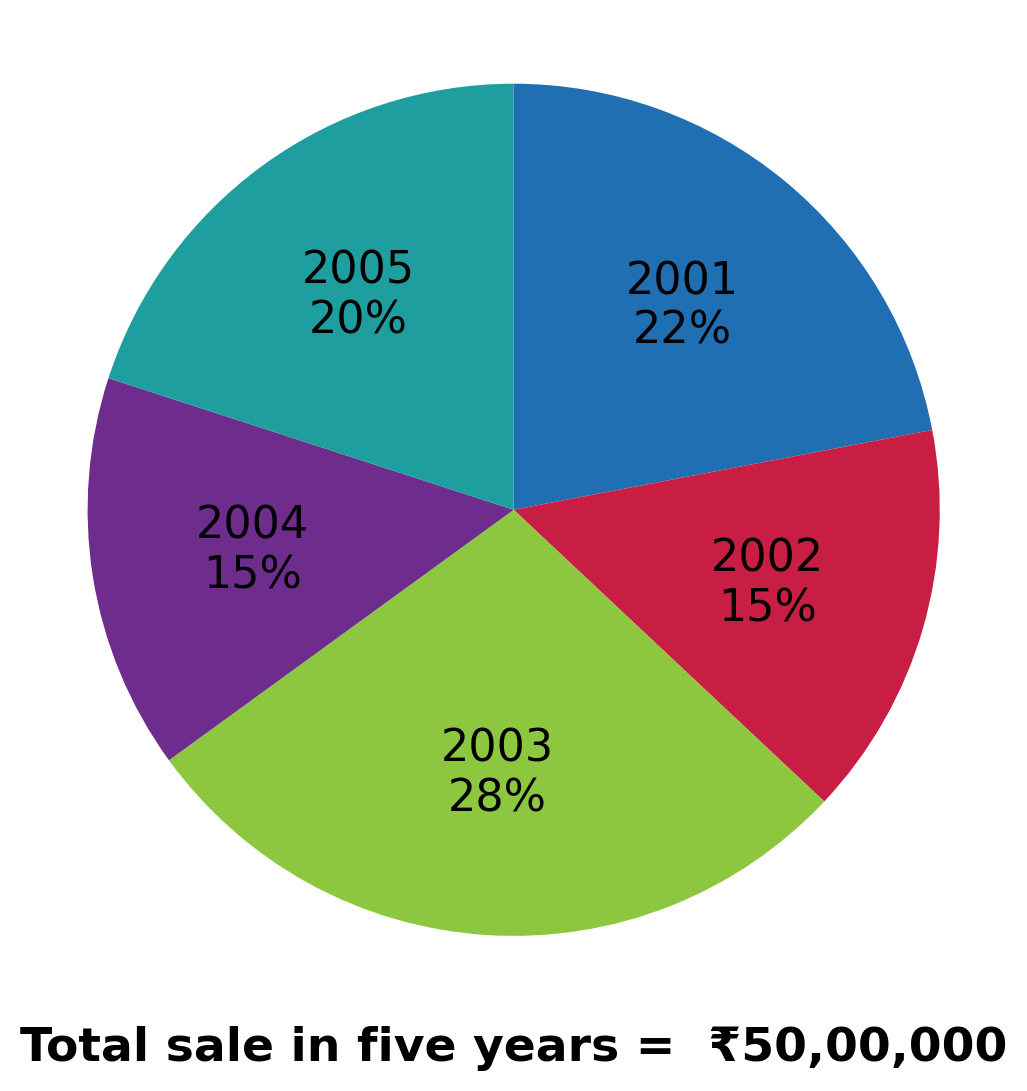
Sale = expenditure + profit
Profit % = (profit / expenditure) × 100%
If profit of the company in 2005 was 25%, then find the expenditure in 2005?
To find the expenditure in 2005, we need to use the formula for profit percentage and the information from the pie chart about sales distribution.
Sales in 2005:
\[ \text{Sales}_{2005} = \frac{20}{100} \times 50,00,000 = 10,00,000 \]
Profit percentage:
\[ \text{Profit \%} = \frac{\text{Profit}}{\text{Expenditure}} \times 100 \]
Let \( E \) be the expenditure and \( P \) be the profit. Then, \( P = 0.25E \).
\[ 10,00,000 = E + 0.25E \]
\[ 10,00,000 = 1.25E \]
\[ E = \frac{10,00,000}{1.25} = 8,00,000 \]
Thus, the expenditure in 2005 is ₹8,00,000.
Correct Option: B) ₹8,00,000
To determine the image position formed by a convex mirror, we will use the mirror formula. The mirror formula relates the object distance (\(u\)), image distance (\(v\)), and focal length (\(f\)) of a spherical mirror. We must also adhere to the sign conventions for spherical mirrors.
Identify the given values and sign conventions:
Apply the mirror formula:
The mirror formula is given by:
\[ \frac{1}{f} = \frac{1}{v} + \frac{1}{u} \]Substitute the known values into the formula:
\[ \frac{1}{+30 \text{ cm}} = \frac{1}{v} + \frac{1}{-20 \text{ cm}} \]Rearrange the formula to solve for \(v\):
\[ \frac{1}{v} = \frac{1}{30} - \frac{1}{-20} \]\[ \frac{1}{v} = \frac{1}{30} + \frac{1}{20} \]Find a common denominator and add the fractions:
The least common multiple of 30 and 20 is 60.
\[ \frac{1}{v} = \frac{2}{60} + \frac{3}{60} \]\[ \frac{1}{v} = \frac{2 + 3}{60} \]\[ \frac{1}{v} = \frac{5}{60} \]Calculate the image distance (\(v\)):
\[ v = \frac{60}{5} \]\[ v = +12 \text{ cm} \]Interpret the result:
The positive sign for \(v\) indicates that the image is formed behind the mirror, which is characteristic of a virtual and erect image formed by a convex mirror.
Correct Option: C) +12 cm is the correct image position. The positive sign indicates that the image is formed behind the mirror, which is always the case for a convex mirror, producing a virtual and erect image.