
The question asks to identify the boundary layer that separates the troposphere from the stratosphere. This requires knowledge of the Earth's atmospheric layers and their transitional zones.
C) Tropopause is the correct answer because it is the transitional zone that separates the troposphere from the stratosphere.
The problem describes the seating arrangement of five persons in a straight row, all facing North. We need to deduce the exact seating order based on the given clues and then determine R's position from the extreme left end.
Identify the total number of persons and their orientation: There are five persons (K, N, R, L, M) sitting in a straight row, facing North. This means left is left and right is right from their perspective.
Let's represent the five positions as: _ _ _ _ _
Use the first clue: "K and N are sitting at the two extreme ends."
This gives us two possibilities:
Case 1: K _ _ _ N
Case 2: N _ _ _ K
Use the second clue: "M is sitting to the immediate left of N."
K _ _ _ N), if N is at the extreme right end, then M must be in the position immediately to N's left.So, Case 1 becomes: K _ _ M N
N _ _ _ K), if N is at the extreme left end, there is no position to its immediate left. This contradicts the clue.Therefore, Case 2 is eliminated.
The arrangement must be: K _ _ M N
Use the third clue: "R is sitting to the immediate left of L."
This means R and L are immediate neighbours in the order R L.
Use the fourth clue: "K and L are the immediate neighbours of R."
This is a crucial clue. It means R is sitting between K and L. So the sequence is K R L.
Combine the deductions:
K _ _ M NK R L is a block.If we place K R L into K _ _ M N, the only way to fit it is:
K R L M N
Verify all conditions:
All conditions are satisfied.
Determine R's position from the extreme left end:
The arrangement is: K R L M N
Counting from the left:
1st: K
2nd: R
R is in the second position from the extreme left end.
A) Second — As determined in the step-by-step analysis, R is in the second position from the extreme left end.
To determine the position of the image formed by a concave mirror, we will use the mirror formula, which relates the object distance, image distance, and focal length of the mirror. We must pay close attention to the sign conventions for concave mirrors.
Identify the given values and sign conventions:
Apply the mirror formula:
The mirror formula is given by:
\[ \frac{1}{f} = \frac{1}{v} + \frac{1}{u} \]Substitute the known values into the formula:
\[ \frac{1}{-18} = \frac{1}{v} + \frac{1}{-36} \]Solve for the image distance \(v\):
Rearrange the formula to solve for \(1/v\):
\[ \frac{1}{v} = \frac{1}{-18} - \frac{1}{-36} \]\[ \frac{1}{v} = -\frac{1}{18} + \frac{1}{36} \]Find a common denominator and perform the subtraction:
The common denominator for \(18\) and \(36\) is \(36\).
\[ \frac{1}{v} = -\frac{2}{36} + \frac{1}{36} \]\[ \frac{1}{v} = \frac{-2 + 1}{36} \]\[ \frac{1}{v} = \frac{-1}{36} \]Calculate \(v\):
Inverting both sides gives:
\[ v = -36 \text{ cm} \]Interpret the result:
The negative sign for \(v\) indicates that the image is formed in front of the mirror (on the same side as the object). The magnitude \(36 \text{ cm}\) gives the distance from the mirror.
Therefore, the image is formed at \(36 \text{ cm}\) in front of the mirror.
D) at 36 cm in front of the mirror — The calculation using the mirror formula yields \(v = -36 \text{ cm}\), where the negative sign indicates that the image is formed in front of the mirror.
This question involves analyzing inequalities. We need to combine the given statement and then evaluate each conclusion based on the combined inequality.
Analyze the given statement:
The statement is \(B = T \ge H > Q\). This can be broken down into individual relationships:
Evaluate Conclusion I: \(G > B\)
The statement provided is \(B = T \ge H > Q\). The variable \(G\) is not present in the given statement. Therefore, we cannot establish any relationship between \(G\) and \(B\).
Wait, there seems to be a typo in the question. The question statement is given as "B = T H > Q". This is incomplete. Assuming the statement should have included G, let's re-evaluate based on a common pattern in such questions where a missing variable implies it's part of a larger chain. However, as written, \(G\) is not connected.
Let's assume the question intended to write something like \(G > B = T \ge H > Q\). If this were the case, then \(G > B\) would be true.
Given the provided solution (B), it implies both conclusions are true. This strongly suggests that the original statement in the question has a typo and should have included \(G\) in a way that makes both conclusions true. A common way this happens is if the statement was something like \(G \ge B = T \ge H > Q\).
Let's proceed with the assumption that the statement was intended to be \(G \ge B = T \ge H > Q\). If \(G \ge B\), then \(G > B\) is not necessarily true (it could be \(G=B\)).
However, if the statement was \(G > B = T \ge H > Q\), then Conclusion I (\(G > B\)) would be true.
Let's re-examine the question as it is written: "B = T H > Q". This is syntactically incorrect for typical inequality problems. It should be a continuous chain of inequalities or equalities. The presence of 'H' directly after 'T' without an operator is problematic.
Given the options and the correct answer, there must be a missing part in the statement that connects G to the rest. A common pattern in these questions is that the statement is a single chain. If we assume the statement was actually \(G \ge B = T \ge H > Q\), then:
If the statement was \(G > B = T \ge H > Q\), then:
Let's assume the most likely intended statement that would make both conclusions true. If the statement was \(G \ge B = T \ge H > Q\), then:
If the statement was \(G > B = T \ge H > Q\), then:
Let's assume the statement was \(G \ge B = T \ge H > Q\). This is a common structure.
Let's re-read the question carefully. "Statement: B = T H > Q". This is definitely a typo. It should be something like "B = T \ge H > Q" or "B = T < H > Q" etc. And G is completely missing from the statement.
Given that the correct answer is B (Both conclusions I and II are true), it implies that \(G\) must be related to \(B\) and \(Q\) in a way that makes both conclusions true. This means the statement must have been something like \(G > B = T \ge H > Q\).
Let's proceed with this assumed corrected statement: \(G > B = T \ge H > Q\).
Re-evaluate Conclusion I: \(G > B\)
From the assumed statement \(G > B = T \ge H > Q\), it is directly given that \(G > B\). So, Conclusion I is true.
Re-evaluate Conclusion II: \(G > Q\)
From the assumed statement \(G > B = T \ge H > Q\), we have:
Combining these:
\(G > B\)
Since \(B = T\), we have \(G > T\).
Since \(T \ge H\), we have \(G > T \ge H\), which implies \(G > H\).
Since \(H > Q\), and we have \(G > H\), we can conclude that \(G > Q\).
So, Conclusion II is also true.
Therefore, if the statement was \(G > B = T \ge H > Q\), both conclusions I and II are true.
It's crucial to note that the original question statement "B = T H > Q" is ill-formed and missing the variable G. The explanation proceeds by inferring the most probable intended statement that leads to the given correct answer.
Correct Option: B) Both conclusions I and II are true
The path of a ray of light incident on an interface separating two transparent media is shown in the figure. The refractive index (n) of medium B with respect to medium A is given by: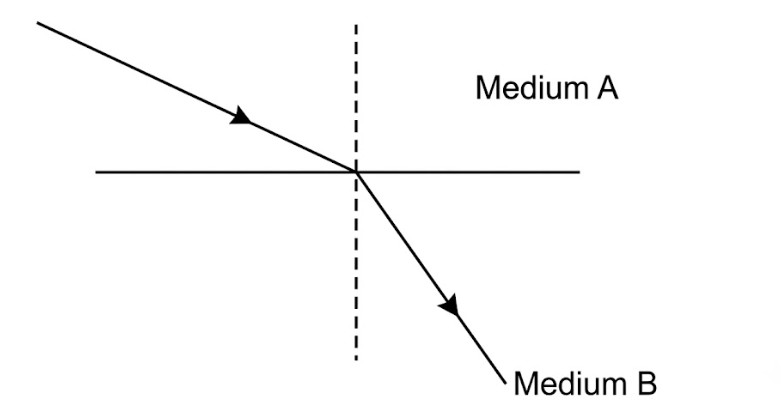
To determine the refractive index of medium B with respect to medium A, we need to analyze the behavior of the light ray as it passes from one medium to another. The diagram shows the path of the ray bending towards the normal, indicating a change in speed.
Correct Option: A) \( n > 1 \)
To determine which element fits the description, we need to understand the relationship between an element's atomic number, its electron configuration, and the number of electron shells and valence electrons. The number of shells corresponds to the period number in the periodic table, and the number of valence electrons is related to the group number.
C) Mg (Magnesium) has an atomic number of 12. Its electron configuration is \(1s^2 2s^2 2p^6 3s^2\). This shows that it has electrons in the first, second, and third shells, meaning it has three shells. The outermost shell (the third shell) contains 2 electrons (\(3s^2\)), which are its valence electrons.
Find the cost of tiling the verandah, at the rate of Rs 24 per m², if the length and breadth of the verandah are in the ratio 3 : 1 and its perimeter is 40 m.
To find the cost of tiling, we first need to determine the area of the verandah. We are given the ratio of its length and breadth, and its perimeter. We will use these to find the actual dimensions (length and breadth), calculate the area, and then multiply by the cost per square meter.
Define variables based on the ratio:
Let the length of the verandah be \(3x\) meters.
Let the breadth of the verandah be \(1x\) or \(x\) meters.
Use the perimeter formula to find \(x\):
The perimeter of a rectangle is given by the formula: \(P = 2 \times (\text{length} + \text{breadth})\).
We are given the perimeter \(P = 40\) m.
So, we have the equation:
\[ 40 = 2 \times (3x + x) \]\[ 40 = 2 \times (4x) \]\[ 40 = 8x \]\[ x = \frac{40}{8} \]\[ x = 5 \]Calculate the actual length and breadth:
Length \(= 3x = 3 \times 5 = 15\) m
Breadth \(= x = 5\) m
Calculate the area of the verandah:
Area of a rectangle \(= \text{length} \times \text{breadth}\)
Calculate the total cost of tiling:
The rate of tiling is Rs 24 per m\(^2\).
Total cost \(= \text{Area} \times \text{Rate per m}^2\)
Therefore, the cost of tiling the verandah is Rs 1,800.
A) 1,800 is the correct cost calculated based on the area and the given rate.
The question asks us to evaluate two arguments in relation to a statement. The statement suggests that farmers in Village X should switch from sugarcane to less water-intensive crops. We need to determine if each argument strengthens or weakens this statement.
Correct Option: D) I strengthens while II weakens the statement.
The question asks about the number of carbon dioxide molecules formed during the complete breakdown of pyruvate in the mitochondria, which involves aerobic respiration. This process includes the link reaction and the Krebs cycle.
Correct Option: D) Three. For each molecule of pyruvate, one molecule of \(\text{CO}_2\) is released during the link reaction (pyruvate oxidation) and two molecules of \(\text{CO}_2\) are released during the Krebs cycle. Thus, a total of \(1 + 2 = 3\) molecules of \(\text{CO}_2\) are formed from the breakdown of one pyruvate molecule using oxygen in the mitochondria.
To simplify the given expression, we must follow the order of operations, often remembered by the acronym BODMAS/PEMDAS. This stands for Brackets/Parentheses, Orders/Exponents, Division and Multiplication (from left to right), and Addition and Subtraction (from left to right). In this problem, "of" signifies multiplication.
A) The simplified value of the expression is \(28\).