
This question tests the fundamental properties of similar triangles. Similar triangles are defined by two key characteristics: their corresponding angles are equal, and their corresponding sides are in proportion. The ratio of the lengths of corresponding sides is given, but this information is not relevant to the relationship between their angles.
Correct Option: D) 1 : 1
When two triangles are similar, their corresponding angles are equal. If angle \(A\) in the first triangle corresponds to angle \(P\) in the second triangle, and they are similar, then \(\angle A = \angle P\). Therefore, the ratio \(\angle A : \angle P\) is \(1:1\).
The question asks to identify the correct statement regarding Newlands' Law of Octaves. We need to recall the key features, successes, and limitations of this early attempt at classifying elements.
A) Newlands’ law of octaves worked well with lighter elements only. This statement is correct. Newlands' Law of Octaves was successful in classifying elements only up to calcium (atomic mass 40). For heavier elements, the octaves rule did not hold true.
A group of numbers/symbols is coded using letters as per the table given below and the conditions which follow. The correct combination of codes following the conditions is your answer.
| Number/ symbol | 4 | % | 5 | 8 | @ | $ | 5 | 4 | ^ | + | # | 3 | 7 | 9 |
| Code Letter | G | O | H | P | T | M | A | B | L | N | F | S | Q | R |
Conditions:
(i) If the first element is a symbol and the last element is a number, the codes for these two (the first and the last elements) are to be interchanged.
(ii) If the first element is an odd number and the last element is an even number, the first and last elements are to be coded as ©.
(iii) If both the second and third elements are perfect squares, the third element is to be coded as the code for the second element.
What will be the code for 5 @ $ ^ 8?
When two trains move in opposite directions, their relative speed is the sum of their individual speeds. The total distance covered to cross each other is the sum of their lengths. We will use the formula \(\text{Distance} = \text{Speed} \times \text{Time}\) to find the unknown length of the second train.
Identify given values:
Calculate the relative speed:
Since the trains are moving in opposite directions, their relative speed is the sum of their speeds.
Convert relative speed to meters per second (m/s):
To convert km/h to m/s, multiply by \(\frac{5}{18}\).
Calculate the total distance covered:
When two trains cross each other, the total distance covered is the sum of their lengths.
Where \(L_2\) is the length of the second train (unknown).
Use the formula \(\text{Distance} = \text{Speed} \times \text{Time}\):
\[ D = S_{\text{rel}} \times T \] \[ L_1 + L_2 = \frac{500}{9} \text{ m/s} \times 12 \text{ s} \] \[ 300 \text{ m} + L_2 = \frac{6000}{9} \text{ m} \] \[ 300 \text{ m} + L_2 = \frac{2000}{3} \text{ m} \]Solve for \(L_2\):
\[ L_2 = \frac{2000}{3} - 300 \] \[ L_2 = \frac{2000 - (300 \times 3)}{3} \] \[ L_2 = \frac{2000 - 900}{3} \] \[ L_2 = \frac{1100}{3} \] \[ L_2 \approx 366.666... \text{ m} \]Round to two decimal places:
\[ L_2 \approx 366.67 \text{ m} \]Correct Option: A) 366.67
The question asks to identify the correct definitions for Chlorenchyma and Aerenchyma, which are specialized forms of parenchyma tissue. We need to recall the functions and structural characteristics of these tissues.
Correct Option: B) Chlorenchyma — Has chlorophyll for photosynthesis (leaves) Aerenchyma — Has air spaces (aquatic plants) and helps them to float
The given pie chart shows the number of students in six different Houses – P, Q, R, S, T and U of VY International School. Study the chart and answer the question.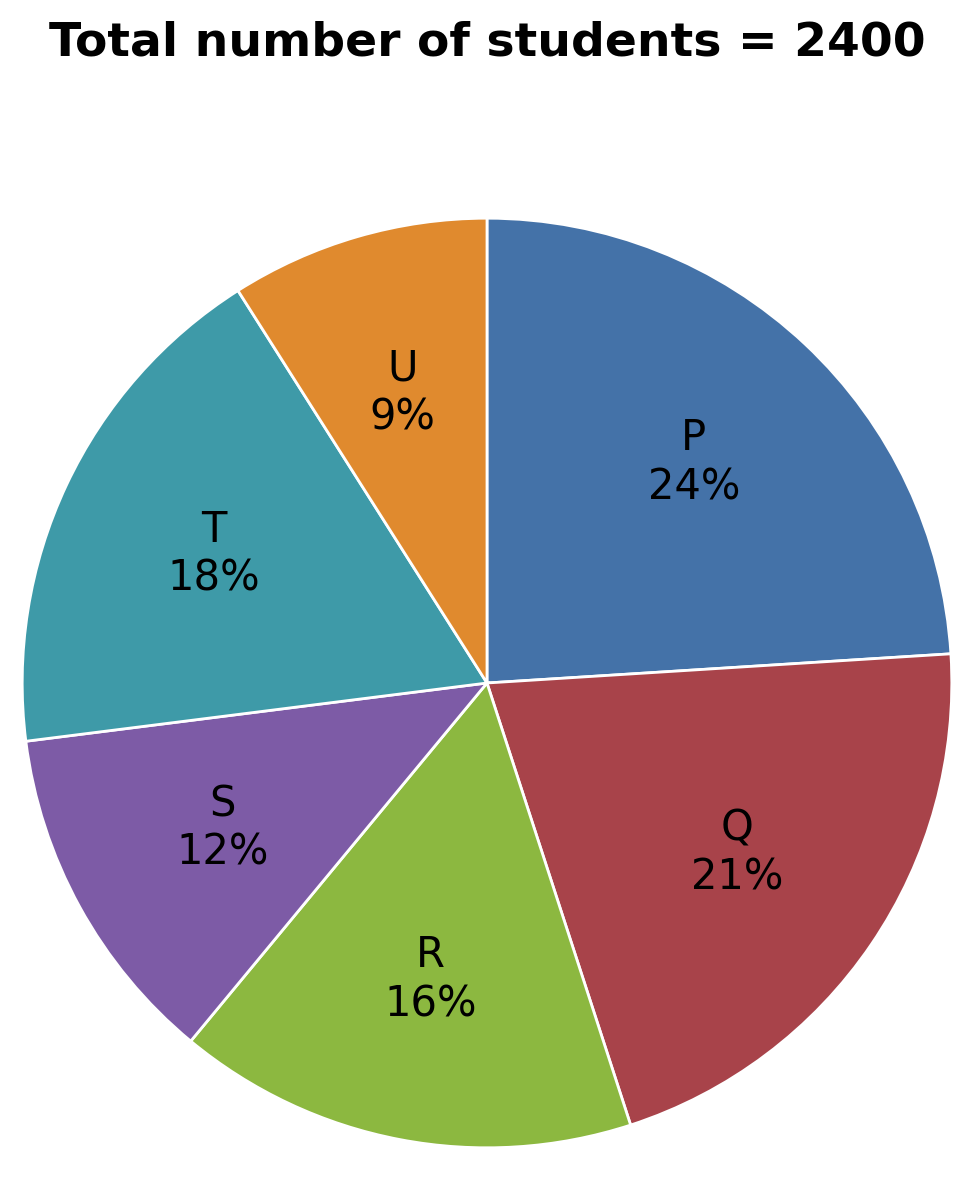
Total number of students = 2400. Find the ratio of students in House S to students in House T.
To find the ratio of students in House S to students in House T, we need to calculate the number of students in each house based on the percentages given in the pie chart and then form the ratio.
\[ \text{Students in S} = \frac{12}{100} \times 2400 = 288 \]
\[ \text{Students in T} = \frac{18}{100} \times 2400 = 432 \]
\[ \text{Ratio} = \frac{288}{432} = \frac{2}{3} \]
Thus, the ratio of students in House S to House T is \(2:3\).
Correct Option: C) 2 : 3
The question asks about the solution used in the electrolytic preparation of Sodium Hydroxide (NaOH). This process is known as the chlor-alkali process, which involves the electrolysis of a specific aqueous solution.
Correct Option: D) Brine — Brine is an aqueous solution of sodium chloride (\(\text{NaCl}\)). The electrolysis of brine produces sodium hydroxide (\(\text{NaOH}\)), chlorine gas (\(\text{Cl}_2\)), and hydrogen gas (\(\text{H}_2\)). This is the industrial method for preparing NaOH.
The problem asks us to calculate the simple interest on a loan and then express this interest as a percentage of Raghav's monthly salary. We will first calculate the simple interest using the given principal, rate, and time. Then, we will divide the calculated simple interest by Raghav's monthly salary and multiply by 100 to find the percentage.
The formula for simple interest is:
\[ \text{SI} = \frac{\text{P} \times \text{R} \times \text{T}}{100} \]Percentage \[= \left( \frac{\text{Simple Interest}}{\text{Monthly Salary}} \right) \times 100\]
\[ \text{Percentage} = \left( \frac{4500}{18000} \right) \times 100 \]\[ \text{Percentage} = \frac{4500}{180} \]\[ \text{Percentage} = 25 \]Correct Option: D) 25%
A rainbow is a natural phenomenon that displays the spectrum of light. This phenomenon occurs due to the dispersion of sunlight by water droplets in the atmosphere. To understand why a rainbow forms, we need to consider the nature of sunlight and how it interacts with raindrops.
Correct Option: B) sunlight is polychromatic
To find the missing number in the series, we need to identify the pattern or rule governing the sequence. We will examine the differences between consecutive terms to determine if there's an arithmetic progression, a geometric progression, or a more complex pattern involving squares, cubes, or decreasing/increasing differences.
Thus, the number that replaces the question mark is \(52\).
Correct Option: D) 52