
Select the option that is related to the fifth letter-cluster in the same way as the second letter-cluster is related to the first letter-cluster and the fourth letter-cluster is related to the third letter-cluster.
MODERN : RONMED :: GERMAN : AENGMR :: JUNIOR :?
The problem asks us to find the relationship between letter-clusters. We need to identify the pattern of transformation from the first cluster to the second, and from the third to the fourth. Once the pattern is identified, we apply it to the fifth letter-cluster to find the missing one.
Correct Option: A) OURJIN
We need to find the initial population of the town given the percentage changes over two years and the final population. We can solve this by working backward from the final population, or by setting up an equation with the initial population as an unknown variable.
C) The population at the beginning of the first year was 4,78,000. This is calculated by reversing the percentage changes: first, dividing the final population by \( (1 - 0.10) \) to account for the 10% decrease, and then dividing the result by \( (1 + 0.10) \) to account for the 10% increase, or more directly by dividing the final population by the combined factor of \( 0.99 \).
We need to determine the total number of persons sitting in a row by piecing together the given clues about their relative positions. We will start with the most definitive clue and build the arrangement step-by-step.
Clue 1: Imaan is sitting at the extreme right end.
Let's denote positions from left to right. So, Imaan is the rightmost person.
... Imaan (Right End)
Clue 2: Vijay is sitting exactly second to the left of Imaan.
This means there is one person between Vijay and Imaan.
_ Vijay _ Imaan
Clue 3: Hriday is sitting to the immediate right of Vijay.
Combining with the previous step, the person immediately to the right of Vijay is Hriday. This means Hriday is the person between Vijay and Imaan.
_ Vijay Hriday Imaan
Clue 4: There are only three persons sitting between Gaurav and Vijay.
Since Vijay is already placed, we can place Gaurav. Gaurav must be to the left of Vijay because there are only two people to Vijay's right (Hriday and Imaan).
Gaurav _ _ _ Vijay Hriday Imaan
Clue 5: There is only one person to the left of Gaurav.
This means Gaurav is not at the extreme left end, and there is one person before him.
_ Gaurav _ _ _ Vijay Hriday Imaan
Clue 6: Kiara and David are immediate neighbours of Lalita.
This implies a block of three people: Kiara-Lalita-David or David-Lalita-Kiara. We need to fit this block into the available spaces. The only available consecutive spaces are the three blanks between Gaurav and Vijay.
So, the arrangement becomes:
_ Gaurav Kiara Lalita David Vijay Hriday Imaan
Count the total number of persons.
Let's count the positions:
1 (blank) + 1 (Gaurav) + 1 (Kiara) + 1 (Lalita) + 1 (David) + 1 (Vijay) + 1 (Hriday) + 1 (Imaan) = 8 persons.
The final arrangement is: (Person 1) Gaurav Kiara Lalita David Vijay Hriday Imaan
Total number of persons = 8.
Correct Option: A) Eight
The question describes a fundamental economic principle related to consumer behavior and satisfaction. It asks for the term that explains why a consumer's satisfaction from a product diminishes with increased consumption of that product. We need to identify the economic law that governs this phenomenon.
Correct Option: D) decreasing marginal utility
This term directly describes the phenomenon where the additional satisfaction (marginal utility) derived from consuming successive units of a good decreases as more of the good is consumed. It is a cornerstone of consumer theory in economics.
To find the effective resistance of resistors connected in series, we need to sum up their individual resistances. This is a fundamental concept in electrical circuits.
Correct Option: C) The effective resistance of the series combination of three resistors, each with a resistance of 2 \(\Omega\), is 6 \(\Omega\).
This is a syllogism problem. We can solve it using Venn diagrams or by applying the rules of syllogistic reasoning. The statements establish a hierarchical relationship between the categories. We need to check if the conclusions logically follow from these established relationships.
From the above, we can deduce a chain relationship:
Potatoes \(\subset\) Tomatoes \(\subset\) Onions \(\subset\) Books
This means that all potatoes are also tomatoes, all potatoes are also onions, and all potatoes are also books. Similarly, all tomatoes are onions and all tomatoes are books.
Since all potatoes are books (from the combined chain: Potatoes \(\subset\) Books), it logically follows that if there are any potatoes, then some books must be potatoes. This conclusion is definitely true.
We are given that "All tomatoes are onions." If all tomatoes are onions, it implies that the set of tomatoes is entirely contained within the set of onions. Therefore, some part of onions must be tomatoes. This conclusion is also definitely true.
D) Both conclusions I and II follow
This question tests the understanding of the magnetic field produced by a solenoid. We need to recall the properties of the magnetic field inside and outside a solenoid when a constant current flows through it.
Correct Option: B) source of a constant magnetic field
As per the figure given below, ΔQRS ≅ ______.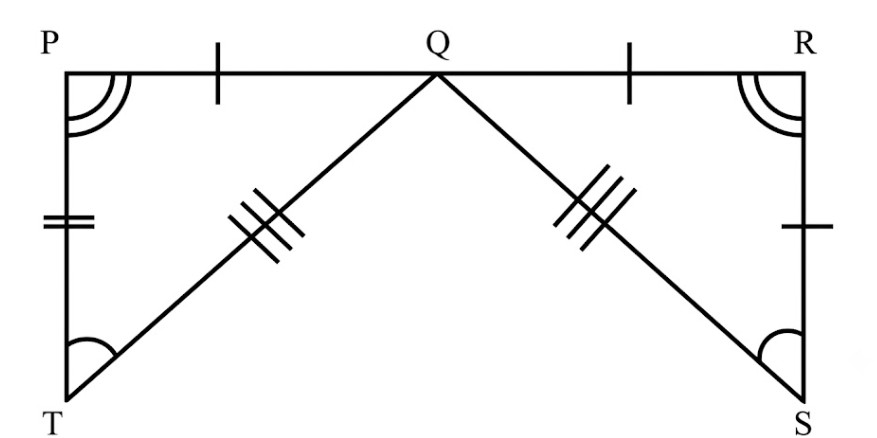
To find the triangle congruent to \( \triangle QRS \), we need to identify a triangle that matches it in terms of side lengths and angles, using the given diagram.
Correct Option: B) \( \triangle QPT \)
Evaluate
9.46\(\overline{7}\) − 2.46\(\overline{7}\) + 4.46\(\overline{7}\).
\(\frac{10521}{1100}\)
\(\frac{10521}{900}\)
\(\frac{10321}{900}\)
\(\frac{10321}{1100}\)
To evaluate the given expression, we first need to convert the recurring decimals into fractions. The general form for converting a mixed recurring decimal \(P.Q\overline{R}\) into a fraction is \[\frac{PQR - PQ}{9 \text{ repeated R times and 0 repeated Q times}}\]. In our case, the recurring part is a single digit, so it will be \(\frac{PQR - PQ}{900}\). After converting each term to a fraction, we perform the addition and subtraction.
The number is \(9.46\overline{7}\). Here, \(P=9\), \(Q=46\), and \(R=7\). The non-recurring part is \(46\) and the recurring part is \(7\).
\[ 9.46\overline{7} = \frac{9467 - 946}{900} = \frac{8521}{900} \]The number is \(2.46\overline{7}\). Here, \(P=2\), \(Q=46\), and \(R=7\). The non-recurring part is \(46\) and the recurring part is \(7\).
\[ 2.46\overline{7} = \frac{2467 - 246}{900} = \frac{2221}{900} \]The number is \(4.46\overline{7}\). Here, \(P=4\), \(Q=46\), and \(R=7\). The non-recurring part is \(46\) and the recurring part is \(7\).
\[ 4.46\overline{7} = \frac{4467 - 446}{900} = \frac{4021}{900} \]Now substitute the fractional forms back into the original expression:
\[ 9.46\overline{7} - 2.46\overline{7} + 4.46\overline{7} = \frac{8521}{900} - \frac{2221}{900} + \frac{4021}{900} \]\[ = \frac{8521 - 2221 + 4021}{900} \]\[ = \frac{6300 + 4021}{900} \]\[ = \frac{10321}{900} \]C) The calculated value is \(\frac{10321}{900}\), which matches option C.
The question asks to identify which element among the given options is NOT part of Group 2 of the Modern Periodic Table. To answer this, we need to recall the elements that belong to Group 2 and their chemical symbols.
A) Na is the correct answer because Sodium (Na) is an element of Group 1 (alkali metals), not Group 2 (alkaline earth metals).