
What will be the total amount payable on a sum of Rs 12,500 after two years at the rate of 10% per annum if the interest is compounded annually?
To find the total amount payable when interest is compounded annually, we can use the compound interest formula. Alternatively, we can calculate the interest for each year separately and add it to the principal.
The formula for the amount (\(A\)) when interest is compounded annually is:
\[ A = P \left(1 + \frac{R}{100}\right)^n \]Thus, the total amount payable after two years is Rs 15,125.
This question tests knowledge of IUPAC nomenclature for organic compounds, specifically carboxylic acids. The name of an organic compound consists of a prefix, a word root, and a suffix. The suffix indicates the functional group present in the molecule.
A) oic acid — This is the correct suffix used in IUPAC nomenclature to denote a carboxylic acid functional group. For example, a three-carbon alkane is propane, and the corresponding carboxylic acid is propanoic acid, where '-e' of propane is replaced by '-oic acid'.
The number of non-square numbers between
872 and 882 is:
The problem asks for the number of non-square numbers between two consecutive perfect squares, \(n^2\) and \((n+1)^2\). A key property in number theory states that the number of non-square numbers between \(n^2\) and \((n+1)^2\) is \(2n\).
The question asks to identify the recipient of the 2021 DST-ICTP-IMU Ramanujan Prize for Young Mathematicians from developing countries. This requires knowledge of significant awards in the field of mathematics and their recipients, particularly those related to Indian mathematicians.
Dr. Neena Gupta, a professor at the Indian Statistical Institute in Kolkata, was indeed awarded the 2021 DST-ICTP-IMU Ramanujan Prize for Young Mathematicians from developing countries. Her work in affine algebraic geometry and commutative algebra, particularly her solution to the Zariski Cancellation Problem for affine spaces, is highly recognized.
D) Neena Gupta — Neena Gupta was awarded the 2021 DST-ICTP-IMU Ramanujan Prize for Young Mathematicians from developing countries for her outstanding work in affine algebraic geometry and commutative algebra. She is known for her solution to the Zariski Cancellation Problem for affine spaces.
What will come in the place of ‘?’ in the following equation, if ‘+’ and ‘−’ are interchanged and also ‘×’ and ‘÷’ are interchanged?
4 ÷ 4 − 45 × 5 + 12 =?
The problem requires us to evaluate a given mathematical expression after interchanging certain arithmetic operators. We need to follow the order of operations (BODMAS/PEMDAS) after applying the changes.
B) The final value of the expression after interchanging the operators and performing the calculations is 13.
The question asks for the target year set by the National Education Policy (NEP) 2020 to achieve a 100% Gross Enrolment Ratio (GER) in school education. This requires knowledge of the specific targets outlined in the NEP 2020 document.
Correct Option: B) 2030
The question asks for the year Mendeleev's Periodic Table was published in a German journal. This requires specific historical knowledge about the development of the periodic table.
Correct Option: D) 1872 — Mendeleev's periodic table was published in a German journal in 1872, which was crucial for its widespread acceptance and recognition in the scientific community.
To find the percentage of salary saved, we need to divide the amount saved by the total salary and then multiply by 100. This is a basic percentage calculation problem.
Thus, the person saves 44.00% of his salary.
Correct Option: C) 44.00%
The percentages of people qualifying the driving test to get a license in different years is shown in the following graph. Study the graph and answer the question.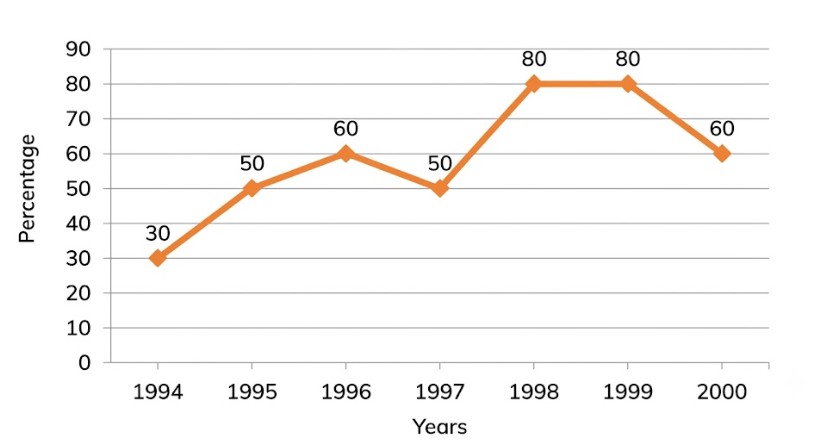
In the years 1996 and 1997 together, 45,000 people qualified the driving test.
If in the year 1996, a total of 25,000 people took the driving test, then how many people took the test in the year 1997?
To find the number of people who took the driving test in 1997, we need to use the percentage data from the graph and the given information about the total number of people who qualified in 1996 and 1997.
Correct Option: B) 60,000
In an electric circuit, if power, voltage and resistance are represented by P, V, R respectively, then the correct relation between them is:
P = \(\frac{V^2}{R}\)
P = V R2
P = \(\frac{V^2}{R^2}\)
P = V2R
This question asks for the correct relationship between power (P), voltage (V), and resistance (R) in an electric circuit. We will start with the fundamental formula for electric power and Ohm's Law, then derive the required relationship.
Recall the fundamental formula for electric power: Electric power (P) is defined as the product of voltage (V) across a component and the current (I) flowing through it.
\[ P = V \times I \quad \text{(Equation 1)} \]Recall Ohm's Law: Ohm's Law states that the voltage (V) across a resistor is directly proportional to the current (I) flowing through it, and the constant of proportionality is the resistance (R).
\[ V = I \times R \quad \text{(Equation 2)} \]Express current (I) in terms of V and R using Ohm's Law: From Equation 2, we can rearrange to solve for I:
\[ I = \frac{V}{R} \quad \text{(Equation 3)} \]Substitute the expression for I into the power formula: Substitute Equation 3 into Equation 1:
\[ P = V \times \left(\frac{V}{R}\right) \] \[ P = \frac{V^2}{R} \]This is the correct relationship between power, voltage, and resistance.
Correct Option: A) \(P = \frac{V^2}{R}\)