
This is a syllogism problem. We need to evaluate the given conclusions based on the provided statements. We can use Venn diagrams or logical deductions to determine which conclusions logically follow from the statements. Remember to consider the statements as true, even if they contradict common knowledge.
Let's analyze each statement and conclusion:
Based on the evaluation, only Conclusion III logically follows.
A) Only conclusion III follows. This is correct because if all springs are brooks, it necessarily means that some brooks are springs.
The question asks to identify a human cell type that can change its shape. This ability is crucial for certain cellular functions, such as movement, engulfment, or navigating through tissues. We need to recall the characteristics of each given cell type.
A) WBC (White Blood Cells) are known for their ability to change shape (amoeboid movement). This characteristic is essential for them to squeeze through capillary walls (diapedesis) and engulf foreign particles or pathogens (phagocytosis) as part of the immune response.
This problem involves determining the final position and direction relative to the starting point after a series of movements. We can solve this by breaking down the movements into their North-South and East-West components. We will track the net displacement in each direction.
D) 100 m, South. As calculated, the net displacement is 100 m towards the South and 0 m in the East-West direction.
Study the following graph carefully and answer the question: Production of two companies A and B over the years.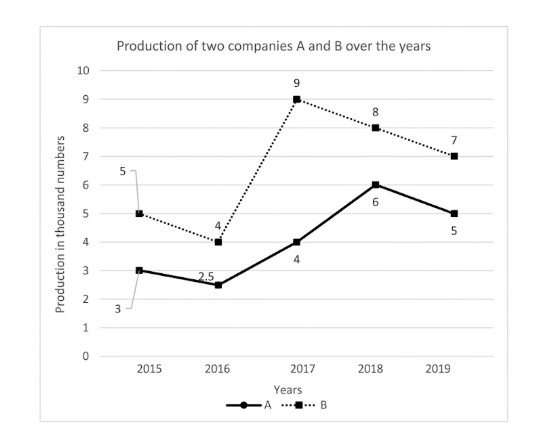
For company A, what is the approximate percentage decrease in production from 2015 to 2016?
To find the percentage decrease in production for Company A from 2015 to 2016, we need to calculate the difference in production between these years and then express this difference as a percentage of the production in 2015.
Correct Option: C) 20%
The question asks to identify the term for a cost that has already been incurred and cannot be recovered. This is a fundamental concept in economics and business decision-making.
Correct Option: D) Sunk cost — A sunk cost is a cost that has already been incurred and cannot be recovered. In economic decision-making, sunk costs should be ignored when making future choices, as they are irrelevant to the present and future profitability of a project or decision.
To determine the image location formed by a convex mirror, we use the mirror formula. For a convex mirror, the focal length is positive, and the object distance is conventionally taken as negative. We will substitute the given values into the mirror formula and solve for the image distance.
Correct Option: D) 1.2 m behind the mirror
This question tests knowledge of qualitative analysis, specifically the reactions of metal salts with ammonia solution. Ammonia solution (aqueous ammonia, \(\text{NH}_4\text{OH}\)) acts as a weak base and can precipitate metal hydroxides if they are insoluble. We need to identify which of the given metal nitrates/chlorides forms a white precipitate with ammonia solution.
Correct Option: C) AlCl₃ solution. Aluminum chloride reacts with ammonia solution to form a white gelatinous precipitate of aluminum hydroxide, \(\text{Al(OH)}_3\).
The question asks for the reason behind the bluish color of water in the deep sea. This phenomenon is related to how light interacts with water molecules and suspended particles. We need to consider the different ways light can interact with a medium, such as scattering, refraction, dispersion, and reflection, and determine which one best explains the observed color.
A) Scattering of light — The bluish color of water in the deep sea is primarily due to the scattering of shorter wavelength (blue) light by water molecules. Longer wavelengths are absorbed more readily, allowing blue light to penetrate further and be scattered back to our eyes.
If θ is an acute angle, find the denominator A, when (cosecθ − cotθ)² = \(\frac{1-\cos\theta}{A}\)
To find the value of A, we need to simplify the left-hand side of the given equation, \((\text{cosec}\theta - \text{cot}\theta)^2\), using fundamental trigonometric identities and algebraic manipulations, until it matches the form \(\frac{1-\text{cos}\theta}{A}\).
Start with the given equation:
\[ (\text{cosec}\theta - \text{cot}\theta)^2 = \frac{1-\text{cos}\theta}{A} \]Express \(\text{cosec}\theta\) and \(\text{cot}\theta\) in terms of \(\text{sin}\theta\) and \(\text{cos}\theta\):
\[ \text{cosec}\theta = \frac{1}{\text{sin}\theta} \]\[ \text{cot}\theta = \frac{\text{cos}\theta}{\text{sin}\theta} \]Substitute these into the left-hand side of the equation:
\[ \left(\frac{1}{\text{sin}\theta} - \frac{\text{cos}\theta}{\text{sin}\theta}\right)^2 \]Combine the terms inside the parenthesis:
\[ \left(\frac{1 - \text{cos}\theta}{\text{sin}\theta}\right)^2 \]Apply the square to both the numerator and the denominator:
\[ \frac{(1 - \text{cos}\theta)^2}{\text{sin}^2\theta} \]Use the identity \(\text{sin}^2\theta + \text{cos}^2\theta = 1\), which implies \(\text{sin}^2\theta = 1 - \text{cos}^2\theta\):
\[ \frac{(1 - \text{cos}\theta)^2}{1 - \text{cos}^2\theta} \]Factor the denominator using the difference of squares formula \((a^2 - b^2) = (a - b)(a + b)\):
\[ \frac{(1 - \text{cos}\theta)^2}{(1 - \text{cos}\theta)(1 + \text{cos}\theta)} \]Cancel out one \((1 - \text{cos}\theta)\) term from the numerator and denominator (since \(\theta\) is acute, \(\text{cos}\theta \neq 1\)):
\[ \frac{1 - \text{cos}\theta}{1 + \text{cos}\theta} \]Now, compare this simplified expression with the right-hand side of the original equation:
\[ \frac{1 - \text{cos}\theta}{1 + \text{cos}\theta} = \frac{1 - \text{cos}\theta}{A} \]By comparing the denominators, we find that \(A = 1 + \text{cos}\theta\).
Correct Option: D) 1 + cos θ
This problem involves a simple age calculation based on a given relationship between two sisters' ages. We are given the age of Aruna's sister and the difference in their ages. We need to find Aruna's age.
C) 26 years