
The problem asks us to find the next number in the given series: 0, 3, 8, 15, 24, 35, ?. We need to identify the pattern or rule governing the sequence of numbers.
D) 48 is the correct number to replace the question mark, as it follows the established pattern of the series.
The question asks to identify the state where the Dree Festival, an important agricultural festival, is primarily celebrated by the Apatani tribe. This requires knowledge of Indian tribes and their associated festivals and geographical locations.
D) Arunachal Pradesh is the correct answer because the Dree Festival is a major agricultural festival primarily celebrated by the Apatani tribe, who are indigenous to the Ziro Valley in Arunachal Pradesh.
This problem involves calculating the shortest distance between two points after a series of movements in different directions. This can be solved by visualizing the path taken and then using the Pythagorean theorem to find the straight-line distance between the start and end points.
A) 5 km is the correct answer because after all movements, Janak ends up 5 km south of his starting point, with no net east-west displacement.
The problem asks us to find the image height given the magnification and the object height for a concave mirror. We can use the formula for linear magnification, which relates the image height to the object height and the magnification factor.
Identify the given values:
Recall the formula for linear magnification:
\[ m = \frac{h_i}{h_o} \]where \(h_i\) is the image height and \(h_o\) is the object height.
Substitute the given values into the formula:
\[ -2 = \frac{h_i}{1 \text{ cm}} \]Solve for the image height (\(h_i\)):
\[ h_i = -2 \times 1 \text{ cm} \] \[ h_i = -2 \text{ cm} \]The negative sign in the image height indicates that the image is inverted. The magnitude of the image height is \(2 \text{ cm}\).
C) The calculated image height is \(2 \text{ cm}\). The negative sign only indicates the orientation (inverted) of the image, while the question asks for the magnitude of the image height.
The following graph shows the profit earned by a company over the years. Study the graph and answer the question that follows.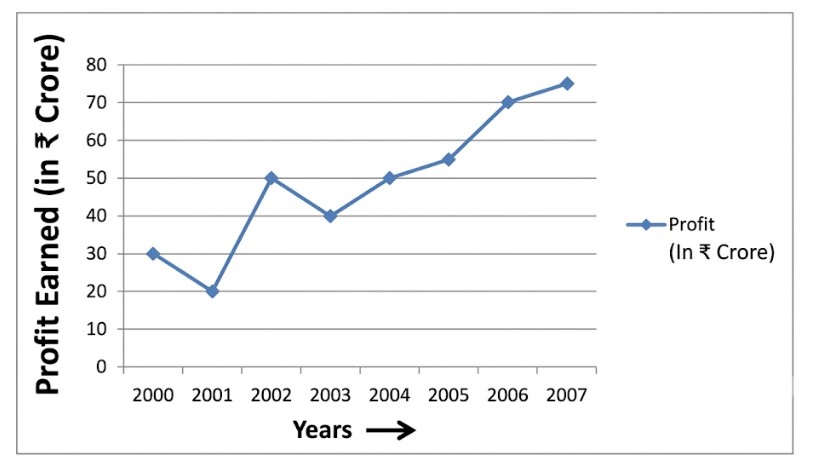
Calculate the increase in profit earned by the company in year 2002 as compared to the previous year.
To determine the increase in profit for the year 2002 compared to 2001, we need to examine the graph and calculate the difference in profit values between these two years.
\[ \text{Increase in Profit} = \text{Profit in 2002} - \text{Profit in 2001} = 50 - 20 = 30 \text{ crore} \]
The increase in profit from 2001 to 2002 is Rs 30 crore.
Correct Option: D) Rs 30 crore
To find out when the traffic signals will change simultaneously again, we need to find the least common multiple (LCM) of the time intervals at which each signal changes. This LCM will represent the duration after which all signals will synchronize again. Once we have this duration in seconds, we convert it into minutes and seconds and add it to the initial simultaneous change time.
Identify the given time intervals: The traffic signals change after 45 seconds, 75 seconds, and 90 seconds.
Find the prime factorization of each interval:
Calculate the Least Common Multiple (LCM): The LCM is found by taking the highest power of all prime factors present in the factorizations.
\[ \text{LCM}(45, 75, 90) = 2^1 \times 3^2 \times 5^2 \] \[ \text{LCM}(45, 75, 90) = 2 \times 9 \times 25 \] \[ \text{LCM}(45, 75, 90) = 18 \times 25 \] \[ \text{LCM}(45, 75, 90) = 450 \text{ seconds} \]Convert the LCM from seconds to minutes and seconds:
Since 1 minute = 60 seconds:
\[ \text{Minutes} = \frac{450}{60} = 7 \text{ with a remainder of } 30 \]So, 450 seconds is equal to 7 minutes and 30 seconds.
Add this duration to the initial simultaneous change time: The signals changed simultaneously at 9:30:00 a.m.
Initial time: 9:30:00 a.m.
Duration until next simultaneous change: 7 minutes 30 seconds
Next simultaneous change time:
\[ 9:30:00 \text{ a.m.} + 0:07:30 \] \[ = 9:37:30 \text{ a.m.} \]Correct Option: D) 9:37:30 a.m.
The question asks to identify the Chief Justice of the Karnataka High Court as of March 2022. This requires knowledge of current affairs and judicial appointments during that specific period.
As of March 2022, Justice Ritu Raj Awasthi was indeed the Chief Justice of the Karnataka High Court. He was appointed on October 11, 2021, and retired on July 2, 2022.
B) Ritu Raj Awasthi was the Chief Justice of the Karnataka High Court as of March 2022.
To solve this problem, we will first determine the individual filling rates of pipes A and B. Then, we will calculate the amount of work done when both pipes are open for 4 minutes. Finally, we will find the remaining work and the time taken by pipe A alone to complete it, adding this to the initial 4 minutes to get the total time.
Calculate the rate of pipe A:
Pipe A can fill the cistern in 21 minutes. So, in 1 minute, pipe A fills \(\frac{1}{21}\) of the cistern.
Calculate the rate of pipe B:
Pipe B can fill the cistern in 28 minutes. So, in 1 minute, pipe B fills \(\frac{1}{28}\) of the cistern.
Calculate the combined rate of pipes A and B:
When both pipes are open, their combined rate is the sum of their individual rates:
\[ \text{Combined Rate} = \frac{1}{21} + \frac{1}{28} \]\[ \text{Combined Rate} = \frac{4}{84} + \frac{3}{84} = \frac{7}{84} = \frac{1}{12} \text{ (of the cistern per minute)} \]Calculate the work done in the first 4 minutes:
Both pipes are open for 4 minutes. So, the fraction of the cistern filled in these 4 minutes is:
\[ \text{Work Done} = \text{Combined Rate} \times \text{Time} \]\[ \text{Work Done} = \frac{1}{12} \times 4 = \frac{4}{12} = \frac{1}{3} \]Calculate the remaining work:
The total work is 1 (representing the full cistern). The remaining work is:
\[ \text{Remaining Work} = 1 - \frac{1}{3} = \frac{2}{3} \]Calculate the time taken by pipe A to fill the remaining work:
After 4 minutes, pipe B is turned off, so only pipe A continues to fill the cistern. Pipe A's rate is \(\frac{1}{21}\) of the cistern per minute.
\[ \text{Time by A} = \frac{\text{Remaining Work}}{\text{Rate of A}} \]\[ \text{Time by A} = \frac{\frac{2}{3}}{\frac{1}{21}} = \frac{2}{3} \times 21 = 2 \times 7 = 14 \text{ minutes} \]Calculate the total time taken:
The total time is the sum of the time both pipes worked together and the time pipe A worked alone.
\[ \text{Total Time} = 4 \text{ minutes (both pipes)} + 14 \text{ minutes (pipe A alone)} \]\[ \text{Total Time} = 18 \text{ minutes} \]Correct Option: A) 18 minutes
The question asks about the final volume of urine excreted by a healthy adult, given the initial filtrate volume. This involves understanding the process of urine formation in the kidneys, specifically glomerular filtration and tubular reabsorption.
C) 1 litre or 2 litres a day. This range accurately reflects the typical daily urine output in a healthy adult after extensive reabsorption of the initial glomerular filtrate.
Bee stings are acidic in nature due to the presence of formic acid. To neutralize an acid and relieve pain, a mild base is required. We need to identify which of the given options is a mild base.
Correct Option: B) \(\text{NaHCO}_3\) (Sodium Bicarbonate) is a mild base that effectively neutralizes the formic acid present in a bee sting, providing relief from pain and irritation.