
The question asks about the primary subject matter of the Yajur Veda. To answer this, one needs to recall the main themes and contents of each of the four Vedas (Rig Veda, Sama Veda, Yajur Veda, Atharva Veda).
Correct Option: A) the rituals of the Yagna. The Yajur Veda is known as the Veda of sacrificial formulas. It contains the mantras and procedures for performing various Vedic rituals and sacrifices (Yagnas).
The question asks to identify which of the given options is NOT a capital receipt. To answer this, we need to understand the distinction between capital receipts and revenue receipts in government accounting.
Correct Option: D) Interest received on loans is a revenue receipt because it is a regular income for the government and does not create a liability or reduce assets.
The question asks about a specific milestone achieved by India regarding Open Defecation Free (ODF) Plus villages by March 2022. This is a factual question related to government initiatives and their progress, specifically the Swachh Bharat Mission (Grameen) Phase II.
C) 50,000 — As per the Ministry of Jal Shakti's announcement in March 2022, India had crossed the milestone of 50,000 ODF Plus villages.
The question asks about the IIT that incubated the startup which developed 'NanoSniffer', the world's first microsensor-based explosive trace detector. This is a factual question related to current affairs and technological developments in India. To answer this, one needs to recall the specific institution associated with the development of NanoSniffer.
A) IIT-Bombay – NanoSniff Technologies, the startup responsible for developing NanoSniffer, was incubated at IIT-Bombay. This makes IIT-Bombay the correct answer.
To solve this problem, we need to identify all the vowels and consonants in the given series. Then, we will scan the series to find consonants that have a vowel immediately on one side and a consonant immediately on the other side. We will count such occurrences.
Correct Option: B) 5
To solve this problem, we need to follow the order of operations, commonly remembered by the acronym BODMAS/PEMDAS. This order is: Brackets/Parentheses, Orders/Exponents, Division and Multiplication (from left to right), and Addition and Subtraction (from left to right).
Thus, the value of the expression is 6.
Correct Option: B) 6
The nature of an image formed by a spherical mirror can be determined by analyzing the sign and magnitude of its magnification. Magnification provides information about whether the image is real or virtual, erect or inverted, and enlarged or diminished.
A) real, inverted and enlarged — The negative sign of magnification indicates an inverted and real image. The magnitude \(|m| > 1\) indicates an enlarged image. Therefore, this option is correct.
Refer to the number and symbol series, and answer the question that follows.
(Left) 6 % 7 & 9 4 3 @ 2 8 * 3 # 9 & 2 (Right)
How many symbols are there between the third element from the right end and the fourth element from the left end of the given series?
The problem asks us to count the number of symbols between two specific elements in a given series. We need to first identify the elements from the left and right ends as specified, and then count the symbols between them.
6 % 7 & 9 4 3 @ 2 8 * 3 # 9 & 26%7&&.2&99.6 % 7 & 9 4 3 @ 2 8 * 3 # 9 & 2& (fourth from left) and 9 (third from right) are: 9 4 3 @ 2 8 * 3 #. Now, we count only the symbols in this segment.@ is a symbol.* is a symbol.# is a symbol.Correct Option: C) 3
Study the graph and answer the question that follows.
The following bar graph shows the total number of girls who got admission in two degree colleges Vikas and Jagruthi from 2015 to 2019.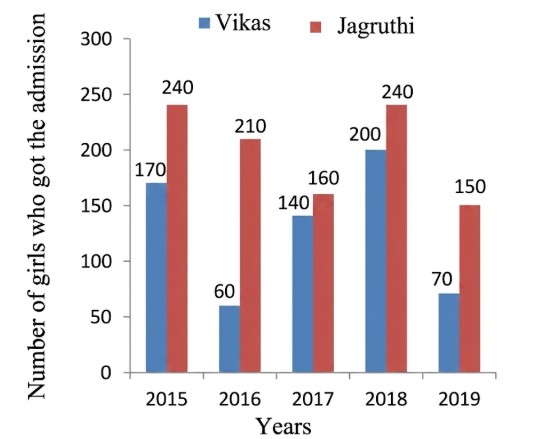
What is the ratio between total girl students in 2016 to the total girl students in 2019 of both degree colleges?
To find the ratio between the total number of girl students in 2016 and 2019 from both colleges, we need to extract the data from the bar graph and calculate the totals for each year.
Therefore, the ratio is 27:22.
Correct Option: B) 27 : 22
This question asks about the consequences of excess demand in an economy. We need to understand what excess demand means and its immediate effects on price levels and employment.
Define Excess Demand: Excess demand occurs when the aggregate demand (total demand for goods and services in an economy) at the full employment level of output is greater than the aggregate supply (total supply of goods and services) at the same level. In simpler terms, people want to buy more than the economy can produce when all resources are fully utilized.
Impact on Prices: When there is excess demand, producers cannot meet the increased demand with increased output because the economy is already at full employment. This leads to competition among buyers for the limited available goods and services, which drives up prices. This general rise in the price level due to excess demand is known as an inflationary gap.
Impact on Employment: Since the economy is already operating at full employment (or near full capacity) when excess demand occurs, there is little scope to increase production by employing more resources (labor, capital). Therefore, excess demand typically does not lead to a significant rise in the employment level; instead, it primarily leads to price increases.
Correct Option: C) Only A
Excess demand leads to an inflationary gap because aggregate demand exceeds aggregate supply at the full employment level, causing prices to rise. It does not significantly increase employment because the economy is already at or near full capacity.
A) Only B — This is incorrect because excess demand primarily leads to inflation, not necessarily a rise in employment, especially if the economy is already at full employment.
B) Both A and B — This is incorrect because while an inflationary gap (A) is a direct consequence, a significant rise in employment level (B) is generally not, as the economy is assumed to be at full employment when discussing excess demand leading to an inflationary gap.
D) Neither A nor B — This is incorrect because excess demand directly causes an inflationary gap.