
The diagram of the human excretory system is given below. Select the option that correctly shows the functions of parts 'a' and 'b'.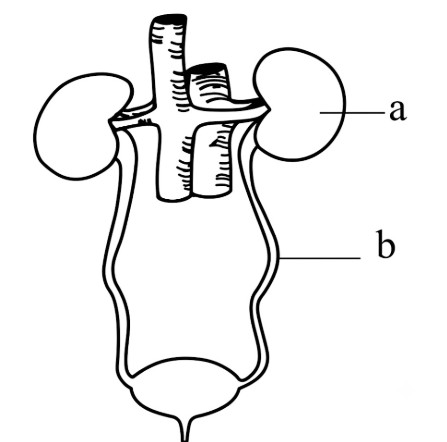
a - Formation of urine, b - Collection of urine
a - Formation of urine, b - Carrying urine for storage
a - Formation of urine, b - Throwing urine outside the body
a - Collection of urine, b - Formation of urine
The human excretory system consists of several key parts, including the kidneys, ureters, bladder, and urethra. Understanding the function of each part is crucial to answering the question correctly.
Correct Option: B) a - Formation of urine, b - Carrying urine for storage
The question asks to identify the state where Panchayati Raj Institutions (PRIs) do not exist as of June 2022. This requires knowledge of the constitutional provisions regarding PRIs and their applicability to various states, especially those with special provisions.
Correct Option: C) Nagaland
The 73rd Constitutional Amendment Act, which provides for the establishment of Panchayati Raj Institutions, does not apply to the states of Nagaland, Meghalaya, and Mizoram. This exemption is primarily due to the unique administrative arrangements and traditional village councils prevalent in these states, which are protected under special constitutional provisions (e.g., Article 371A for Nagaland). Therefore, as of June 2022, Panchayati Raj Institutions do not exist in Nagaland.
The question asks for the economic term that describes the change in consumption resulting from a one-unit change in income. This concept is fundamental in Keynesian economics.
A) Marginal propensity to consume is the correct answer because it directly measures the change in consumption for every unit change in income. It is a key concept in macroeconomics, particularly in understanding the multiplier effect.
This question tests general knowledge about international trade and agricultural exports. To answer correctly, one needs to recall recent developments in global agricultural markets, specifically regarding cucumber exports.
Correct Option: A) India
Magnification produced by a lens is equal to:
\( \frac{u}{v} \)
\( \frac{-v}{u} \)
\( \frac{v}{u} \)
\( \frac{-u}{v} \)
The question asks for the formula for magnification produced by a lens. Magnification is defined as the ratio of the height of the image to the height of the object. It can also be expressed in terms of image distance and object distance. We need to recall the standard formula for linear magnification for lenses.
Correct Option: C) \( \frac{v}{u} \)
The linear magnification produced by a lens is given by the ratio of the image distance (\(v\)) to the object distance (\(u\)).
To find such pairs, we need to compare each letter in the word 'CAPITAL' with every other letter, both in the forward and backward directions. For each pair, we count the number of letters between them in the given word and check if this count matches the number of letters between them in the English alphabet.
Correct Option: D) 2
The problem asks us to find the relationship between the letter-clusters and apply the same logic to the fifth letter-cluster. We need to analyze the transformation from the first to the second cluster and from the third to the fourth cluster to deduce the rule.
A) VRATS — This option correctly represents the letters of STARV in reverse order.
The question asks to identify the correct group of scientists who received the Shanti Swarup Bhatnagar Prize for Science and Technology in 2021. This requires knowledge of the recipients of this specific award for that year.
The Shanti Swarup Bhatnagar Prize for Science and Technology is one of India's highest multidisciplinary science awards, given annually by the Council of Scientific and Industrial Research (CSIR) for notable and outstanding research in various scientific disciplines.
For the year 2021, the recipients included:
Based on this list, we can evaluate the given options.
D) Dr. Amit Singh, Dr. Kanishka Biswas, and Dr. Anish Ghosh
All three scientists listed in option D were indeed recipients of the Shanti Swarup Bhatnagar Prize in 2021.
This problem involves tracking changes in direction. We need to visualize Q's movement and turns to determine the final facing direction. We can imagine a standard compass rose (North, South, East, West) to help.
After all the movements and turns, Q is facing West.
B) West is the correct direction Q is facing now.
The problem involves calculating the cost price of each laptop based on profit percentages and the difference in total profit under two scenarios. We will set up equations for the total profit in both scenarios and use the given difference to find the cost price of a single laptop.
Let the cost price of each laptop be \(C\).
Scenario 1: Original Sales
Scenario 2: Hypothetical Sales
Difference in Profit
Calculate Cost Price (\(C\))
Thus, the cost price of each laptop is Rs. 25,000.
Correct Option: B) Rs. 25,000