
This is a logical reasoning problem involving arrangement. We need to deduce the floor on which each person lives based on the given clues and then identify who lives on the second floor. We will systematically place the friends on floors 1 to 6 using the provided information.
This gives us a block of three people in a fixed order:
Combining this with the previous deduction, we get a block of four people:
This means these four must occupy four consecutive floors.
Let's consider the possible arrangements for the block of four (Varuni, Wasim, Zunaid, Yash) on floors 1-6.
Let's re-evaluate "Only one person lives between Udita and Varuni". This means their floors are separated by exactly one floor. For example, if Varuni is on 5, Udita could be on 3 (with someone on 4) or on 7 (not possible). If Varuni is on 5, and Zunaid is on 3, then Udita cannot be on 3. Udita cannot be on 7. So this entire case is problematic.
Correct Option: C) Zunaid
The question asks about the fundamental chemical properties of non-metals, specifically their electronegativity and how they form chemical bonds. We need to recall the definitions of electropositivity, electronegativity, and how these properties relate to electron transfer during bond formation.
Therefore, the statement that non-metals are electronegative in nature and form bonds by gaining electrons is true.
Correct Option: B) Non-metals are electronegative in nature and form bonds by gaining electrons.
The question asks to identify the primary energy currency used by cells for most of their metabolic processes. We need to recall the fundamental molecules involved in energy transfer within biological systems.
Based on this analysis, ATP is the molecule directly used by cells to power most of their activities.
A) ATP is the universal energy currency for most cellular processes. Its hydrolysis releases energy that drives various cellular functions.
A number, when decreased by 37\( \frac{1}{2} \)%, gives 375. The number is:
The problem states that a number, when decreased by a certain percentage, results in a given value. We need to find the original number. This can be solved by setting up an algebraic equation where the original number is represented by a variable, and then solving for that variable.
Let the unknown number be \(x\).
The percentage decrease is given as \(37\frac{1}{2}\)%. First, convert this mixed fraction percentage to an improper fraction and then to a decimal or a simple fraction.
\[ 37\frac{1}{2}\% = \frac{75}{2}\% \]To convert this percentage to a fraction, divide by 100:
\[ \frac{75}{2}\% = \frac{75}{2 \times 100} = \frac{75}{200} \]Simplify the fraction:
\[ \frac{75}{200} = \frac{3 \times 25}{8 \times 25} = \frac{3}{8} \]The problem states that the number \(x\) is decreased by \(37\frac{1}{2}\)% of itself. This means we subtract \( \frac{3}{8} \) of \(x\) from \(x\).
\[ x - \frac{3}{8}x = 375 \]Combine the terms on the left side:
\[ \left(1 - \frac{3}{8}\right)x = 375 \]\[ \left(\frac{8}{8} - \frac{3}{8}\right)x = 375 \]\[ \frac{5}{8}x = 375 \]Now, solve for \(x\) by multiplying both sides by the reciprocal of \( \frac{5}{8} \), which is \( \frac{8}{5} \):
\[ x = 375 \times \frac{8}{5} \]Perform the multiplication:
\[ x = \frac{375 \times 8}{5} \]\[ x = 75 \times 8 \]\[ x = 600 \]D) 600 — When 600 is decreased by \(37\frac{1}{2}\)% (or \( \frac{3}{8} \)), the decrease is \( \frac{3}{8} \times 600 = 3 \times 75 = 225 \). So, \(600 - 225 = 375\), which matches the given condition.
The question asks to identify the months associated with the retreating monsoon season in India. Understanding the different monsoon seasons and their typical timings is crucial for answering this question.
The question asks to identify the type of fabric that 'Malmal' represents, specifically its finest variety. This requires knowledge of different textile types and their historical or common names.
Correct Option: C) muslin
This problem involves successive profit calculations. We are given the final price Arjun paid and the profit percentages at each stage. We need to work backward from Arjun's price to find Krishan's cost price.
A) Rs 1,400 is the correct cost price for Krishan.
To find the day of the week on 8 April 2022, given that 10 March 2011 was a Thursday, we need to calculate the total number of odd days between these two dates. Odd days are the remainder when the total number of days is divided by 7. Each year contributes 1 odd day, and a leap year contributes 2 odd days. We will calculate the odd days for the full years first, then for the remaining months and days.
This is a circular seating arrangement problem. We need to deduce the positions of five businessmen (X, Y, Z, W, Q) sitting around a circular table facing the center based on the given clues. We will place them one by one according to the conditions and then identify who is to the immediate left of W.
Clue 1: X is an immediate neighbour of Y and Z.
This means Y and Z are on either side of X. So the arrangement looks like Y - X - Z or Z - X - Y. Let's assume Y - X - Z for now. If this leads to a contradiction, we can try the other order.
Clue 2: W is to the immediate left of Y.
Since everyone is facing the center, 'left' is clockwise. So, if Y is at a position, W is immediately clockwise to Y. Combining with the previous step, we have W - Y - X - Z.
Clue 3: W is to the immediate right of Q.
Since everyone is facing the center, 'right' is anti-clockwise. So, if W is at a position, Q is immediately anti-clockwise to W. This means Q is immediately before W in the circular arrangement. So, we have Q - W - Y - X - Z.
Final Arrangement:
We have placed all five businessmen: Q, W, Y, X, Z in a circular order. Let's visualize this clockwise: Q, then W, then Y, then X, then Z, and then back to Q.
Identify who is to the immediate left of W:
In a circular arrangement facing the center, 'immediate left' means the person immediately clockwise to W. Following our arrangement (Q - W - Y - X - Z), if we start from W and move clockwise, the next person is Y. However, the question asks "Who is sitting to the immediate left of W?". If W is facing the center, the person to W's immediate left is the one sitting immediately clockwise to W. Looking at our sequence Q - W - Y - X - Z, if W is at a position, the person immediately to its left (clockwise) is Y. But let's re-evaluate the "left" and "right" definitions carefully for circular arrangements.
Let's draw it:
    Q\---/Z\
     |     |
     W     X
     |     |
Y/---\If W is facing the center, its immediate left is the person to its clockwise side. In our sequence Q-W-Y-X-Z (clockwise), if you are W, then Y is to your immediate right (anti-clockwise) and Q is to your immediate left (clockwise). Let's re-verify the "left" and "right" definitions.
If you are sitting at a circular table facing the center:
Let's re-construct the sequence based on these definitions:
Combining these: Q -> W -> Y (clockwise sequence). So far: Q, W, Y.
So the final clockwise arrangement is: Q - W - Y - X - Z.
Now, let's find who is to the immediate left of W.
If W is facing the center, its immediate left is the person sitting immediately clockwise to W. In our clockwise sequence (Q, W, Y, X, Z), the person immediately clockwise to W is Y.
Wait, let's re-read the question and my interpretation of left/right. "W is to the immediate left of Y" means if Y is facing the center, W is on Y's left. If Y is facing center, Y's left is clockwise. So, W is clockwise to Y. This means the sequence is Y -> W (clockwise).
"W is to the immediate right of Q" means if Q is facing the center, W is on Q's right. If Q is facing center, Q's right is anti-clockwise. So, W is anti-clockwise to Q. This means the sequence is W -> Q (clockwise).
So, we have Y -> W (clockwise) and W -> Q (clockwise). This implies the clockwise sequence is Y -> W -> Q.
Now, X is an immediate neighbour of Y and Z. We have Y, W, Q. The remaining two are X and Z. X must be next to Y. So, the sequence could be Z - X - Y - W - Q (clockwise).
Let's verify all conditions with this clockwise arrangement: Z, X, Y, W, Q.
This arrangement: Z - X - Y - W - Q (clockwise) satisfies all conditions.
Now, the question: Who is sitting to the immediate left of W?
If W is facing the center, its immediate left is the person immediately clockwise to W. In the sequence Z - X - Y - W - Q (clockwise), the person immediately clockwise to W is Q.
B) Q is sitting to the immediate left of W. Our final arrangement (Z - X - Y - W - Q clockwise) shows that Q is immediately clockwise to W, which means Q is to the immediate left of W when W is facing the center.
Study the pie chart and answer the question that follows.
The following pie chart gives the information about the production of sugar in different districts as a percentage of total sugar production in all districts put together in a State.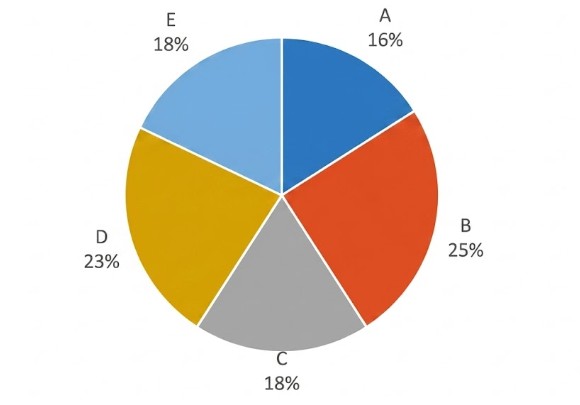
The production of sugar from district C is how much percentage less than that of the production of sugar from district B?
To find how much percentage less the sugar production from district C is compared to district B, we need to calculate the difference in their production percentages and express it as a percentage of district B's production.
Thus, the production of sugar from district C is 28% less than that of district B.
Correct Option: D) 28%