
In a queue, Rahul is 21st from the front and Ankit is 10th from the rear end, and there are 4 people between them. How many people are there in the queue if Ankit is standing somewhere behind Rahul in the queue?
This problem involves determining the total number of people in a linear queue based on given positions from the front and rear, and the number of people between two individuals. The key is to correctly combine these positions, considering the specified relative order of the individuals.
Identify Rahul's position: Rahul is 21st from the front.
Identify Ankit's position from the rear: Ankit is 10th from the rear end.
Identify the number of people between them: There are 4 people between Rahul and Ankit.
Consider the relative order: The problem states that Ankit is standing somewhere behind Rahul in the queue. This means Rahul is ahead of Ankit.
Calculate the total number of people: To find the total number of people, we can sum Rahul's position from the front, the number of people between them, and Ankit's position from the rear. Since Ankit is behind Rahul, their positions do not overlap in a way that requires subtraction for the 'between' count.
Total people = (Rahul's position from front) + (Number of people between them) + (Ankit's position from rear)
Total people \( = 21 + 4 + 10 \)
Total people \( = 35 \)
C) 35 is the correct answer. By adding Rahul's position from the front, the 4 people between them, and Ankit's position from the rear, we get the total number of people in the queue as 35.
A) 36 — This would be incorrect. It might result from an arithmetic error or an incorrect assumption about overlapping positions.
B) 38 — This is incorrect. It would imply a different number of people between them or an error in calculation.
D) 37 — This is incorrect. This might occur if one of the given numbers was misread or if there was an error in summing the positions.
The problem presents a series of number pairs where the second number is related to the first number by a specific logical rule. We need to identify this rule and apply it to the last given number to find the missing value.
A) 9 is the correct answer because it follows the pattern established by the other pairs: \(\sqrt{\text{First Number}} - 1 = \text{Second Number}\).
The question asks to identify the gases evolved when ferrous sulphate is heated. This is a classic example of a thermal decomposition reaction. We need to recall the chemical formula of ferrous sulphate and its decomposition products upon heating.
C) Sulphur dioxide and sulphur trioxide. As derived from the thermal decomposition reaction of ferrous sulphate, the two gases evolved are sulphur dioxide (\(\text{SO}_2\)) and sulphur trioxide (\(\text{SO}_3\)).
The percentage expenditure of a school is shown in the following pie-chart. Blue represents the teaching fee, red represents the books and stationery expense, green represents transportation fee, and purple represents other program expenses. Study the pie-chart and answer the question.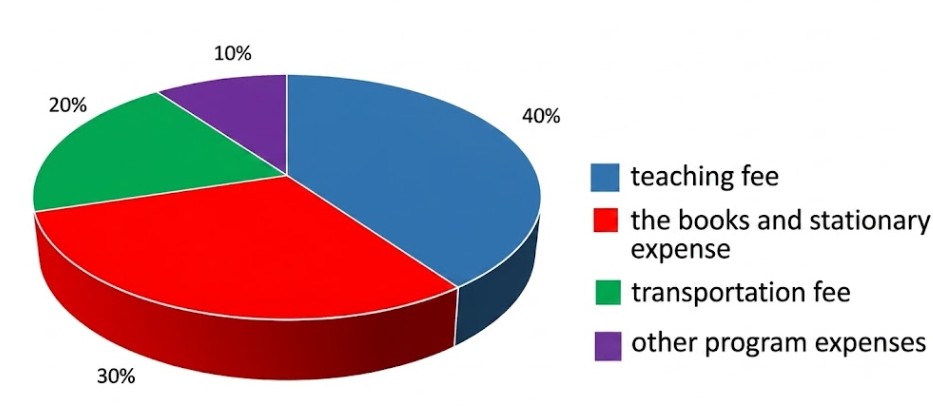
The total income is Rs 27,00,000. What is the amount spent on teaching fee and transportation fee if the total school expense is one-third of the total income?
To find the amount spent on teaching fee and transportation fee, we need to calculate the expenses based on the given pie-chart percentages and the total income.
\[ \text{Total Expense} = \frac{1}{3} \times 27,00,000 = 9,00,000 \text{ Rs} \]
\[ \text{Teaching Fee} = 0.40 \times 9,00,000 = 3,60,000 \text{ Rs} \]
\[ \text{Transportation Fee} = 0.20 \times 9,00,000 = 1,80,000 \text{ Rs} \]
\[ \text{Total for Teaching and Transportation} = 3,60,000 + 1,80,000 = 5,40,000 \text{ Rs} \]
Thus, the total amount spent on teaching fee and transportation fee is Rs 5,40,000.
Correct Option: A) Rs 5,40,000
This is a syllogism problem. We will use Venn diagrams to represent the given statements and then evaluate each conclusion based on these diagrams. We need to consider all possible valid diagrams to ensure a conclusion logically follows.


A) Only conclusion III follows.
The problem involves finding the measure of the smaller angle in a parallelogram, given a relationship between two adjacent angles. We will use the property that adjacent angles in a parallelogram are supplementary (sum up to 180 degrees).
Let the two adjacent angles of the parallelogram be \(x\) and \(y\).
According to the problem statement, one angle is two-thirds the other. Let's assume \(y\) is two-thirds of \(x\). So, we can write this relationship as:
\[ y = \frac{2}{3}x \]We know that adjacent angles in a parallelogram are supplementary. Therefore, their sum is 180 degrees:
\[ x + y = 180^\circ \]Now, substitute the expression for \(y\) from step 2 into the equation from step 3:
\[ x + \frac{2}{3}x = 180^\circ \]Combine the terms involving \(x\):
\[ \frac{3x + 2x}{3} = 180^\circ \]\[ \frac{5x}{3} = 180^\circ \]Solve for \(x\):
\[ 5x = 180^\circ \times 3 \]\[ 5x = 540^\circ \]\[ x = \frac{540^\circ}{5} \]\[ x = 108^\circ \]Now find the value of \(y\) using the relationship \(y = \frac{2}{3}x\):
\[ y = \frac{2}{3} \times 108^\circ \]\[ y = 2 \times 36^\circ \]\[ y = 72^\circ \]The two adjacent angles are \(108^\circ\) and \(72^\circ\). The smaller angle is \(72^\circ\).
B) The measure of the smaller angle is 72°.
The question asks for the correct explanation behind carbon's greater tendency for catenation compared to silicon. Catenation is the ability of an element to form bonds with atoms of the same element, creating long chains or rings. This property is primarily dependent on the strength of the bond formed between identical atoms.
D) Carbon–carbon bond is stronger than Si–Si bond due to the smaller size of carbon as compared to silicon. This statement accurately explains why carbon exhibits greater catenation. The smaller size of carbon allows for more effective orbital overlap and stronger C-C bonds, making the chains more stable.
To find the potential difference across the resistor, we can use the formula for heat produced in a resistor, which is related to current, resistance, and time. Once the current is found, Ohm's law can be applied to calculate the potential difference.
The heat produced (\(H\)) in a resistor is given by:
\[ H = I^2 R t \]where \(I\) is the current flowing through the resistor, \(R\) is the resistance, and \(t\) is the time.Rearrange the formula to solve for \(I\):
\[ I^2 = \frac{H}{R t} \]\[ I = \sqrt{\frac{H}{R t}} \]Ohm's Law states that:
\[ V = I R \]C) 20 V is the correct potential difference across the resistor.
To find the effect on total revenue, we need to calculate the initial revenue and the final revenue after the price decrease and sales increase. Revenue is calculated as Price × Quantity (Sales). We can assume initial values for price and sales to simplify calculations or use percentages directly.
Let the initial price of a laptop be \(P = 100\).
Let the initial number of laptops sold (sales) be \(S = 100\).
Initial Revenue \(R_1 = P \times S = 100 \times 100 = 10000\).
The price is decreased by 35%.
\[ \text{New Price} = P - (0.35 \times P) = 100 - (0.35 \times 100) = 100 - 35 = 65 \]Sales increased by 20%.
\[ \text{New Sales} = S + (0.20 \times S) = 100 + (0.20 \times 100) = 100 + 20 = 120 \]New Revenue \(R_2 = \text{New Price} \times \text{New Sales} = 65 \times 120\).
\[ R_2 = 65 \times 120 = 7800 \]Change in Revenue \( = R_2 - R_1 = 7800 - 10000 = -2200\).
Percentage Change \[= \frac{\text{Change in Revenue}}{\text{Initial Revenue}} \times 100\].
\[ \text{Percentage Change} = \frac{-2200}{10000} \times 100 = -0.22 \times 100 = -22\% \]A negative percentage indicates a decrease.
B) 22% decrease. The total revenue decreased by 22%.
The thickness of the troposphere, the lowest layer of Earth's atmosphere, varies geographically. This variation is primarily influenced by temperature, which affects the expansion and contraction of air. We need to identify the region where the troposphere experiences the greatest expansion due to higher temperatures.
Correct Option: D) The Equator receives the most direct sunlight, leading to higher temperatures. Warmer air expands and rises, pushing the tropopause higher and making the troposphere thicker at the Equator (around 16-18 km).